Your Bakery Is Giving Away Flour (and You Don't Know It): Control Real Ingredient Consumption with Kardex Tauro
Your Bakery Is Giving Away Flour (and You Don't Know It): Control Real Ingredient Consumption with Kardex Tauro
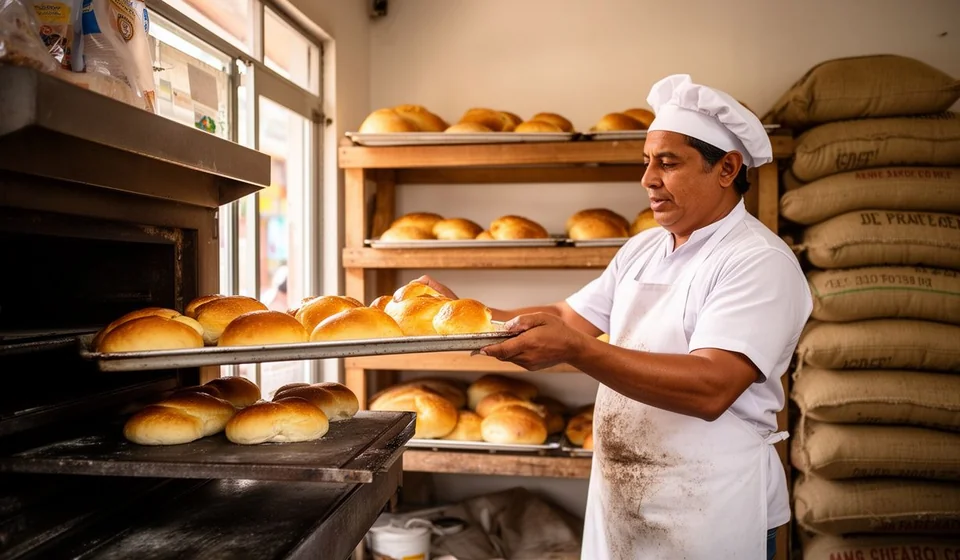
Every dawn, while Cali is still asleep, Rodrigo fires up the ovens at La Espiga Bakery in the San Fernando neighborhood. He kneads, bakes and sells around a thousand loaves a day. And yet, every Friday, when he checks the supply room, he feels that something does not add up: he ordered twelve bags of flour that month, sold every loaf he baked and still had to order one "emergency" bag that appears in no account at all. It is not theft: it is shrinkage, unrecorded consumption and recipes measured by eye. If that story sounds familiar, keep reading: in this article we show you how a neighborhood bakery controls every gram of raw material with Kardex Tauro.The invisible enemy of bakeries: shrinkage that no one records
In a business that makes products, flour does not turn into money overnight. Before it reaches the counter, it goes through receiving, storage, weighing, mixing, proofing, baking and packaging, and at each of those steps something is lost. It is normal for a bakery to have operating shrinkage of between 3% and 5% of its inputs. The problem starts when the real loss exceeds 10% and nobody can prove it, simply because there is no record. Shrinkage hides in three places:- At weighing and mixing: when the recipe is measured "by eye," every batch uses more flour, yeast or butter than necessary.
- During the process: dough stuck to the troughs, bread that burns, failed proofing that ends up in the trash bin.
- In storage: expired ingredients, torn bags, or humidity that ruins a sack of flour and is never written off from inventory.
Step one: record every ingredient issue with Internal Consumption
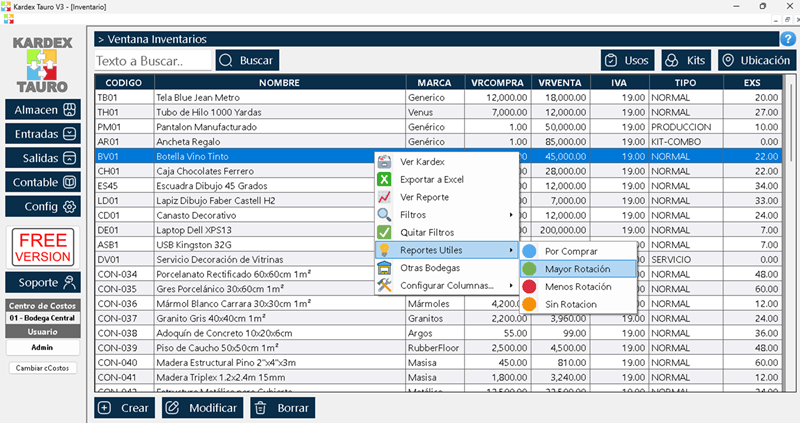
Kardex Tauro has a window designed precisely for this: Internal Consumption. A consumption is an inventory issue for internal use, with no external sale: the flour is not sold, it is transformed. When a consumption is recorded, the system deducts the product's stock and automatically generates the Stock ledger entry, so every movement has accounting support from day one. This window has features that make all the difference compared with a simple paper log:- Named responsibilities: every consumption requires stating who requests it and who receives it, so there are no anonymous stock issues.
- Cost charged to areas: the value of the inputs is charged to the corresponding area or cost center, such as Production, Packaging or Cleaning.
- Filters and reports: consumptions can be searched by date, product, area or person in charge, and exported for analysis.
- Raw materials for manufacturing: flour, sugar, yeast, eggs and butter that leave the storeroom for the worktables.
- Packaging material: paper bags, boxes and labels used up when packing the bread for sale.
- Cleaning supplies: degreasers, industrial soap, gloves and cleaning tools, which also cost money and must also be recorded.
The recipe as a standard: Kits/BOM and the Production Line product type
Recording consumptions is the first step, but real control appears when the recipe lives inside the system. In Kardex Tauro, Kits or BOM (Bill of Materials) define the "recipe": a parent product with its subcomponents and the exact quantity of each one. The software's official documentation sums it up with the clearest example that exists: flour + water + yeast + salt = bread. Of course, not every product is manufactured, which is why each item is created with a type that defines how it behaves:| Product type | What it is for | Does it control production? |
|---|---|---|
| Normal | Items bought or sold directly, such as a bag of flour or packaging. | No |
| Kit / Combo | Packages assembled from other products, ideal for promotions. | Partially: it assembles the combo but does not compare real vs. theoretical consumption. |
| Production Line | Products manufactured from a recipe: bread, cakes, pastries, arepas. | Yes: enables production orders, statistical control and shrinkage detection. |
| Service | Activities that are billed without moving inventory. | No |
Production Orders: the bread leaves the oven with exact numbers
With the recipe in place, the day's production is executed through Production Orders, a function available only for Production Line products. When an order is executed, the system makes two movements at the same time: it deducts the raw materials from inventory and records the entry of the finished product. One single step, two accounting effects and zero paper forms. The workflow is simple:- Define the recipe: create the finished product, for example seasoned bread rolls, with its BOM of flour, water, yeast, salt and butter in exact quantities.
- Create the production order: enter how many units you will make today and the system automatically calculates the theoretical inputs required.
- Execute the order: Kardex Tauro generates the raw material issues and the finished product entry in one single movement.
- Compare real vs. theoretical: check how much input actually left the storeroom against what the recipe required.
- Analyze and adjust: the differences reveal waste and shrinkage, and let you correct the recipe or the process before they cost more money.
Analysis: what changes when a bakery controls its consumption
| Aspect | Without Kardex Tauro | With Kardex Tauro |
|---|---|---|
| Input issues | Unrecorded: the flour "vanishes" from the supply room. | Internal Consumption with a person in charge, an area and a Stock ledger entry. |
| Recipes | They live in the head baker's memory and are measured by eye. | Standardized BOM with exact quantities per product. |
| Daily production | Nobody knows how much was made or with how much input. | Production Orders that issue raw materials and receive finished goods. |
| Shrinkage and waste | Invisible: accepted as a normal business expense. | Detected by comparing theoretical vs. real consumption. |
| Cost of the bread | Estimated by guesswork, almost always below the real cost. | Exact sum of the cost of the recipe's components. |
| Inventory balancing | Never closes and nobody knows why. | Every difference is explained and traced to its source. |
Use case: La Espiga, the neighborhood bakery in Cali that stopped losing flour
Rodrigo owns La Espiga Bakery in the San Fernando neighborhood of Cali: six employees, three bread lines (seasoned, country and butter-soaked), cakes on order and around a thousand loaves a day. Every month he bought twelve fifty-kilogram bags of flour and still ended up ordering one or two extra "emergency" bags that never appeared in his accounts. He was convinced it was theft or careless staff, until he implemented Kardex Tauro. This is what he did in the first three weeks:- He set up his products: he created the three bread types as Production Line products, with their complete recipe of flour, water, yeast, salt, sugar and butter.
- He standardized consumptions: every input leaving the supply room is recorded as a Internal Consumption, with who requests it, who receives it and the Production area.
- He started issuing daily orders: at five in the morning, before the first batch, the day's production order is created with the planned units.
- He reviewed reports every Friday: he compares the theoretical consumption of the orders against the real consumption from the storeroom and analyzes the differences with his team.
- Shrinkage detected: real flour consumption exceeded theoretical consumption by 11%, the equivalent of one and a half extra bags every month that nobody saw.
- Shrinkage controlled: the deviation dropped to 3%, a normal operating level for an artisanal bakery.
- Monthly savings: close to 850,000 Colombian pesos recovered across flour, eggs, butter and packaging material.
- Correct pricing: once he knew the real cost per loaf, Rodrigo adjusted the price of his seasoned rolls, which had been giving away margin for years.
The metrics every bakery should watch
With the information recorded, control becomes a habit. These are the minimum metrics we recommend reviewing week by week:- Consumption deviation: the percentage between the theoretical inputs of the orders and the real consumption. If it exceeds 5%, something is happening in the process.
- Unit cost per product: the real cost of making one unit, the only solid basis for pricing without losing money.
- Shrinkage by recipe: identifying which products waste the most lets you attack the exact problem, not everything at once.
- Inventory accuracy: when counts close with differences under 1%, the control is truly working.