How to Stop Your Phone Repair Shop from Giving Away Parts on Every Repair?
How to Stop Your Phone Repair Shop from Giving Away Parts on Every Repair?
Your business does not sell screens or batteries: it sells the service of repairing them. Yet every repair order your shop takes carries away a physical piece of your stock: a screen, a battery, a charging port, a flex cable, a camera module, adhesive, solder and small components. If you do not know exactly what leaves your parts shelf, who takes it and which device it was installed on, your profit is quietly leaking away, piece by piece, in materials you never get paid for.
This is the most common mistake in cell phone, electronics and appliance repair shops: the business sells a service, but most of the inventory movements that service creates are never recorded anywhere. There is no sales invoice for the part, because the customer did not buy it: they paid for a repair. So the screen the technician installed leaves the stockroom without a document, nobody deducts it from inventory, and over time your system says you have eight screens when you actually have two left.
The answer is not more discipline or more detailed notebooks: it is using the right kind of document. Kardex Tauro includes a tool called Internal Consumption (Internal consumption), designed precisely to record internal inventory exits, such as the spare parts consumed by each repair. This article walks you through how to implement it in your shop and turn spare parts from a black hole of costs into reliable data that improves your pricing and your profitability.
The problem: your parts stock is a black hole of costs
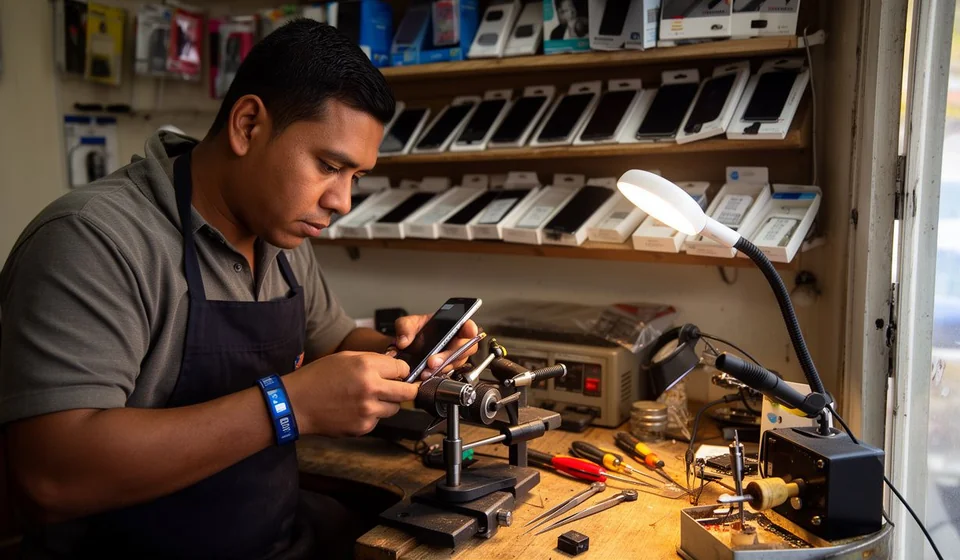
Picture a typical day in a phone repair shop. A customer drops off a phone with a cracked screen. The receptionist opens the work order, the technician takes a screen from the shelf, installs it and the customer pays. The service was recorded at the register, but the screen that left the stockroom was never recorded in any inventory. On paper, on the shelf or in the technician's mental list, that screen still exists. When the third urgent device of the week arrives and there is no screen left, you end up buying at retail prices, paying up to thirty percent more than wholesale, just to keep the customer.
The consequences of not recording parts consumption per service pile up silently:
- Unrecorded exits: parts leave the stockroom with no record at all, as if they evaporated.
- Nobody is accountable: there is no trace of which part was used, on which device, or which technician installed it.
- Ghost stock: what you believe you have in stock does not match what is physically there, so you buy the wrong things and run out of the urgent ones.
- Invisible cost per job: the invoice only records what you charged; it never links the parts that job consumed, so you cannot tell whether a repair made you money or lost it.
- Warranty claims without proof: if an installed screen turns out to be defective, without the serial number you cannot claim a replacement from your supplier or know which batch failed.
- Parts leaving for other purposes: without controls, a part can end up in a favor job, in a technician's side sale, or simply "lost".
The most dangerous fact of all is that you do not know what each service really costs you. If you charge $180,000 for a screen replacement that costs you $95,000, you believe you keep $85,000 of gross margin. But if one out of every ten screens leaving your stockroom is never charged or justified, your real margin drops by ten percentage points and you cannot explain why.
Invoice or consumption: the difference that is costing you money
When a spare part is sold separately to a customer, it is indeed invoiced as a regular sale: in Kardex Tauro that part is a Normal type product and can be invoiced like any other merchandise. But when a part is installed as part of a technical service, there is no sale: there is an internal expense. Recording that expense with an invoice is a mistake, because the invoice creates an account receivable, revenue and a sale that do not exist. That is exactly what Internal Consumption is for.
| Aspect | Sales invoice | Warehouse consumption |
|---|---|---|
| Third party involved | External customer making a purchase | Internal employee or department receiving the parts |
| Financial effect | Creates revenue and an account receivable | No accounts receivable or payable: it is internal use |
| Inventory effect | Deducts stock when finalized | Deducts stock when finalized |
| Ledger record | Sales entry in the Stock ledger | Merchandise exit entry in the Stock ledger |
| Purpose | Charge a customer for a product | Track internal use and assign the cost to the service or department |
This distinction is the key to a service business: the value of the parts consumed is not income, it is the direct cost of each repair. Once that cost is recorded and assigned to the right job, you can finally calculate how much you truly earn from each type of repair and price accordingly.
What a Internal Consumption is in Kardex Tauro
A Internal Consumption is the document that formalizes the exit of products from inventory for the company's internal use, with no sale to an external customer. In a repair shop, the typical use case is one that the system explicitly recognizes: "Spare parts used in equipment maintenance". Its main features are:
- Automatically deducts stock when the document is finalized: the installed screen stops counting as available.
- Creates the corresponding Stock ledger entry as an inventory exit, leaving full traceability of the movement.
- Generates no accounts receivable or payable: it is not a sale, it is internal consumption.
- Requires two third parties: who receives (the technician performing the repair, who physically takes the part) and who requests (the person who checked in the device and ordered the job). Both are mandatory: without them, the system will not save the document.
- Validates stock: you cannot consume products that are not available in inventory.
- Links serial numbers: if the part uses a serial number or IMEI, the serial stays linked to the consumption, so you can trace exactly which unit was installed in each device.
- Filters and reports: you can filter by receiving employee, date range or value, and combine filters. Results can be exported to Excel or printed as a report.
The double record of who requests and who receives works like a control signature: the receptionist cannot declare a consumption without a technician listed as receiver, and the technician cannot take parts without a request backing it up. Every screen ends up linked to an order, a device and an accountable person.
Your shop without controls vs. your shop with Kardex Tauro
| Daily situation | Without controls | With Kardex Tauro |
|---|---|---|
| Knowing how many screens and batteries are left | The technician's memory or a notebook | Updated stock: every finalized consumption deducts the part |
| Part installed during a service | Leaves the stockroom unrecorded | Finalized Internal Consumption with receiving technician and requester |
| Cost of parts per repair | Unknown | The consumption value is assigned as the cost of the service |
| Defective screen under warranty | Impossible to trace the unit or batch | Serial linked to the consumption: supplier claim with proof |
| Knowing how much each technician spends | Nobody knows | Consumption report per employee, exportable to Excel |
| Deciding what and how much to buy | Emergency retail purchases | Reliable stock levels to buy wholesale at the right time |
Steps to implement consumption control in your shop
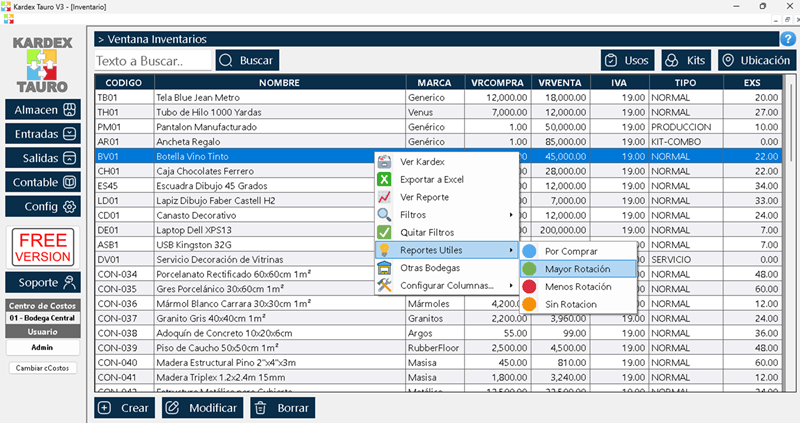
- Build a complete catalog of parts and supplies. Load every screen, battery, connector, flex cable, camera module and adhesive into Kardex Tauro as a Normal product with a clear code (for example SCR-IP11 or BAT-S22) and its purchase cost. For high-value screens and modules, enable serial tracking.
- Record every purchase. Each time you receive merchandise from a supplier, register the inbound movement so your stock levels and unit costs in the Stock ledger reflect the reality of your storeroom.
- Set the operating rule. Every part that leaves the stockroom to be installed in a device must leave with a Internal Consumption. Nobody takes parts "from the box" without a document anymore.
- Open the consumption for each work order. When the receptionist checks in the device, she is listed as the requester; the assigned technician is the receiver. Both third parties are recorded.
- Add the parts with quantity and value. The system validates that the products are available in inventory before allowing you to save the document.
- Finalize the document. When the consumption is closed, Kardex Tauro deducts the stock and creates the exit entry in the Stock ledger. If you installed serialized screens, the serial numbers are linked automatically.
- Review with filters and reports. Every week or month, generate the consumption report by technician and period, export it to Excel and compare it with the services invoiced. That is where leaks and improvement opportunities show up.
Success metrics: how to know the control is working
- Recording coverage: 100% of closed jobs have their parts consumption finalized the same day.
- Physical vs. system inventory: the difference between what Kardex Tauro reports and what is actually on the shelf drops below 1% or 2%.
- Known cost per job: you can state exactly what the parts of every repair cost and what the real gross margin of each type of service is.
- Fewer emergency purchases: urgent retail buying drops noticeably because stock levels no longer surprise you.
- Higher gross margin: once real costs are identified, many shops recover between 5 and 12 margin points without raising prices.
- Backed warranty claims: every claim to the supplier is made with the serial number of the installed part, and replacements stop getting lost.
Real case: TecnoFix Chapinero, the phone shop that stopped giving parts away
TecnoFix is a cell phone repair shop in the Chapinero neighborhood of Bogota, with four people and around thirty devices repaired every week. Its storeroom manages around one hundred and twenty references among screens, batteries, connectors, flex cables and modules. For years, control relied on the reception notebook and the lead technician's memory.
The breaking point came with a high-end screen. The technician reported it as "damaged during installation" and asked for another one. The original screen never showed up, there was no way to claim it from the supplier because its serial number was unknown, and the shop absorbed the whole loss. That was when they decided to implement Kardex Tauro with a warehouse consumption for every work order.
Today, when TecnoFix receives a device, the receptionist opens the consumption as requester and the assigned technician appears as receiver. Every screen leaves the storeroom with its serial recorded, and when the job is finished the document is closed: stock is deducted automatically and the value of the parts becomes the cost of that repair. The results of the first months were striking:
- Average gross margin per job rose from around 15% to more than 27%, without raising prices.
- Emergency retail purchases fell by roughly 60%.
- The gap between physical inventory and the system dropped below 1%.
- With the serial number at hand, the supplier accepted the replacement of two defective screens that would previously have been lost.
- The consumption report per employee revealed that one technician consumed 40% more parts than average, which led to retraining and to a policy of inspecting screens before opening their packaging.
The figures in this case illustrate what happens in small shops across the region, but the mechanics are always the same: what is not recorded is not controlled, and what is not controlled is lost.
Conclusion: your shop sells services, not inventory. Control what you spend
A cell phone, electronics or appliance repair shop lives on technical skill and customer trust, but its profitability is decided in the storeroom: knowing which part went out, who received it, which device it was installed on and what it cost. Kardex Tauro's Internal Consumption turns that control into part of your daily operation, with no invented invoices, no notebooks and no reliance on anyone's memory.
Kardex Tauro is an inventory management system designed for small businesses with up to 50 employees, sized just right for a shop like yours. You do not need an accounting department or a tech expert to implement it: you need the decision that every part gets recorded. Start this week: catalog your parts, define who requests and who receives, and open your first warehouse consumption. Your storeroom, your cash register and your accountant will thank you.