Is Your Cleaning Company Profitable — or Just Busy? Track Supply Costs Per Contract
Is Your Cleaning Company Profitable — or Just Busy? Track Supply Costs Per Contract
You run a cleaning company. Every month you buy detergents, bleach, soaps, disinfectants, trash bags, toilet paper, brooms and mops to serve your office contracts. And every month your crews use those supplies at your clients' facilities. The service gets invoiced, the supplies get used… and at the end of the month you simply hope the business is making money. But what if one of your contracts is consuming more than it pays for? What if the profit you think you have is being carried away, gallon by gallon of bleach and roll by roll of paper, by costs that nobody records? This is not a sales problem: it is a control problem. In small cleaning businesses margins are thin, and the difference between winning and losing is not about charging more: it is about knowing how much each contract actually consumes. When that consumption is unknown, you end up charging below your real cost, renegotiating poorly, and discovering the loss only when it is too late. The good news is that there is a practical way to solve it: tracking supply consumption per contract with Kardex Tauro.Why your accounting does not show you the problem
If you run your business like most small cleaning companies, your accountant records the purchase of supplies as one global monthly expense: a batch of cleaning products came in, its value was taken out of the cashbox, and nobody knows which client used it, which service consumed it or how much was left over. With that picture, all your contracts look equally profitable… until one of them starts eating the profit of the others. These are the typical symptoms of a lack of control:- You do not know what each contract consumes: supply costs are split roughly, by eye, among all clients.
- Overconsumption is detected too late: when the month's budget is already gone and you have to buy again.
- Supplies get lost with no one responsible: if nobody signs off on what was delivered and to whom, you cannot tell whether the bleach was used at the client's building or ended up somewhere else.
- Rates are set by guesswork: you charge what the competition charges, not what serving each contract really costs.
Internal Consumption: the document your cleaning company needs
Kardex Tauro solves this with the Internal Consumption document: an issue of supplies for internal use, not for sale. When your supervisor hands the crew the material to serve a contract, you record that issue as a consumption and the system immediately deducts the stock and posts the corresponding entry to the Stock ledger of each product. Unlike an invoice, a warehouse consumption generates no accounts receivable or payable: you are not selling, you are spending the supply inside your own operation. But it requires two pieces of data that change everything: who receives and who requests. The receiver can be the crew supervisor, the shift leader, or even the client, when the contract requires delivering the supplies at the building's lobby and logging them as a reference. The requester is the person who asked for the material: the service coordinator or the contract manager. With those two names, no overconsumption stays anonymous. And the most valuable part: the consumption is assigned to an area, project or contract, just like the system's classic example: cleaning supplies used in maintenance. That way, the cost of the detergent and the disinfectant is charged exactly to the client that consumed it.First set the business up, then control consumption
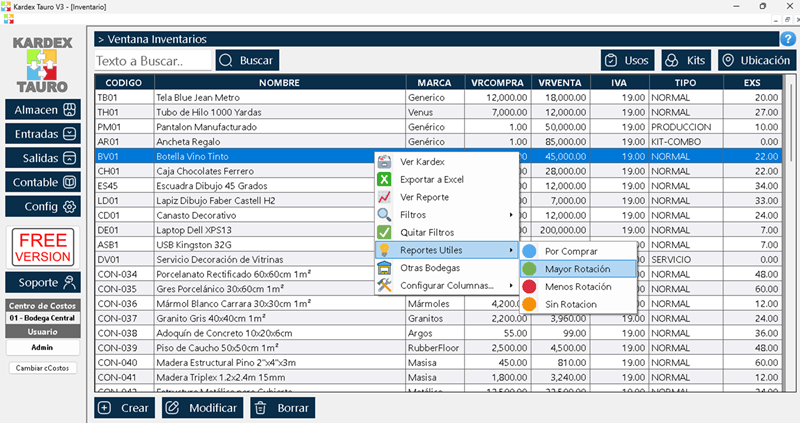
Before recording consumptions, your catalog must be properly configured in Kardex Tauro. The system's product types let you clearly separate what you buy from what you sell:- Normal products: each supply —detergent, bleach, soap, bags, paper, brooms, mops, disinfectant— is created as a normal product, with its unit of measure and its cost.
- Service products: the cleaning service by the hour, by visit or by monthly contract is set up as a service, because it is not an object you store but a job you sell.
- Optional Kit or Combo type: to speed up deliveries, you can build a per-office cleaning kit with the standard supplies of each contract.
Profitability per contract: without control vs. with control
Compare what happens in your company today with what happens when every supply issue is recorded and charged to its contract:| Business aspect | Without consumption control | With Internal Consumption per contract |
|---|---|---|
| Supply cost per client | Estimated or split equally among clients | Calculated exactly, using the Stock ledger cost of each product |
| Contracts that lose money | Invisible: one good client's profit pays for another client's waste | Shown in the consumption report by area or project |
| When overconsumption is detected | At the end of the month, after overspending | At every issue: who receives, who requests and how much |
| Pricing or renewal decisions | By guesswork or by what competitors charge | With the real cost of each contract in hand |
| Real business profitability | One global figure that may be misleading | Real margin per client, comparable month after month |
| Next month's purchases | Roughly the same as always | Based on the real consumption of each contract |
Implementation in six steps
Setting up consumption control does not require changing how your crew works, only how you record the material:- Create your catalog: register each supply as a Normal product with its cost and unit, and the cleaning service as a Service product.
- Record purchases with a Purchase Order so that stock and Stock ledger always reflect the real cost.
- Create an area or project per contract: for example, North Tower office contract, or simply each client's name.
- Issue the material with a Internal Consumption per contract, always stating who receives and who requests it.
- Review the consumption report by area or project every week and compare it with the contract's budget.
- Adjust on time: if a contract goes over budget, renegotiate the rate, change the procedure or strengthen supervision before the month ends.
The four metrics that reveal the truth
Once consumptions are recorded, the figures that used to be hidden appear. These are the metrics you should watch on every contract:- Monthly consumption per contract: the total supply cost charged to each client; if two similar offices consume very different amounts, that is an alert.
- Supplies as a share of billing: for office cleaning, a healthy range is usually between 10% and 18% of what you invoice; above that, the contract starts eating profit.
- Consumption per employee or shift: it lets you spot crews that use twice the product to do the same job.
- Overconsumption against budget: the difference between planned and actual spending, measured week by week so you can correct early.