Why Close Your Warehouse to Count Inventory? Try Cycle Counts Instead

Why Close Your Warehouse to Count Inventory? Try Cycle Counts Instead
Every year the same moment arrives: the inventory has to be reconciled. The warehouse closes, shipments are paused, and the whole team spends a weekend counting boxes, only to find out that the final numbers do not match what the system says. And the worst part: nobody knows how long the error has been there. If this sounds familiar, there is good news: you do not need to shut down your business to have reliable inventory. There is a practice used by warehouses all over the world called cycle counting, and any small or medium-sized business can start using it next week. Here is what it is, how to schedule it by priority, and what to do when a count does not match.What cycle counting is and why it works so well
Cycle counting means counting one part of your inventory every day or every week, on a rotating basis, instead of counting everything at once. For example: dairy products on Mondays, grains and dry goods on Tuesdays, cleaning supplies on Wednesdays. By the end of the month you have covered the entire warehouse, yet you never locked the door or told a customer to come back tomorrow. The logic is simple: if your inventory drifts out of sync little by little, it can also be corrected little by little. The benefits show up within the first week:- Sales never stop: you count one section or product family at a time while the rest of the warehouse keeps operating normally.
- Errors are caught early: if something went wrong this week, you find out this week, not six months from now.
- Work is spread out: instead of one exhausting marathon with the whole team, you run short sessions with a few people, at a calm pace.
- Counts are more accurate: counting 200 items calmly is far more reliable than counting 8,000 in a rush, tired.
- Your staff knows the warehouse better: people who count regularly end up taking better care of the merchandise.
Full inventory vs cycle counting: the comparison
Look at this table before you decide. It shows why more and more small businesses are dropping the annual full count as their main method:| Aspect | Full inventory count | Cycle counting |
|---|---|---|
| Frequency | Once or twice a year | Rotating: every day or every week |
| Warehouse closure | Yes: everything stops | No: one section at a time |
| Impact on sales | High | None or minimal |
| Error detection | Late: months later | Fast: within days |
| Staff required | The whole team at once | A few people, on a steady basis |
| Count quality | Low: rush and fatigue | High: calm and methodical |
| Operating cost | High and concentrated | Low and spread out |
Why your inventory drifts out of sync (even when you are careful)
Before you start counting, it helps to understand what creates the differences. These are the most common causes in small-business warehouses:- Receiving errors: 48 units arrive but 50 are entered, or the wrong code is recorded.
- Sales not posted on time: the order goes out, but the system update is left for later or forgotten.
- Shrinkage and breakage: a container breaks or a box is damaged and nobody records the loss.
- Returns handled badly: the goods go back on the shelf, but the system never finds out.
- Expired or damaged products: they are pulled off the shelf and thrown away without any record.
- Similar codes or pack sizes: almost identical products that staff mix up when picking or stocking.
Schedule counts by priority: the ABC rule
Not every product deserves the same attention: a mistake on an expensive, fast-selling item hurts more than one on an item that has sat on the shelf for months. That is why counts are scheduled by priority:- A items (expensive, fast-moving): few references, lots of value. Count them every week or every two weeks.
- B items (medium movement): count them once a month, balancing effort and control.
- C items (slow movers or low value): every three to six months. The risk of counting them less often is low.
Running a partial count step by step, without stopping sales
Here is how a cycle count is executed in a warehouse that keeps selling normally:- Set the rotating calendar: assign each section or product family to a day of the week according to its ABC priority.
- Pull the list from the system: check the items to count, with their locations and the stock the system reports. The goal is to compare afterwards, not to count while looking at the number.
- Count with a method: the warehouse staff counts the assigned section during a slow period and records real quantities, unit by unit.
- Mark what has been counted: use labels or tape so nothing is counted twice and no reference is skipped.
- Compare against the system: separate three groups: matches, differences, and physical stock that is not registered at all.
- Investigate and adjust: recount the doubtful ones, look for the cause, and record the adjustment if it applies, as explained below.
- Close and record: today's count is documented and closed; tomorrow belongs to the next section.
What to do when a count does not match
A count that does not match is not a failure: it is valuable information. The error was already there; what you achieved is finding it. Here is what comes next:- Do not adjust on the first try: if the system says 40 and you found 35, recount before touching anything. Many differences come from count errors or misplaced goods.
- Search the whole warehouse: check nearby shelves, returns areas, loading docks and unopened boxes. Lost stock is usually misplaced, not vanished.
- Review recent movements: compare receipts, shipments, returns and shrinkage from the last few days, and ask the staff what happened.
- Find the real cause: theft, data entry error, unrecorded shrinkage or code confusion. Each cause needs a different fix.
- Adjust with backup: once the cause is clear, record the adjustment in the system with the reason. Never adjust just to make the number match: that only hides the problem.
- Watch for patterns: if the same product fails three times in a row, something is wrong with that code or location. If losses concentrate in one section, review its processes.
The inventory system: the memory of your warehouse
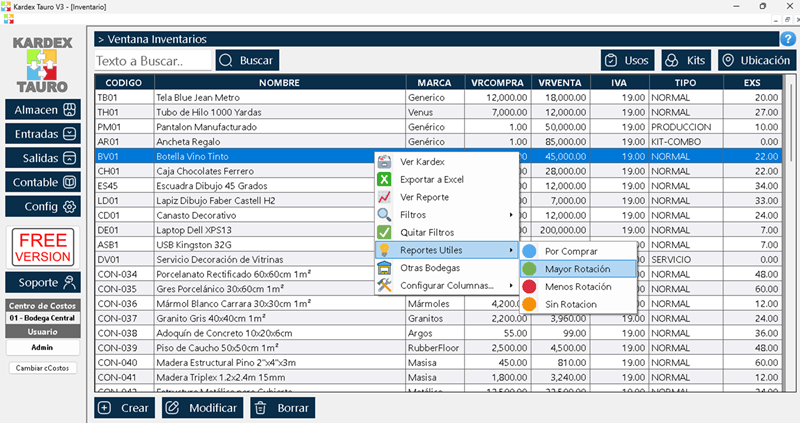
This is where software changes the game. Counting with notebooks and spreadsheets is possible, but fragile: lists get lost and nobody remembers the March adjustment. With a system like Kardex Tauro, every count becomes a living record:- Adjustments with history: the system records every adjustment with date, person responsible, product and reason. Months later you can say with certainty: this shortage started on that day, for this cause, and this is how it was fixed.
- Automatic comparison: you load the count and instantly see the differences per product.
- Accuracy reports: the software calculates what percentage of your inventory is reliable and how it improves month after month.
- Clear priorities: value and turnover reports tell you exactly which products belong to category A.
- Full traceability: receipts, shipments, returns and adjustments stay linked, so you can rebuild which movements created a difference.
How to know it is working: success metrics
Counting is not enough: you have to measure whether the method is doing its job. These are the metrics we recommend tracking from the first month:- Inventory accuracy (%): counted items whose stock matches the system. If you start at 70% and reach 92% in three months, you are on the right track. A realistic goal is above 95%.
- Number of differences per week: it should go down over time, a sign that processes are improving.
- Value of the differences: measuring in money tells you how much you are protecting: a mistake on a cheap product is not the same as one on an expensive product.
- Recurring errors on A items: if a critical item fails three counts in a row, there is a root problem to solve.
- Time per count: with practice, counting 100 items takes less and less time.
- Stockouts avoided: by counting your best sellers often, you stop running out of stock at the worst possible moment.