
History of the Abacus
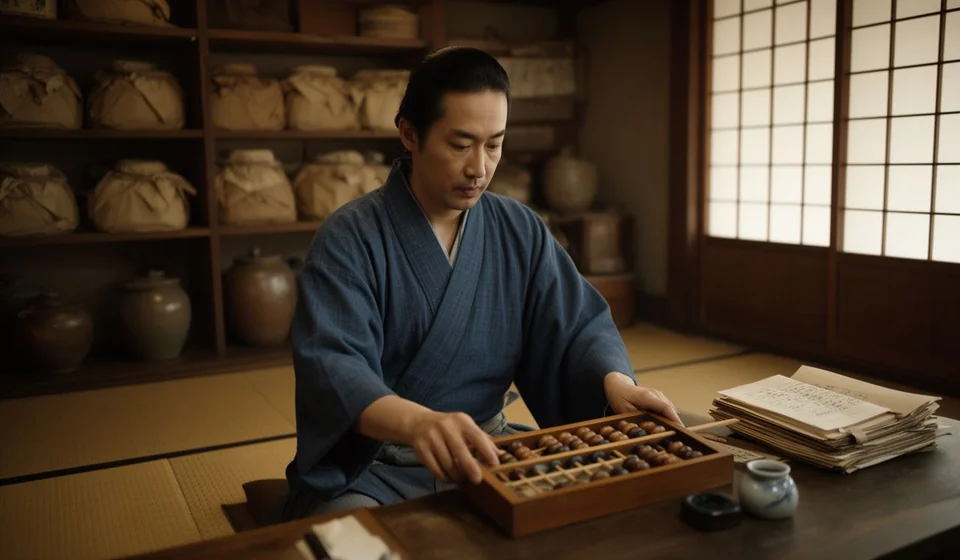
History of the Abacus
Few tools have served people as long as the abacus, and fewer still are still at work. Boards with beads or pebbles were used to reckon long before written arithmetic became ordinary business practice, and they are used today in shops, classrooms, competitions and in the hands of people who cannot read a screen. This is the story of that instrument: where its name comes from, how it took a different shape in each country that adopted it, how it met the electric calculator and did not lose, and why it has never gone away.
The abacus is easy to dismiss as a museum piece, and that would be a mistake. Its logic, a place for every unit and a bead or a pebble for every quantity, is the same logic that sits behind a written column of figures and behind a spreadsheet cell. Understanding the abacus is a way of understanding the most practical part of accounting: counting things, and keeping the count straight.
A board, a pebble and a word
The word is older and humbler than most people expect. Abacus comes from the Greek abax, which meant a board or a reckoning table: a flat surface on which something was placed in order to be counted. Nothing in the original meaning suggests a machine. It suggests a board.
The companion word has the same kind of history. Our word calculate comes from calculus, the pebble that was moved about on those boards. In Rome the person who did that work, the calculator, was literally the one who handled the pebbles. The vocabulary of modern arithmetic, from calculation to the small machine on a desk, descends from a stone small enough to hold between two fingers.
The Salamis Tablet and the Roman hand abacus
The oldest abacus that has survived is a Greek marble counting board known as the Salamis Tablet, made around 300 BC. It is a slab marked with lines and groups of signs, and it gives a rare physical glimpse of how a counting board was laid out and used. It was not an isolated curiosity either: counting boards of one kind or another appear across the ancient Mediterranean world.
In Rome the practice took several forms at the same time. There was the hand abacus, a small board with slots and metal counters, portable enough to be carried into a market or a warehouse. There were pebbles placed on boards, the simplest version of the idea and the one that named calculation. And there was finger reckoning, in which the hand itself became the instrument and quantities were shown by the position of the fingers. A merchant, a clerk or a steward might use any of the three, depending on the size of the sum and on where he happened to be standing.
China: the suanpan and the art of zhusuan
In China the abacus reached the form that most people would recognise today. The suanpan is a rod abacus with two beads above the horizontal bar and five below. The two groups are not decorative: the arrangement encodes the decimal system, so that a number can be set, added to and read off by moving beads with thumb and forefinger.
The instrument cannot be separated from the technique of using it. UNESCO describes zhusuan, the traditional method of calculation on the suanpan, as a practice in which the abacus carries thirteen to nineteen rods with beads, and in which the skill is handed down from generation to generation. Learning it is not only a matter of knowing where the beads go: the technique comes with easy-to-learn rhymes and formulas that guide the hand, which is exactly why it has travelled so well down the generations.
Japan: the soroban
The Japanese abacus, the soroban, derives from the Chinese suanpan, which reached Japan in the 14th century, probably by way of the Korean peninsula. Japanese makers and teachers then refined it, and in its modern form the soroban carries one bead above the bar and four below: fewer beads than the Chinese instrument, with the same decimal logic underneath.
That modern form was standardised in the late 19th century. By then the abacus was already a deep part of Japanese education, because it was taught in Japanese schools for more than five hundred years. For a long period that teaching was compulsory; later it became optional. Today it is studied mainly in private after-school academies, the juku, which keep the skill alive outside the ordinary timetable.
November 1946: the abacus against the electric calculator
The best-known episode in the modern life of the abacus took place in Tokyo in November 1946, and it has the shape of a fable, except that it happened. The United States Army newspaper Stars and Stripes organised a contest between the soroban and an electric calculator belonging to the army. The abacus was operated by Kiyoshi Matsuzaki. The abacus won four rounds to one; the calculator took only the multiplication round.
The story is usually told as a joke about an old tool beating a new machine, and it deserves a more careful reading. The contest put a trained person using a familiar instrument against a machine of that period operated by a person. Its real lesson is not that beads beat electronics, but that a practised hand on a well-designed instrument is very fast at the operations that instrument was built for, a lesson that has been relearned in many technologies since.
The abacus today
The abacus did not retire when the calculator arrived. In Japan the soroban is still taught in some primary schools and, above all, in private academies. The Japan Chamber of Commerce and Industry runs an official examination with six levels of proficiency, and a third-level certificate is taken as qualifying its holder to work in public corporations. That is a professional signal and not a school ritual: the skill is examined, graded and used when people are hired.
Training on the soroban leads to anzan, blind calculation, in which the student pictures the abacus and calculates without moving a single bead. It is one of the reasons families still pay for those classes: the instrument is the means, and the mental arithmetic it leaves behind is the point.
In China, zhusuan was inscribed in 2013 on the UNESCO Representative List of the Intangible Cultural Heritage of Humanity. Clubs and associations teach the practice and organise competitions, treating it as something to be transmitted rather than merely preserved.
The abacus has also found a second life among blind users. Two tactile abaci derive from the soroban: the toggle type and the Cranmer abacus. Both use circular beads, longer rods and a leather backing so that the beads do not slide and the position of every bead can be felt with confidence.
In the classroom it is used for a reason that has nothing to do with speed. It lets a child see place value and carrying before meeting them in written arithmetic: ten beads on one rod become one bead on the next, and a column of figures stops being an arbitrary rule and becomes something that was done with the hands.
Three abaci side by side
The instrument took a different shape in each country that made it its own. The table below compares the three that are best known.
| Abacus | Where it appeared | Beads above and below | What it is used for |
|---|---|---|---|
| Suanpan | China | Two beads above the bar and five below | Traditional calculation and zhusuan, as well as teaching, clubs and competitions |
| Soroban | Japan, where it arrived from the Chinese suanpan in the 14th century | One bead above the bar and four below in its modern form | Teaching in schools and private academies, the official examination, and mental calculation |
| Schoty | Russia | Ten beads per rod | Counting and calculation |
From the beads to the pen: the scuole d'abaco
Between the 13th and 16th centuries, Italy developed a kind of school that carried the old name into a completely new practice: the scuole d'abaco. These were private schools where the sons of merchants, aged twelve to fourteen, spent about two years learning practical arithmetic. The syllabus was the working toolkit of a trading house: Hindu-Arabic numerals, multiplication tables, division, fractions, the rule of three, conversions between moneys and measures, and the arithmetic of interest and of partnerships.
There is a nuance here that is easy to miss and worth getting right. The pupils of the scuole d'abaco did not learn on a bead abacus. They worked with pen and paper. The name of those schools came from the same Greek root as the instrument, abax, a reckoning, and in that setting it meant practical computation rather than a device with beads. What the merchants' sons learned was the arithmetic needed to price goods, keep accounts and share a profit, and they learned it in ink, on paper, over about two years.
The tradition produced remarkable teachers. Luca Pacioli was one of those masters of abbaco: he taught abbaco and bookkeeping to the sons of the merchant Rompiasi in Venice for six years from 1464, and his Summa de arithmetica of 1494 came out of that tradition. It is worth being plain about what Pacioli did and did not do. He did not invent double-entry bookkeeping. He wrote down and organised a method that merchants and their teachers were already using, and that act of writing it down is what made him famous.
So the word that began on a counting board ended up naming a school of pen-and-ink arithmetic, while the instrument itself kept its beads and its practitioners elsewhere, in the markets of East Asia where it had become a tool of daily trade.
Why the beads have not gone away
Every generation has predicted that the abacus would vanish, and every generation has been wrong for the same reason: it never competed with arithmetic, it made arithmetic reliable in the hands of a person under pressure. That is the problem the counting board solved for a merchant with a queue of customers, the problem the stock ledger card solved for a warehouse keeper, and the problem that software solves today.
Kardex Tauro keeps balances and movement histories for a business in the same spirit in which a counting board kept a column of figures: every quantity has a place where it can be set, read and checked. The beads and the grooves are gone; the demand for a reliable place to put a number has not.
