Is Your Warehouse a Maze? How Physical Storage Organization Slashes Search Time by up to 70%

If Finding a Product Takes You Fifteen Minutes, Your Warehouse Is Eating Your Profits
For many small and medium businesses, the inventory problem does not start when stock is counted: it starts when someone needs to find something and does not know where it is. The warehouse assistant looking for a spare part walks the aisles, opens half-emptied boxes, asks whether anyone moved it and, fifteen minutes later, finds it behind a stack of boxes of another SKU, label facing the wall. That drama repeats twenty times a day, five days a week, and nobody records it as a loss because it never appears on an invoice. But a loss it is: hours of payroll spent searching, delayed orders, waiting customers and an inventory that never reconciles because the goods are where someone left them, not where the system says they should be. The good news is that this problem is not solved by buying more technology or scolding the staff: it is solved with physical organization. A well-organized warehouse is the difference between a business that ships in minutes and one that loses hours every single day. And the best part is that the rules for achieving it are few, inexpensive and can be applied this very weekend.The golden rule: one fixed location for every product
The first rule of professional warehousing is also the simplest: every product has one single place, and that place never changes. One rack, one row and one specific level for each SKU, always the same. When the product arrives, it goes to its location; when it leaves, it leaves from that location; when someone asks where it is, that location is pointed out and nobody argues. It sounds obvious, but most SME warehouses work the other way around: goods are placed wherever they fit, in the first free slot the receiver finds, and every week the warehouse reorganizes itself by accident. For the rule to work, every location must have a short code that anyone can read and say in seconds. For example, the code R3-B-2 means rack 3, row B, level 2. That code is written on the rack with tape or a label, noted on each product's record and repeated in the inventory software. When the Stock ledger registers a product, it also registers its address: the same one the assistant will see when going to pick it or put it away. One fixed location per product turns searching into a direct trip, with no guessing.What searching really costs: numbers that do not forgive
To understand why this topic deserves attention, it is worth putting numbers on the disorder. Take the case of a warehouse of spare parts or finished goods with two thousand active SKUs, three employees and twenty-five daily shipments. This is what the comparison between operating without fixed locations and operating with them looks like:| Indicator | Without fixed locations | With fixed locations |
|---|---|---|
| Average time per search | 12 to 15 minutes | 30 to 60 seconds |
| Daily warehouse searches | 25 to 40 | 25 to 40 |
| Hours lost searching per day | 5 to 9 hours | Less than 1 hour |
| Wrong-SKU shipments per month | 8 to 12 | 0 to 2 |
| Physical count variance | 5% to 8% | Under 1% |
High-turnover zones: what moves the most sits closest to the door
Not all products deserve the same shelf. Those shipped every day must sit near the shipping door; those that leave once a month belong in the middle zone; and those that barely move go to the back of the warehouse or to the top levels. This classification is known as ABC analysis and it is simple to apply: group A, which concentrates most of the outbound movement, takes the first aisles; group B, with moderate movement, takes the middle; and group C, low-turnover or seasonal items, goes at the far end. The reason is pure physics: every meter between the shelf and the door is multiplied by every shipment of the day. If a group A item moves forty times a day, saving ten meters per trip means four hundred fewer meters of walking daily, which by the end of the month become hours. Keeping the SKUs of the same family together (all the packaging for one client, all the screws of one gauge, all the bottles of one brand) also prevents picking mistakes and lets the staff learn the warehouse map by heart, without checking every time.Clear aisles, heavy loads low and signs that explain themselves
Warehouse order is also won on the floor and in the aisles. An aisle blocked by boxes forces detours, breaks the flow and is the first excuse for leaving goods anywhere. That is why every zone needs its own clear, marked aisle: floor markings that delimit main aisles, pallet positions and shipping areas, plus visible signs at the start of each row showing the families it holds. If a new visitor can find a product using only the signs, without asking, the warehouse is well signposted. Safety is also part of order, and some rules are non-negotiable:- Heavy loads low: the heaviest and bulkiest packages go on the lower and middle levels, never above shoulder height, to prevent injuries and falling loads.
- Maximum heights: the stack of boxes or bags must not exceed the height indicated by the package manufacturer or the rack's capacity; anything over the limit is relocated, not stacked higher.
- Fragile items protected: breakables go on middle levels with dividers, away from aisles where forklifts or hand trucks pass.
- Aisles always clear: no temporary goods on the aisle floor; if there is no room, that is a sign the warehouse needs another space review.
- Ladders and access equipment nearby: the gear for reaching high levels is stored in one fixed, visible spot, so nobody improvises with chairs or boxes.
New stock and old stock: never mixed without a label
One of the quietest causes of inventory loss is mixing new goods with old goods. When a fresh batch of a product with a lot or expiry date arrives and is placed on top of the previous one without any mark, staff ship whatever is closest at hand first: the new stock. The old stock stays behind, ages, expires or becomes obsolete, and months later it appears as a loss nobody understands. The rule is simple: what arrives first must leave first (FEFO), and to make that happen, new goods are never mixed with old goods without marking them. The new batch goes behind or below the existing one, is separated with a marker showing the receiving date or lot, and the Stock ledger record notes that date so the system helps remember which batch must be shipped first. For products with expiry dates, this single practice can dramatically cut losses from expiration within the first few months.Physical order and the inventory count: two sides of the same coin
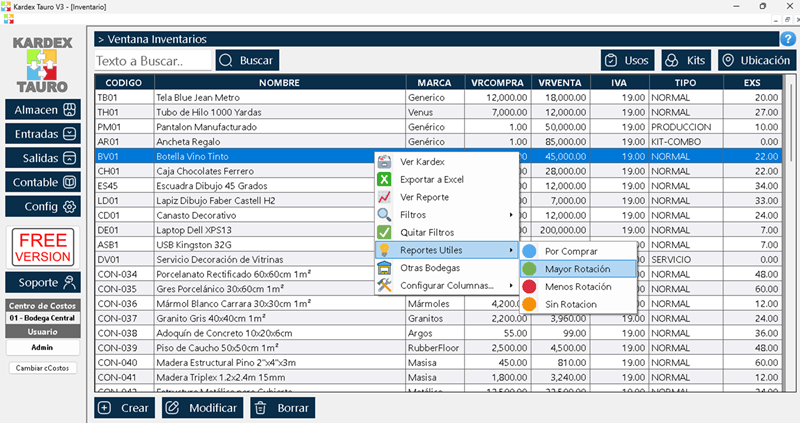
Anyone who believes warehouse order and inventory control are separate subjects gets a surprise at the first physical count. Counting is finding: if every product has a fixed location and families are kept together, the count becomes a methodical walk through rack, row and level, where skipping a SKU is almost impossible. But when goods are scattered across three different places, the count forces a search in all of them, and whatever is not found is declared missing without anyone being sure it is really gone. Kardex Tauro stores the location of every product: the rack, row and level where it should be, together with its lot and receiving date. That means the system not only knows how much there is, but where it is, and when you do a physical inventory, order works in your favor: the count is organized by location, variances are found quickly, and shortages stop being a mystery because the report shows exactly which SKU and which spot did not match. With an orderly warehouse, a physical count that used to take an entire weekend can close in a single day, with numbers you can defend.Five steps to organize your warehouse this weekend
- Empty by zones, not all at once: work aisle by aisle and rack by rack so the reorganization does not turn the warehouse into an even bigger mess.
- Assign location codes: define the naming convention (rack, row, level), label every space and record each product's location in Kardex Tauro.
- Rearrange by family and turnover: keep SKUs of the same family together and place high-turnover items near the shipping door, with heavy loads on the lower levels.
- Mark dates and lots: separate new stock from old stock, label receiving dates or lots, and arrange the shelf so what arrived first leaves first.
- Set maintenance rules: assign one person the weekly duty of checking clear aisles, legible signs and products sitting outside their location.
Success metrics: how to know the order is working
Order is not defended with opinions: it is defended with indicators. These are the metrics worth reviewing during the first thirty days:- Average search time: it must drop from minutes to under one minute per shipped SKU.
- Percentage of products with an assigned location: the goal is 100% of active SKUs with their rack, row and level recorded.
- Picking errors: deliveries with the wrong SKU or quantity must trend toward zero.
- Physical count variance: the gap between what was counted and what was recorded must stay below 1%.
- Expired or obsolete products detected: if FEFO rotation works, losses from expiration fall month after month.
- Counting hours: the physical inventory must close faster every time, until it stabilizes at a single day.