Do You Always Pull the Oldest Stock First? How FIFO Rotation Works (and What Ignoring It Costs You)

Why a Simple Shelving Order Can Save You Thousands in Losses
Picture two identical boxes of juice in your warehouse. One arrived three weeks ago and the other yesterday. When an order comes in, which one do you grab first? If your answer is not "the one that arrived first," this article is for you. FIFO rotation (First In, First Out) is the golden rule for any business that handles products with expiration dates, and mastering it can mean the difference between a profitable stockroom and one that throws away its merchandise every month.
In food, beverage, pharmaceutical and cosmetics businesses, time is an invisible cost. Every extra day a product spends on your shelf silently erodes its value. Applying FIFO does not require sophisticated technology or big investments: it requires order, discipline and a clear method. In this article I explain step by step how to implement it, which mistakes to avoid and how a good inventory system multiplies the results of this simple practice.
What FIFO Rotation Actually Is and Why It Works
FIFO is an inventory management method that establishes that the product that enters the warehouse first must be the first to leave. In other words: the oldest stock is sold or used before the newest. It is the opposite of LIFO (Last In, First Out), where the last item to arrive is the first to go out — a method that only makes sense in certain accounting cases and is dangerous with perishable merchandise.
The logic is simple: every product with an expiration date has a clock running from the day it is manufactured. If you let new stock "cut in line" and ship what just arrived first, the old stock stays at the back of the shelf, piling up days, weeks and months until its date arrives and there is no choice but to discard it. And there goes your margin.
Which Businesses Absolutely Need It
- Food and beverages: supermarkets, grocery stores, convenience stores, restaurants, cafés, wholesale distributors.
- Pharmacies and drugstores: regulated medicines that can never be sold past their expiration date under any circumstance.
- Cosmetics and personal care: creams, makeup, sunscreens and hygiene products with a limited shelf life.
- Supplements and natural products: vitamins, herbal remedies and items that lose effectiveness over time.
- Any business with expiry dates: from florists to pet stores selling dry food.
If you sell any of these products, FIFO rotation is not a recommendation: it is a condition for survival.
What Ignoring FIFO Costs You: Shrinkage Builds Up Quietly
You may think that an expired product every now and then "is not a big deal." Let us do realistic math. Suppose your business has expiration shrinkage of just 2 % of your purchases. If you buy 50,000 currency units of merchandise per month, that means 1,000 per month and 12,000 per year. That figure comes straight out of your pocket and nobody recovers it.
And shrinkage is only the tip of the iceberg:
Consequences of Not Rotating Properly
- Direct product loss: expired goods cannot be sold, and in many cases cannot even be donated or given away. Straight to the trash.
- Returns and complaints: a customer who receives a product close to expiry — or already expired — will likely return it, ask for a refund and, worst of all, never come back.
- Health and legal risks: with medicines and food, shipping expired product can lead to fines from health authorities.
- Reputation damage: in the age of online reviews, a single upset customer can cost you dozens of potential customers.
- Tied-up capital: money invested in merchandise nobody will buy is money that is not working for you.
- Wasted space: old boxes block your warehouse and complicate daily operations.
The good news is that almost all of this loss can be prevented with rotation discipline. Expiration shrinkage never reaches zero with perishable products, but a well-rotated warehouse reduces it to minimal levels.
How to Apply FIFO in Your Warehouse, Step by Step
Implementing rotation is not complicated, but it demands that everyone on the team follows the same criteria every single day. These are the essential steps.
Step 1: Mark the Receipt Date on Every Box
When new merchandise arrives, the first thing to do is record when it came in. Use a marker, label or sticker with the date of the day — or better yet, the expiration date printed on the packaging. A box without a date is a box without an identity: nobody will know whether it should go out today or in three months.
Step 2: Place New Stock Behind or Below, Old Stock in Front or on Top
This is the physical rule of FIFO. When you shelve new merchandise, put it behind or below the stock that was already there, and make sure the oldest product sits in front or on top, ready to be picked. Apply the same principle in refrigerators and display cases: whatever expires first goes where the customer and the stock clerk can see it.
Step 3: Check Expiration Dates When Receiving
Do not take the supplier's word for it. When you receive each order, verify that the expiration dates are correct and far enough away. Reject lots with near-term expiry if your supplier can replace them, and always negotiate to receive merchandise with the longest possible shelf life. A lot that arrives with three months of life forces you to sell it in three months, whether you like it or not.
Step 4: Train Your Staff Never to Ship New Stock While Leaving Old Stock Behind
FIFO falls apart in practice when the clerk grabs the box at the front without checking dates, or when the new employee shelves fresh merchandise over the old stock. Train the whole team with simple rules: first, what expires first, new stock always goes behind, when in doubt, check the date. Reinforce the habit with constant supervision during the first weeks and make rotation part of the opening and closing routine.
Step 5: Run Periodic Checks for Near-Expiry Dates
Once a week, walk through the warehouse looking for products with close expiry dates (for example, less than 30 days away). Pull them out of the normal flow, move them to a visible fast-sale zone and activate them with promotions, discounts or a quick-sale strategy. That product can still become money if you react in time.
| Action | When to Do It | Expected Result |
|---|---|---|
| Mark receipt date | When each order arrives | Every product has identity and order |
| Place new stock behind/below | Every time merchandise is received | Old stock is always accessible up front |
| Verify supplier dates | When receiving and negotiating orders | More shelf life available to sell |
| Train staff | On hiring and in short meetings | Rotation is applied every day |
| Near-expiry inventory check | Weekly | Timely promotions, less shrinkage |
Metrics to Watch to Know If Your Rotation Is Working
Rotation is not an end in itself: it is a means to protect your profitability. These are the metrics that tell you whether you are doing it right.
- Expiration shrinkage rate: divide the value of expired discards by your total purchases. If it exceeds 1 %, there is room to improve.
- Inventory days (average age): how many days a product stays in your warehouse on average. Fewer days, less risk.
- Value of near-expiry inventory: how much money sits in products with less than 30 days of shelf life. This figure should trend toward zero.
- Returns due to damaged or expired product: every return is an alert that something is failing in your dispatch process.
Record these figures month after month and watch the trend: if shrinkage drops and returns decrease, your rotation is working. If not, review where the chain is breaking.
The Role of Software: Records Make FIFO Error-Proof
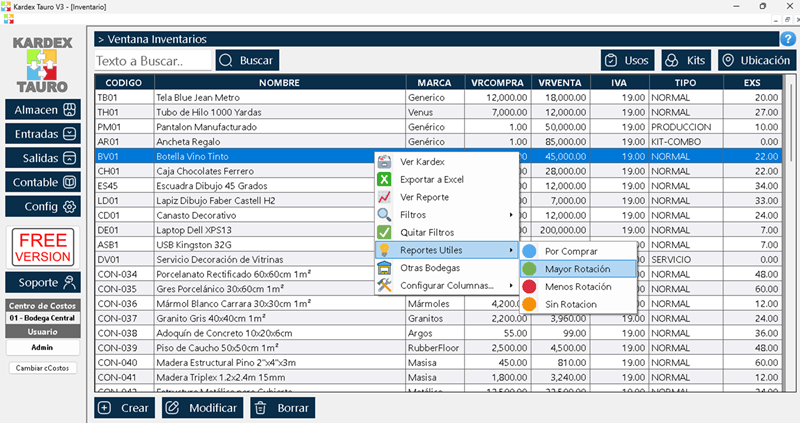
Manual discipline is the foundation, but humans forget, get distracted and change roles. That is where technology comes in. A good inventory system like the one we offer at Kardex Tauro lets you register batches, serial numbers and expiration dates per product, so every unit in your warehouse is identified from the moment it arrives until it leaves.
With that data recorded, you can know in seconds which batch is close to expiring, how many units remain of each batch and which orders should be dispatched first. The system also helps you generate alerts before a product reaches its deadline, turning a memory-based decision into a data-driven one. When the clerk checks the screen and sees "this batch expires in 15 days," rotation stops depending on somebody's memory.
You do not need to start with technology: start with the habit. But once the habit exists and volume grows, digital records become essential to scale without losing control.
Conclusion: FIFO Rotation Is a Daily Decision That Protects Your Money
Pulling the oldest product first sounds like a minor detail, but it is one of the warehouse practices with the greatest direct impact on a small business's profitability. It reduces shrinkage, avoids returns, protects your reputation and keeps your capital working instead of rotting on a shelf.
Start today with one small step: the next time you receive merchandise, mark its date and place it behind the stock you already have. Then repeat tomorrow and the day after, train your team and lean on a system that records your batches and expiry dates. In three months you will see the difference in your loss report.
Ready to stop losing money to expired product? Try Kardex Tauro and take control of your batches and expiration dates from day one.
