VAT return in Colombia: how to file it step by step
VAT return in Colombia: how to file it step by step
When the VAT balance does not add up, the problem is almost never in the form: it is in the documents that feed the subtraction. The VAT return in Colombia is filed on Form 300 with the DIAN, the national tax authority, through electronic means, and it is settled with two numbers — the VAT charged on sales and the VAT paid on purchases — which must come from the invoices, not from the figure the accounting software displays. This article explains how to build the return from the supporting documents, how to tell whether filing is bimonthly or four-monthly, which purchases give the right to deduct, what to do with a credit balance and how to correct a return that was already filed incorrectly.
What exactly is declared when you file VAT
VAT is an indirect tax: the company does not pay it, the final consumer does. The company charges it, records it and remits it to the DIAN. That distinction explains everything that follows. When a taxed product is sold, the tax is charged, recorded as output VAT and held as collected funds until the return is filed. When the company buys, VAT arrives on the invoice and that amount becomes, if the requirements are met, deductible VAT.
The document is called Form 300 and it is filed electronically with the DIAN. It is not annual: it covers one period, either two months or four months, and each period is filed and paid separately. Filing a nil return is still filing, and failing to do so leaves the period open even if the company issued no invoices.
Nor is it the income tax return or the withholding tax return. Those are different forms, with different periods, and the information does not move from one to the other just because it sits in the same system. When accounting mixes the three taxes in a single account, a mismatch is guaranteed.
Bimonthly or four-monthly: how to know which one applies
The company does not choose the filing frequency: the law sets it according to the size of its revenue. The rule compares gross income for the previous year with a threshold expressed in UVT, the tax value unit set by the Tax Statute. Above that threshold, filing is bimonthly; below it, four-monthly. The threshold is updated every year, so check the value in force for the current year before planning your calendar.
There are two layers to the exact date, and they are often confused. The first is the period being filed. The second is the due date, which the tax calendar assigns according to the last digit of the NIT, the tax identification number, regardless of company size. Two companies in the same sector with the same volume can have different dates simply because their NIT ends in a different digit.
The frequency can also change. A company that grows past the threshold moves to bimonthly filing; one that shrinks may return to four-monthly. The change does not always happen in January, because it depends on the applicable rule and on when the test is applied. If last year was atypical, confirm with your accountant whether the current frequency still holds.
Some cases fall outside this logic. VAT liable taxpayers are those who sell taxed goods or services; non-liable taxpayers and those under the simple regime have their own rules. If the company is under the simple regime, what it files is its specific return, not Form 300.
The two numbers that matter: output VAT and deductible VAT
The whole return comes down to two figures and one subtraction. Output VAT (IVA generado) is the tax charged on the period's taxed sales. Deductible VAT (IVA descontable) is the tax paid on purchases and expenses that meet the requirements to be deducted. The difference between the two is the result of the return.
If output VAT is higher, there is a balance payable: money the company collected from its customers and must remit. If deductible VAT is higher, there is a credit balance: the company paid more VAT than it charged, and that excess is not lost — it is carried forward or claimed back.
| Item | What it is | Where it comes from |
|---|---|---|
| Output VAT | Tax charged on the period's taxed sales | Sales invoices and credit notes for the period |
| Deductible VAT | Tax paid on purchases and expenses that meet the requirements | Valid purchase invoices, related to the activity |
| Balance payable | Output VAT greater than deductible VAT | Result of the subtraction; remitted to the DIAN |
| Credit balance | Deductible VAT greater than output VAT | Result of the subtraction; offset or claimed |
Two warnings about that subtraction. Only figures from the same period are netted: mixing a December invoice into a February period throws off two returns at once. And the subtraction is done on VAT, not on the invoice total. Anyone who adds up the full amount of purchases and applies the rate to the whole sum already has a base error that no later adjustment fixes.
Which purchases give deductible VAT and which do not
This is the biggest source of mismatches. Many people assume that every expense carrying VAT gives the right to deduct, and it does not. Deductible VAT is not automatic: it requires a valid invoice, a link to the company's activity and a connection to taxed operations. If any of the three fails, the VAT paid turns into additional cost.
| Situation | Deductible VAT? | Why |
|---|---|---|
| Purchase of goods for taxed resale, with a valid invoice | Yes | Valid invoice, link to the activity and taxed destination |
| Operating expense with a valid invoice, tied to taxed sales | Yes | It is a cost or expense of the taxed activity |
| Purchase without a valid invoice or with incomplete support | No | The documentary requirement fails; the VAT becomes cost |
| Purchase of an excluded good, with no VAT on the invoice | No | There was no VAT to deduct; the amount is cost from the start |
| Purchase used only for untaxed activity | No | There is no taxed operation to attach it to |
| Purchase later covered by a credit note | Reduced | The credit note adjusts the period's deductible VAT |
The invoice is the most delicate point. A purchase without a valid invoice gives no right to deduct even if the payment is on the bank statement and the expense is real. The statement proves the money left; it does not prove the operation is deductible. That distinction is what gets discussed in an audit.
The destination of the good also matters. Anything that does not generate VAT in its final use produces no deductible VAT, and a purchase intended for an untaxed line cannot be deducted just because the invoice arrived with VAT. If a supplier issues a credit note, the period's deductible VAT goes down: recording the purchase and not the credit note leaves the balance payable understated, and the gap shows up later with interest.
Proration: when the company sells taxed and untaxed
Many small and medium businesses do not sell only taxed products. They have a taxed line, an exempt line, an excluded line or some untaxed operation. When that happens, the VAT on purchases that serve the whole operation cannot be deducted in full: it has to be prorated. You determine what share of the activity is taxed, and only that portion of the common VAT is deductible; the rest becomes cost.
Proration is calculated with the period's operations, not with a management estimate. Done by eye, deductible VAT comes out inflated and the return loses consistency against the books. And it is not a one-time exercise: each period has its own proportion, because the sales mix changes.
There is one exception. When the VAT on a purchase can be identified with a specific operation — a purchase used only for the taxed line, for instance — it is not prorated but assigned. Proration applies to what is common, to what cannot be separated. Distinguishing assignable from common avoids two opposite mistakes: prorating everything and losing legitimate deductions, or deducting everything and ending up with a return that cannot be defended.
In exempt, excluded or untaxed operations the temptation is to treat the VAT as deductible because the expense exists and the invoice is in order. It is not. If the company has several lines, document the criterion before an audit arrives and you have to rebuild it from memory.
From the sales and purchase ledger to the form
The right order is documents, ledgers, form. Not the other way around. If the starting point is the figure in the software, you are filing a result without knowing how it was built, and when the DIAN asks you will have nothing to answer with.
The procedure that works has five steps. Close the period: no invoice may be left unrecorded. Reconcile sales: sales invoices less credit notes, against the revenue report. Reconcile purchases: valid invoices with VAT, separating what is deductible from what is not. Review the special cases — proration, credit notes, invoices dated the last day of the period. Only then transfer the figures to the form.
Two checks save more returns than any software. Confirm that no invoice is recorded twice, something common when batches of purchases are digitized. And review invoices issued and voided on the same day, which sometimes stay in the sales ledger when they should not, or disappear when they should be there. A third control is the date: an invoice received on the last day of the period but recorded in the following one moves deductible VAT from one return to another and throws off two periods.
A full two-period example
Take a trading company that sells at the general rate. In period 1 it sold taxed goods for $8,000,000: output VAT is $1,520,000. In the same period it bought merchandise and paid expenses with deductible VAT of $3,000,000, which yields $570,000 in deductible VAT. It also bought an excluded good for $1,500,000: the invoice shows no VAT, so it adds not one peso of deductible VAT.
The subtraction for period 1: $1,520,000 − $570,000 = $950,000 payable. That is the amount remitted to the DIAN.
In period 2 taxed sales fall to $5,000,000, with output VAT of $950,000. Purchases rise: VAT paid on purchases and expenses reaches $1,200,000, equivalent to taxed purchases of $6,315,789. The subtraction is now $950,000 − $1,200,000 = $250,000 credit balance.
| Item | Period 1 | Period 2 |
|---|---|---|
| Taxed sales | $8,000,000 | $5,000,000 |
| Output VAT | $1,520,000 | $950,000 |
| Purchases and expenses with deductible VAT | $3,000,000 | $6,315,789 |
| Deductible VAT | $570,000 | $1,200,000 |
| Purchase of excluded good | $1,500,000 | — |
| VAT on the excluded purchase | $0 | $0 |
| Result | $950,000 payable | $250,000 credit |
Look at what the excluded purchase did: $1,500,000 of purchase and zero deduction. Had someone put it into the base, deductible VAT would have risen on paper and the balance payable would have dropped with no support behind it. And look at period 2: the company sold less, bought inventory and ended with a credit balance. It is neither a loss nor a prize; it is VAT it paid and did not manage to pass on in that period.
Credit balance: offset it or request a refund
A credit balance is not lost money or a system error. It is VAT the company paid and did not charge during the period. There are two ways out: offset it against the following returns or request a refund.
Offsetting is the natural route for most small and medium businesses. The balance is carried into the next period and subtracted from whatever balance payable results. It requires no extra filing, but it does require recording it properly: if one period's credit balance does not appear in the next, the return does not add up and the balance is lost in practice.
A refund is requested formally, requires orderly supporting documents and may be subject to verification. That is where a good share of requests fail: the company is right about the balance but cannot prove it invoice by invoice. Before requesting one, confirm that the balance holds up in a reconciliation and not only in the software report. And keep in mind that a VAT credit balance is not automatically netted against debts on other taxes: those are different forms.
How to correct a return already filed
A filed return cannot be erased: it is corrected. And the logic depends on which way the balance moves. Paying more is not the same procedure as asking money back.
If the correction increases the balance payable, the path is direct. The corrected return is filed with the higher amount and the correction penalty is acknowledged, calculated on the difference. The company pays more, but the matter closes, and correcting early costs less than waiting for a requirement.
If the correction lowers the balance payable or increases a credit balance, the process is more demanding. The administration looks more closely at a correction that returns money to the taxpayer. There the supporting documents are the whole discussion: without invoices, without a reconciliation and without a clear explanation of the error, the correction does not stand on its own. One rule prevents rework: correct the original period, not the current one. Carrying the adjustment into the next period leaves two returns wrong instead of one.
The mistakes that cost the most
Expensive mistakes are almost never technical: they are mistakes of judgement, which is why they repeat.
| Mistake | Symptom | Consequence |
|---|---|---|
| Filing the software's VAT figure without reconciling | A small difference nobody can explain | It accumulates and surfaces as a requirement |
| Deducting purchases without a valid invoice | Deductions higher than the support | Higher tax due plus a penalty |
| Forgetting supplier credit notes | Balance payable understated | A difference paid later, with interest |
| Not prorating with untaxed activities | Inflated deductible VAT | A return that cannot be defended in an audit |
| Mixing VAT with withholdings or income tax | Figures that do not belong in the form | Two wrong returns and a growing mismatch |
| Not keeping invoices and credit notes | The balance cannot be proven | The audit ends in an adjustment |
The most common is the first: taking the software's VAT figure without reconciling it against the invoices. The symptom is a balance that almost adds up, with a difference nobody explains and that gets covered with an adjustment. The consequence arrives months later, when the accumulated difference is already a requirement and nobody knows which period it came from.
How to reconcile the software VAT with the return
Reconciling is not comparing two totals and accepting the difference if it is small. It is explaining every peso. The method has three layers: compare totals, explain differences document by document and leave a written trail.
Start with the totals. Output VAT per the books against output VAT on the form: they should match to the peso. If they do not, the difference is traced invoice by invoice, not by estimate. Repeat with deductible VAT, where more differences appear, because judgement calls — what is deducted and what is not — get mixed with recording errors.
Once the difference is identified, document it. A note in the period file saying "difference of X on invoice Y, not deductible because of Z" is worth more than any verbal explanation. In an audit, what is not written down does not exist. And if the difference cannot be explained, do not force it: an adjustment invented to make the total match gets discovered and turns into a penalty, while a documented difference is understood and closed.
An honest closing before you decide
This walkthrough helps you understand the mechanics and organize the work, but it does not replace your accountant. The VAT return involves judgement calls — proration, special operations, corrections — that depend on each company's facts and are best confirmed with whoever signs. If the company is under the simple regime, if it has significant exempt or excluded operations, or if it comes from several periods without reconciliation, the starting point is not the form: it is a review of the supporting documents.
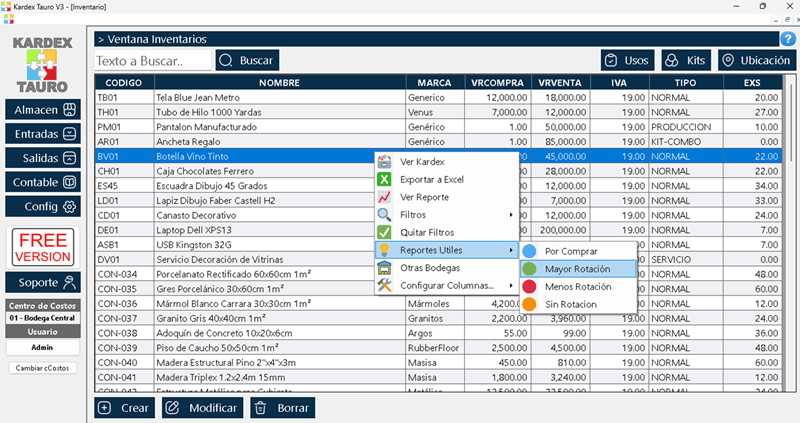
What any team can do without waiting for advice is stop filing from the software report and start filing from the documents. That decision alone removes most of the mismatches seen in practice. And if inventory, invoicing and accounting live in the same system, reconciliation stops being a closing task and becomes the consequence of having recorded things properly. In Kardex Tauro that is the starting point: the figure that reaches the form can be traced back to the invoice that originated it.