Accounting entries: what they are, types and examples
Accounting entries: what they are, types and examples
An accounting entry is the record of an economic event in at least two accounts that move in opposite directions: what comes in on one side leaves, is owed or is consumed on the other. Once that idea is clear, the rest — entry types, PUC codes, inventory adjustments — stops being a recipe to memorize and becomes a logical consequence. This article explains how an entry is built, the five types used in practice, and the eight entries a company with inventory repeats every month, with figures and codes from the Colombian unified chart of accounts.
What an accounting entry is, and why it is always two accounts
An entry is the smallest unit of bookkeeping: a date, some accounts and two columns, debit and credit. The rule behind it is double entry: every economic event affects at least two accounts, and total debits always equal total credits. That is why there is no such thing as a single-account entry, even when the money leaves from just one place.
Selling is not "cash comes in". It is an event with four consequences: a receivable is born or cash arrives, inventory goes out, revenue is born, and a tax payable is born. The entry does not narrate the sale: it breaks it down.
That is the difference between a bank statement and a ledger. The statement says $1,666,000 came in; the entry says where it came from, how much was revenue, how much was tax and which inventory was consumed. When the books "don't balance", it is almost never a missing peso: it is one of those breakdowns that is missing.
The five parts of a well-made entry
A complete entry has five parts. If one is missing, the record loses evidentiary value or becomes impossible to audit six months later.
- Date. The date of the event, not the day someone remembered to record it. A January entry written in February is still a January entry.
- Account, with code and name. The code alone is useless: nobody remembers what 1435 is a year later. The name alone does not work either, because it cannot be summed. They go together.
- Debit and credit in separate columns. Never a negative figure to "subtract". An entry with negative numbers is a disguised total.
- Description. What happened, in one line: purchase per invoice 1024, one hundred units, supplier X. Not "miscellaneous" and not "adjustment".
- Source document. Invoice, cash receipt, payment voucher, count sheet, credit note. An entry without a source document is not an entry: it is a note in the margin.
The source document is not bureaucracy: it is what lets you answer, months later, why it was recorded and who authorized it.
Debit and credit without mystery: the rule of nature
Debit and credit do not mean good and bad, nor money in and money out. They are the two sides of the same account: debit is the left side, credit the right. What changes from one account to another is its nature, and everything else follows from that.
| Account type | Increases with | Decreases with | Code example |
|---|---|---|---|
| Asset | Debit | Credit | Inventory 1435 |
| Expense | Debit | Credit | Operating expenses 51 and 52 |
| Cost of sales | Debit | Credit | Cost of sales 6135 |
| Liability | Credit | Debit | Suppliers 2205 |
| Equity | Credit | Debit | Class 3 |
| Revenue | Credit | Debit | Sales revenue 4135 |
Read the table backwards and you have ninety percent of beginner mistakes. When someone says "I credited the bank account", they almost always mean the bank went down: the asset decreased on the credit side.
One detail gets forgotten: income statement accounts — revenue, expenses and costs — accumulate during the period and are closed at the end. They end at zero and their effect moves to equity as the result for the year: closing does not erase profit, it transfers it.
The entry types that are actually used
Five types cover almost everything a small business records. The difference between them is not format but timing and intent.
| Type | When it is used | What risk it carries |
|---|---|---|
| Opening | At the start of the business or the period: assets, liabilities and opening equity are loaded | If personal assets are mixed with business assets, equity is inflated from day one |
| Journal | Ordinary operations: purchases, sales, collections and payments | High volume; an account error repeats hundreds of times before anyone notices |
| Adjusting | Period end: depreciation, provisions, ending inventory, deferred items | It gets postponed and then done in one shot, with no support |
| Closing | Moving results to equity and leaving income statement accounts at zero | Done badly, the result for the year is duplicated |
| Reclassification | Correcting a misused account without changing the total | It serves to hide errors instead of explaining them |
Reclassification entries deserve a warning. They are legitimate: sometimes a purchase was recorded as an expense when it belonged in inventory. But if the company lives on reclassifications, the problem is not the entry but the accrual process; twenty reclassifications a month do not mean the accountant is careful, they mean the operation is not coming in through the right door.
The PUC: how to read an account code
The Unified Chart of Accounts for merchants, known as the PUC, is the catalog that orders accounts by class. It reads left to right: the first digit is the class, the first two the group, the first four the account and the first six the subaccount. So 1105 is cash within class 1, assets; 2205 is suppliers within class 2, liabilities; 4135 is sales revenue within class 4.
The codes in this article are for reference: cash 1105, banks 1110, accounts receivable 1305, inventory 1435, deductible VAT 2408, suppliers 2205, output VAT 2404, labor obligations 2505, sales revenue 4135, cost of sales 6135, operating expenses 51 and 52, and withholding tax 2365. The exact catalog depends on the entity, its activity and how the accounting software is configured: a distributor does not use the same subaccounts as a service company.
Two practical consequences. The code does not replace the name: write both. And cost of sales is not an expense: one affects gross margin, the other operating result. Confusing them unbalances nothing and ruins the analysis.
Inventory purchases: the entry almost everyone gets wrong
A merchandise purchase has three lines and in practice gets recorded with two.
Debit inventory for the value of the goods, debit deductible VAT for the tax on the invoice, and credit suppliers if bought on credit or banks if paid in cash. If VAT is added to inventory, the asset is overstated and the tax credit disappears from the balance sheet until the return is filed.
The most common error is one of judgment, not addition: sending the whole purchase to expenses because "it was an expense". It is not. Goods held for sale are an asset until they are sold. Recording them as an expense brings the loss forward, sinks the month's profit and leaves physical inventory with no accounting support.
There is a requirement that gets overlooked: deductible VAT is only deductible if the invoice meets the requirements. A purchase without a valid invoice can be a cost, but it does not generate a VAT credit. That detail changes the month's cash flow and shows up in no standard report.
An account payable is not an overdue debt: without due dates in the system, the supplier report says how much is owed, but not what is past due.
Sales, cost of sales and the entry that goes missing
A sale is recorded in two entries that go together, even if they appear separately in the ledger: revenue and cost. Everyone makes the first; the second is the one that goes missing.
Debit accounts receivable, or cash if paid on the spot, for the full invoice; credit sales revenue for the value of the goods and credit output VAT for the tax. At the same moment: debit cost of sales and credit inventory for what those goods cost.
If the cost is not recorded, three things happen: inventory is inflated, cost is understated and profit is overstated. The third is the most expensive, because taxes are calculated on that profit and dividends are paid out of it. A margin that looks like one hundred percent and is really forty-three is not a data-entry error: it is a business decision taken on false numbers.
With perpetual inventory the cost is recorded on every sale and the inventory balance reflects quantities and real cost. With periodic counts, cost is determined at the end and during the month the margin is an estimate: it pays to know which of the two worlds you are in before trusting a profitability report by product.
Returns and credit notes: reversing without unbalancing
A return is not fixed by deleting the sale. It is fixed with a credit note and two entries: the one that reverses revenue with its tax, and the one that reverses the cost.
First entry: debit sales returns, or a reduction of revenue depending on how the chart is built, for the value of the returned goods; debit output VAT for the tax; credit accounts receivable for the total. Second entry: debit inventory and credit cost of sales for what those goods cost.
If only revenue is reversed, inventory ends up short and cost high. If only cost is reversed, revenue ends up inflated. The two entries are a single accounting operation and carry the same date and the same support.
Two checks prevent trouble: that the credit note is authorized and references the original invoice, and that the returned unit physically enters inventory with its count sheet. A return recorded in the system and not received in the warehouse is a shortage waiting for the next count. If the customer already paid, the note becomes a refund or a credit balance: that is defined by policy, not by the entry.
Inventory adjustments, depreciation and provisions
Adjustments exist because there are events that happened and were not invoiced, assets consumed without leaving the bank, and merchandise that is not where the system says.
Inventory shortage: debit shortage expense and credit inventory. Overage: debit inventory and credit overage income. In both cases the support is the count sheet, with date, responsible person and the items counted. An adjustment without a count sheet is a made-up number that the next count will contradict.
Depreciation: debit depreciation expense and credit accumulated depreciation. The main asset account is not touched: the equipment stays recorded at gross value and accumulated depreciation shows how much has been consumed. Subtracting depreciation directly from the asset erases that history and complicates any appraisal, sale or insurance claim.
Provisions: doubtful receivables and labor obligations, in account 2505. In both cases, debit expense and credit the provision. A provision is not a payment: it is the recognition that part of an asset or of the result is no longer certain. Reversing it when the risk disappears matters as much as creating it, especially on receivables that are collected late.
The eight entries of a company with inventory
A small case shows it all together. A trading company receives a capital contribution, buys one hundred units at $20,000 with 19% VAT, sells forty at $35,000, takes back a return of five, pays the supplier, depreciates equipment and counts inventory. All amounts are in Colombian pesos. These are the eight entries, with round figures so you can replicate them.
| Entry | Account (code) | Debit | Credit |
|---|---|---|---|
| 1. Contribution | Banks (1110) | $50,000,000 | |
| 1. Contribution | Capital (class 3) | $50,000,000 | |
| 2. Purchase | Inventory (1435) | $2,000,000 | |
| 2. Purchase | Deductible VAT (2408) | $380,000 | |
| 2. Purchase | Suppliers (2205) | $2,380,000 | |
| 3. Sale | Accounts receivable (1305) | $1,666,000 | |
| 3. Sale | Sales revenue (4135) | $1,400,000 | |
| 3. Sale | Output VAT (2404) | $266,000 | |
| 4. Cost | Cost of sales (6135) | $800,000 | |
| 4. Cost | Inventory (1435) | $800,000 |
The first entry says where the company came from: the bank goes up and equity goes up by the same amount. The second separates goods from tax; the debt to the supplier is for the full $2,380,000. The third splits the invoice between revenue and VAT payable. The fourth is the one that is usually missing, and the one that holds the margin together.
| Entry | Account (code) | Debit | Credit |
|---|---|---|---|
| 5. Return | Sales returns (class 4) | $175,000 | |
| 5. Return | Output VAT (2404) | $33,250 | |
| 5. Return | Accounts receivable (1305) | $208,250 | |
| 5b. Cost reversal | Inventory (1435) | $100,000 | |
| 5b. Cost reversal | Cost of sales (6135) | $100,000 | |
| 6. Supplier payment | Suppliers (2205) | $500,000 | |
| 6. Supplier payment | Withholding tax (2365) | $12,500 | |
| 6. Supplier payment | Banks (1110) | $487,500 | |
| 7. Depreciation | Depreciation expense (51) | $100,000 | |
| 7. Depreciation | Accumulated depreciation (class 1) | $100,000 | |
| 8. Shortage | Shortage expense (51) | $60,000 | |
| 8. Shortage | Inventory (1435) | $60,000 |
The return is worth $175,000 plus $33,250 of VAT, and the cost reversal is five units at $20,000. The payment to the supplier withholds 2.5% of the $500,000: $487,500 leaves the bank and $12,500 stays as an obligation to the tax authority, the DIAN. Depreciation comes from dividing $6,000,000 over five years and then over twelve months. The shortage is three units at cost.
Two checks close the exercise. Each entry balances on its own: in entry six, $500,000 of debit against $12,500 plus $487,500 of credit. And ending inventory tells a coherent story: one hundred units came in, forty went out, five came back and three were missing; sixty-two remain at $20,000, that is $1,240,000, the exact balance the sequence leaves. If your ledger does not get there, the error is in one of the eight, not in the count.
Errors that balance but are still wrong
Balancing is not the same as being right. An entry can have debits equal to credits and still sit in the wrong account or have no support. These are the cases that repeat most.
- Everything to expenses. Symptom: balance sheet inventory does not match the warehouse and profit moves with no explanation. Consequence: a gross margin useless for setting prices.
- VAT added to the cost of goods. Symptom: the tax credit never appears on the return. Consequence: overpaying, or losing the credit balance for lack of records.
- Sale without cost of sales. Symptom: inventory that grows while sales grow. Consequence: inflated profit, tax on a gain that does not exist.
- Return without cost reversal. Symptom: high returns and a warehouse with fewer units than the system reports. Consequence: shortages that surface months later with no one accountable.
- Depreciation subtracted from the asset. Symptom: the gross value of the equipment drops every month. Consequence: historic cost and traceability are lost for a sale or an insurance claim.
- Withholding not recorded. Symptom: the supplier keeps a balance after being paid. Consequence: paying twice, or losing the certificate that supports the tax deduction.
- An adjustment to hide the imbalance. Symptom: a "differences" entry that reappears every month. Consequence: the real error is never found and the expense grows in silence.
An honest close before you decide
This article covers the bookkeeping of a trading company with inventory and a local chart of accounts. It does not replace an accountant: with IFRS, consolidation, construction contracts, goods in transit or process production, the treatment changes and should be confirmed with whoever signs the financial statements. PUC codes are for reference; VAT and withholding rates are checked every year against current rules before configuring a system.
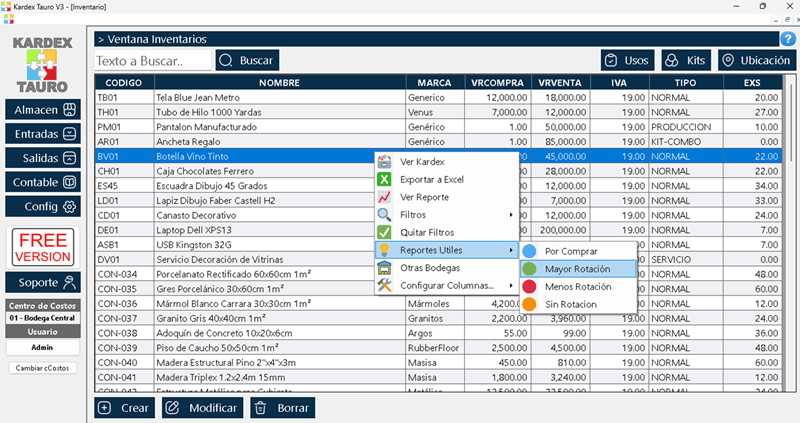
What can be stated without caveats: if every entry carries a date, named accounts, separate debit and credit, a description and support, bookkeeping stops being a month-end chore and becomes the tool for knowing what happened in the business. An inventory and invoicing system that produces those entries at the moment of the event, such as Kardex Tauro, saves the reconstruction, but it does not fix wrong judgment: that is still the job of whoever decides which account applies.