Signed for the Delivery Without Looking Inside? Verify Every Shipment Against Your Purchase Order

Signed for the Delivery Without Looking Inside? Verify Every Shipment Against Your Purchase Order
The supplier's truck has just pulled up to your door. The warehouse assistant unloads the boxes, stacks them next to the counter, signs the delivery note without counting anything and puts the goods away. Two weeks later, when someone opens a box to sell, they find fewer units than the invoice says, a different model, or damaged merchandise. By then the invoice has been paid, the return window has closed, and the only answer the supplier offers is a shrug.
That scene is not a rare case: it is the daily routine of thousands of small businesses that receive goods on trust, without checking. Receiving is the most neglected moment of the purchasing cycle and one of the most expensive, because it packs into a few minutes the mistakes you pay for over the following weeks: shortages, overages, wrong products and damage nobody claimed in time. The good news is that receiving properly does not require expensive technology or more staff: it requires a method. And that method fits in one sentence: always verify what arrives against the purchase order and the supplier's invoice, before putting goods away and before signing anything.
Receiving is the only moment when your inventory tells the truth
Once the goods are on the shelf, every discrepancy becomes hard to explain. If 94 units arrive but the system records 100 because nobody counted, the shortage does not disappear: it turns into a chronic imbalance later blamed on poorly recorded sales, theft or dispatch errors. Receiving is the only point in the cycle where you can compare your inventory against documents that do not depend on anyone's memory: the purchase order your business issued and the invoice the supplier wants to collect. After that moment, what the supplier claims to have sent and what actually came through the door never meet again. Receiving without checking is building your inventory on what the seller says, instead of on what you received.
Check against three documents, not against memory
Checking does not mean counting boxes and moving on: a box can be complete and still hold the wrong product. To receive properly you need three documents at hand and you need to know the role each one plays.
| Document | What it validates | What to do if it does not match |
|---|---|---|
| Purchase order | The product, quantity, price and date your business agreed to buy. | It is your backing to claim shortages, reject overages and charge the correct price. |
| Delivery note or dispatch guide | What the supplier claims to have sent on this trip. | Check box by box: if the delivery note says more than arrived, write the difference down before signing. |
| Invoice | The exact amount you are going to be charged. | Never approve an invoice without first checking quantities, prices and products against what was received. |
The golden rule is simple: you pay the invoice against what was received, not against what was billed. And anything not written down at the moment of receiving simply does not exist for the supplier.
The six-step receiving routine
A receiving procedure does not have to be bureaucratic: it just has to be the same every time. Repeat these six steps on every delivery and your storeroom will stop accumulating surprises.
- Count the packages before unloading. Compare the number of physical boxes, parcels or packages with what the delivery note states. If they do not match, write it down immediately and do not carry on as if nothing happened.
- Match every product against the purchase order. Do not rely on generic descriptions: compare codes, references and pack sizes with what you actually ordered.
- Verify the quantities. Open the boxes and count. Do not trust the sealed packaging or the famous "it says one hundred on the label": a unit-by-unit count is the only proof that counts.
- Confirm the product is the right one. Check model, colour, size, batch and, when applicable, expiry dates. A wrong reference is discovered today with a minute of checking, or in a month, when the customer returns the purchase.
- Inspect the condition of the goods. Look for crushed packaging, moisture, dents or tears. If you find damage, separate the damaged batch from the good one and take photographs on the spot.
- Record the discrepancies and label what was received. Note shortages, overages and damaged items on a signed receiving report, and label the accepted goods with the date, the purchase order number and the supplier's name before putting them away.
Shortages, overages and damage: record them the same day or never claim them
These three words cover most of the problems of a careless receiving process. A shortage means less arrived than you paid for: it must be written down so it can be deducted from the invoice or replaced. An overage is not a gift: it may be merchandise from another order or another customer, and if you accept it without recording it, your inventory and your accounting will be out of line forever. Damage is money that is already hurt: you must decide on the spot whether to return it, discount it or have it replaced. All three share one rule: they are recorded at the moment of receiving or they are never recorded at all. An email sent three weeks later, with no written backup and no photos, helps nobody.
Signing the delivery note is a statement, not a formality
When you sign a delivery note without writing anything, you are declaring that the goods arrived complete and in good condition. If you find a shortage afterwards, the supplier has a simple answer: you signed. That clean signature makes returns impossible, turns shortages into your own losses and turns damage into merchandise that gets sold off or thrown away. So whenever something does not add up, sign with remarks: write "received short by X units, pending confirmation" or "received with damaged boxes, to be verified". A signature with remarks protects your rights; a clean one hands them to the supplier.
What receiving without control really costs: four silent leaks
- Overpaying: with an average shortage of 3% on five million in monthly purchases, you lose one hundred and fifty thousand every month: almost two million a year. Nobody steals it: it was simply never counted.
- Inflated inventory: the system shows stock that does not exist. The Stock ledger displays units that never came in, and that distorts purchases, sales and month-end closings.
- Impossible returns: damage and errors discovered late can no longer be claimed. The whole business absorbs the cost: damaged merchandise that gets sold off, given away or thrown out.
- Permanent imbalances: the warehouse says one thing, accounting says another and the owner says a third. Every closing becomes an argument, and every argument burns hours nobody gets back.
Kardex Tauro records the inbound movement and compares it with what was ordered
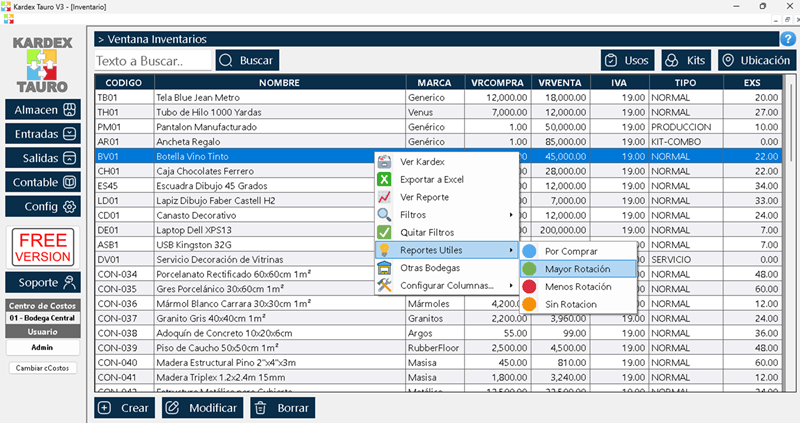
Receiving with a method is easier when the system supports you. Kardex Tauro records the inbound movement the moment the goods are received and automatically compares it against the purchase order: if you ordered 100 units and the actual count was 94, the difference is visible before the goods ever reach the shelf. Every inbound movement stays linked to its supplier, its order number and its date, and stock only grows with verified entries. That means your Stock ledger stops counting what the supplier claims to have sent and starts counting what you actually received and approved. With the receiving history you can also see which suppliers fail the most and negotiate with data instead of impressions.
Conclusion: check before you store, record before you sign
Receiving merchandise without checking is the most silent way to overpay: the money is not lost in a robbery, it is lost in a hurried signature. On your next delivery, apply the full rule: count the packages, check the purchase order, verify quantities and products, inspect for damage, record the differences in writing and label what you received with its date. That is fifteen minutes that save you weeks of claims and imbalances. And if you want those checks recorded and compared automatically against what you ordered, Kardex Tauro is built for exactly that: manage purchases, suppliers and inventory from a single place, with no loose spreadsheets or notebooks. Start today with the next delivery: your bottom line will notice.