How Much Is Shrinkage Costing You? The Damaged Product Nobody Records Is Eating Your Profit
How Much Is Shrinkage Costing You? The Damaged Product Nobody Records Is Eating Your Profit
You found the crushed box behind the shelf two weeks ago. You left it there "to check later," and it is still in the same spot, taking up space and adding units to the inventory you think you have. In another corner there is a jar that expired three months ago, two bottles with broken caps and an opened package that nobody can sell anymore. None of that shows up in your system… until the physical count arrives and you discover that the stock you thought you had does not exist. That difference between what the system says and what is really there is called shrinkage, and in small businesses it silently eats a percentage of the profit every single month. Shrinkage is not a minor issue: it is money you already paid for that disappears without a trace. Every damaged, expired or stolen product is a purchase that will never become a sale. Worse, when shrinkage goes unrecorded, the inventory fills with false data, purchasing decisions are made wrong, and nobody can explain where the shortage comes from. The good news is that it can be controlled with three actions: separate the damaged product, record every write-off with its cause and measure the result. In this article we show you how to do it, step by step.The real cost of damaged product is higher than it looks
When a product gets damaged it does not only lose its purchase value: it also loses the profit it could have earned, the space it occupies and the trust of a customer who might receive it in bad condition. A dented can sold by mistake can turn into a return or the loss of a customer who buys every week, and an expired food item left on the shelf is a health risk that can end in a fine. That is why the first mistake of many small businesses is not having shrinkage: it is letting damaged goods live side by side with sellable stock. These are the symptoms that your business is losing money because of this:- You only discover the damage during the physical count: expired or broken product sits on the shelf for weeks while the system shows it as available.
- You sell damaged product by mistake: the cashier or salesperson grabs whatever is at hand without checking the condition of the package.
- You do not know how much you lose each month: there is no single number measuring the value of what gets damaged, expired or lost.
- You restock without asking why it got damaged: you buy the same product under the same conditions and the shrinkage repeats itself.
First rule: separate damaged goods from sellable stock today
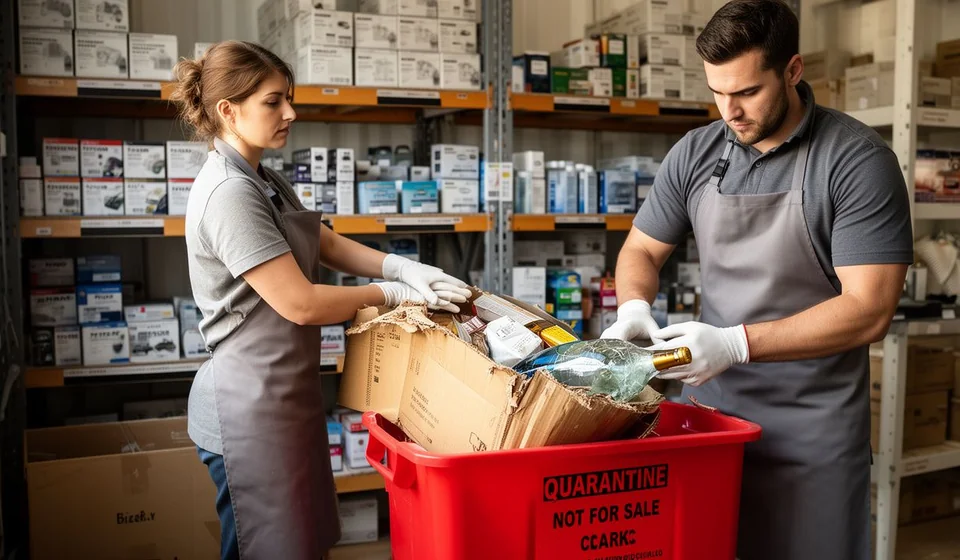
The simplest rule of shrinkage control is also the most effective one: the moment someone detects a damaged, expired, broken or opened product, that product stops being sellable inventory. It does not stay on the shelf, it does not wait for a month-end decision and it does not mix with the good units. To make this happen, your warehouse needs a quarantine zone: a delimited area, marked with a visible sign, where everything that cannot be sold waits for its record and its final disposal. It can be a red box, a low shelf with a label or a separated corner: what matters is that it is a fixed place known by the whole team, and that nobody takes a product out of it to sell it again. The basic procedure for pulling damaged product takes less than five minutes and should be repeated every time someone spots it:- Detect: anyone on the team who finds a damaged, expired, broken or opened product sets it aside immediately, away from the sales or storage area.
- Mark: write the date and the reason for removal on the package or on a label, so the information does not depend on memory.
- Isolate: take the product to the quarantine zone, away from sellable stock, so nobody confuses it or sells it by mistake.
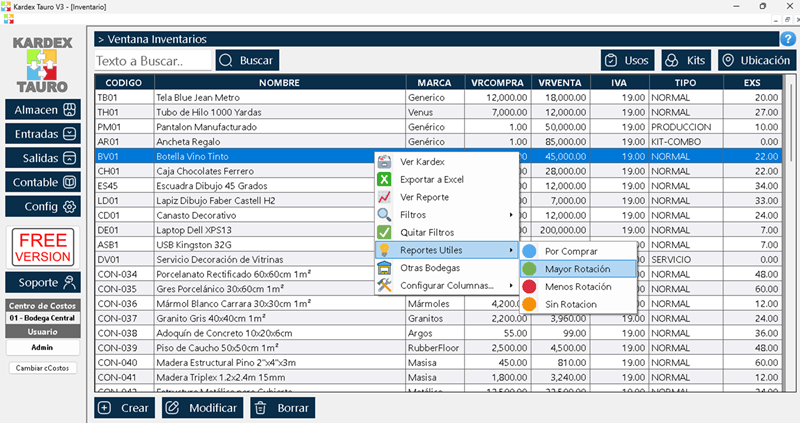
- Record: enter the write-off in the system with its cause, on the same day or at closing time, not weeks later.
- Dispose: decide the final destination: return to the supplier, discard, donate or sell as damaged goods, always outside the active inventory.
Record the write-off with its cause: not all shrinkage is the same
A can that fell from the shelf is not the same as a whole batch that expired, and a shortage caused by theft is not the same as a mistake when recording a sale. Every type of shrinkage has a cause, and the cause is what tells you what to fix. That is why recording every write-off with its cause is not a bureaucratic chore: it is the information that separates an occasional accident from a systematic problem. These are the basic causes your business should be able to identify:| Cause | What it means | Typical example |
|---|---|---|
| Deterioration | The product was damaged by handling, falls or poor storage | Crushed boxes, broken bottles, opened packages in the warehouse |
| Expiration | The product lost its shelf life before being sold | Food, medicine or cosmetics past their date on the shelf |
| Theft | The product left without a recorded sale | Shortages found at the count of high-value items |
| Damage | The product was damaged by external causes beyond control | Goods soaked by leaks, hit during transport |
| Recording error | The shortage comes from a wrongly entered figure | A sale recorded twice or an inbound receipt with the wrong quantity |
Who reports and who approves: clear responsibilities
Shrinkage recording works when everyone knows what their job is. If anyone can write off a product without control, the system fills with duplicate records and write-offs nobody can verify; if nobody has the duty to report, shrinkage goes back into hiding. The minimum assignment of responsibilities is this:- The warehouse keeper or salesperson reports: they are the ones who spot the damaged product and take it to the quarantine zone, and they enter the initial report of the write-off.
- The manager or owner approves: they review the write-off, confirm the cause and approve it in the system before the stock is deducted.
- One responsible person per record: each write-off is linked to the person who reported it and the one who approved it, so there is always someone who can answer for it.
Check your shelves regularly: shrinkage likes to hide
No procedure works if damaged product spends months hidden behind the good units. A regular review of shelves and warehouse is what turns shrinkage control into a routine instead of a month-end surprise. Set a fixed time every week or every two weeks, and go over these points:- Expiration dates: check batch by batch and pull out whatever expires soon, applying the rule that what came in first gets sold first.
- Package condition: look for dents, tears, moisture or open seals at the back of the shelves, not only in the front row.
- Storage conditions: check for leaks, excessive heat, pests or dangerous stacking that could damage the merchandise.
- The quarantine zone: verify that no product has piled up without being recorded and that nobody has taken units out of it to sell.
What is not recorded corrupts your inventory and hides theft
This is the point that costs the most money: unrecorded shrinkage does not disappear, it stays inside your inventory as false data. If the system says you have ten units of a product and six of them are damaged in the warehouse without a write-off, your system keeps telling you that you have ten: with that number you rebuy what you do not need, miscalculate the value of your merchandise and, when the physical count arrives, you cannot tell whether the shortage is damaged product, a recording error or theft. And there is the biggest danger: when nothing is recorded, theft hides among the shrinkage, because the shortage explains itself, mixed in with damage and errors. The only way to tell a real theft from real damage is to record everything, with cause and with a responsible person.Measure your shrinkage: the percentage of sales that tells the truth
Everything above comes down to one number that every business should know: the shrinkage percentage over sales. It is calculated by dividing the value of shrinkage for the period by the sales for the same period and multiplying by one hundred. For example, if in one month your shrinkage added up to 150,000 and your sales were 5,000,000, your shrinkage is 3%. In retail, a healthy percentage is around 1% to 2%; above that, there is a problem eating your profit. Measuring it month after month lets you set a target and check whether your actions are working:- Shrinkage of 1% or less: your control is working; keep the review and recording routine.
- Shrinkage between 1% and 2%: there is room to improve rotation and handling of the merchandise.
- Shrinkage above 2%: review the causes one by one and attack the one with the biggest share of the total value.
Start today: shrinkage is controlled with order, not luck
Controlling shrinkage does not require more technology or more staff: it requires deciding that damaged product is set apart on the same day it is detected, that every write-off is recorded with its cause, and that someone is responsible for reporting and reviewing. With those three habits, your inventory tells the truth again, your purchases become more accurate, and theft loses the hiding place it has always used. Start this week: set up your quarantine zone, assign who reports and record the first write-off with its cause. If you want that control to be automatic and to keep a history, try Kardex Tauro.