What is a cardex?
What is a cardex?
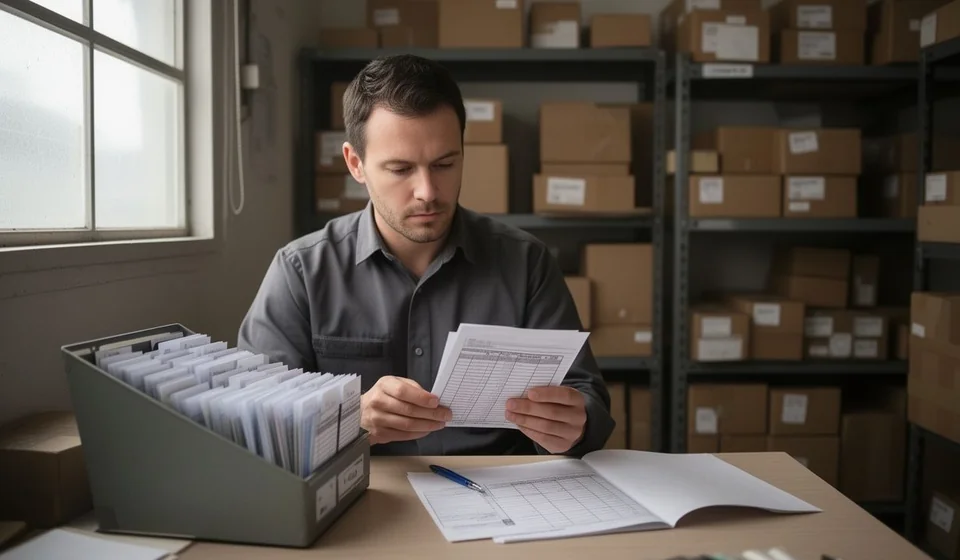
A cardex —also spelled kardex or cárdex— is an individual stock-control record: a card, physical or digital, where the complete history of inbound and outbound movements is kept for a single product. Each item in the warehouse has its own card, and after every movement the cardex shows the remaining balance. It is one of the oldest and most widespread tools in inventory management: it is still used in small warehouses with printed cards and, at the same time, it is the principle behind modern stock-control software.
In this article we explain in detail what a cardex is, how this card system was born, which columns it contains, what it is used for in the warehouse and in accounting, and how the physical card cardex differs from the digital one. We also clear up a very common doubt across Latin America: cardex and kardex are the same tool, only the spelling changes.
The cardex: an individual record per product
In inventory control, the cardex is the record where every stock movement is entered, item by item. A general inventory is a snapshot of the whole warehouse taken at a given moment; the cardex, by contrast, is a living history that is updated with every operation: when goods arrive from a supplier, when an order is sold or shipped, when an item is returned, or when shortages are found during the physical count.
That is why the cardex is not a simple list: it is a control mechanism. Because each product keeps its own card, the warehouse manager can answer in seconds how many units should be on hand, when the last batch arrived, and which supplier it came from. That information is the basis for detecting differences between what is recorded and what is actually on the shelves.
Every cardex card holds at least three types of data:
- Product data: code, description, unit of measure, and location inside the warehouse.
- Movement data: date, type of operation (inbound or outbound), and the number of the supporting document.
- Balance data: units received, units issued, and the resulting stock after each operation.
Where the cardex comes from: from index cards to software
The stock-card system is more than a century old. It began in the English-speaking world as the card index: individual cards filed in drawers and cabinets, so that each card stood for a single product or account. As trade and industry boomed in the first half of the twentieth century, these cards became the standard way of running warehouses, and the term kardex spread across Latin America to name both the filing cabinet and the record itself.
Later, the method moved from paper to spreadsheets and, finally, to inventory management software. The important point is that software did not invent the concept: it digitized it. Today, when a system shows the kardex of a product, it is doing exactly what the storekeeper used to do with a card: sorting the movements chronologically and calculating the balance.
What columns does a cardex have?
Although the design may vary from one company to another, the structure of the cardex has stayed practically the same since its beginnings. These are the typical columns of a cardex card:
| Column | What it records |
|---|---|
| Date | The day on which the inbound or outbound movement takes place. |
| Concept or detail | The description of the operation: purchase, sale, return, adjustment, or transfer. |
| Document no. | The number of the invoice, delivery note, or receipt that supports the movement. |
| Inbound units | The units entering the warehouse in that operation. |
| Outbound units | The units leaving through sales, internal use, or shrinkage. |
| Balance | The stock remaining after adding or subtracting the movement. |
| Remarks | Useful notes: batch number, expiration date, or product location. |
The reading is simple: the balance of the last row is the current stock of the product. If the cardex is properly kept up to date, that figure must match the physical count made in the warehouse; when it does not, the remarks column usually holds the clue about what happened.
What is the cardex used for in the warehouse?
In the day-to-day operation of a storeroom, the cardex performs very concrete functions:
- Knowing how much is available: it answers precisely whether an order can be shipped with the current stock.
- Detecting shortages and surpluses: comparing the recorded balance with the physical count reveals losses, theft, or recording errors.
- Planning purchases: the outbound history shows how fast each item is consumed and helps decide when and how much to reorder.
- Tracing movements: if a product has problems, the cardex shows which supplier and which batch it came from.
- Supporting decisions: it provides organized evidence for audits, claims, and warehouse checks.
A warehouse without a cardex operates blind: it does not know for sure what it has, what it lacks, or how much it should buy. The cardex turns inventory into organized, reliable information.
What is the cardex used for in accounting?
The cardex is not only a warehouse tool: it also feeds the accounting department. Because it records the valued inbound and outbound movements of every item, it supports the calculation of the cost of goods sold and the valuation of the ending inventory for the period. With cardex data, the accounting team can apply valuation methods such as weighted average, FIFO (first in, first out), or LIFO, according to the company's criteria and the rules that apply to it.
The cardex also backs the figures on the financial statements: when the accountant reports the value of the inventory, that value must rest on a physical, documented record for each product. That is why, in many companies, the cardex signed by the storekeeper is part of the supporting documents delivered at the end of each month or during an audit. A good cardex connects the physical world of the warehouse with the financial world of the company.
Physical card cardex vs. digital cardex
It is worth distinguishing the two ways a cardex is kept today:
- Physical card cardex: the traditional system, with printed or pre-printed cards filled in by hand and stored in binders or drawers. It is inexpensive and does not depend on electricity or equipment, and it remains useful in small warehouses with low volumes of movement. Its drawbacks: it is slow to update, wears out with use, and is exposed to calculation errors and loss of information.
- Digital cardex: the electronic version, kept in a spreadsheet or, better, in an inventory system. The record updates in real time, computes balances automatically, avoids arithmetic mistakes, and lets anyone check the history of any product from anywhere. Its drawback is the initial investment and the need for disciplined data entry.
In practice, many companies make the move from paper to a system in stages: first they digitize the active cards, then they stop opening new ones. The underlying goal is the same in both cases: to have a reliable record, organized by product, that tells the truth about the stock. Technology changes the medium, not the method.
Cardex, kardex, or cárdex: is there any difference?
It is one of the most repeated questions in the inventory world, and the answer is short: there is no difference. Cardex and kardex are the same tool; they are spelling variations of a term that arrived from English and was adapted differently in each country. In fact, the Spanish Royal Academy includes the form cárdex, with an accent mark, as a fully Spanish adaptation of the word.
Across Latin America, usage is divided by region and even by company: in Mexico it is common to see kardex, in Colombia and the Andean region cardex is very frequent, and cárdex also appears in formal texts. The important thing is not to get confused: whoever looks for a warehouse kardex is looking for exactly the same thing as whoever looks for a cardex, and any system or provider that speaks of one should work for the other.
Conclusion
The cardex is, in essence, the memory of each product in your warehouse: the record that tells you how much came in, how much went out, how much remains, and where each batch came from. Whether on physical cards or in a digital system, keeping an up-to-date cardex is one of the most effective practices for protecting inventory, buying better, and delivering reliable information to the accounting department.