What does kardex mean?
What does kardex mean?
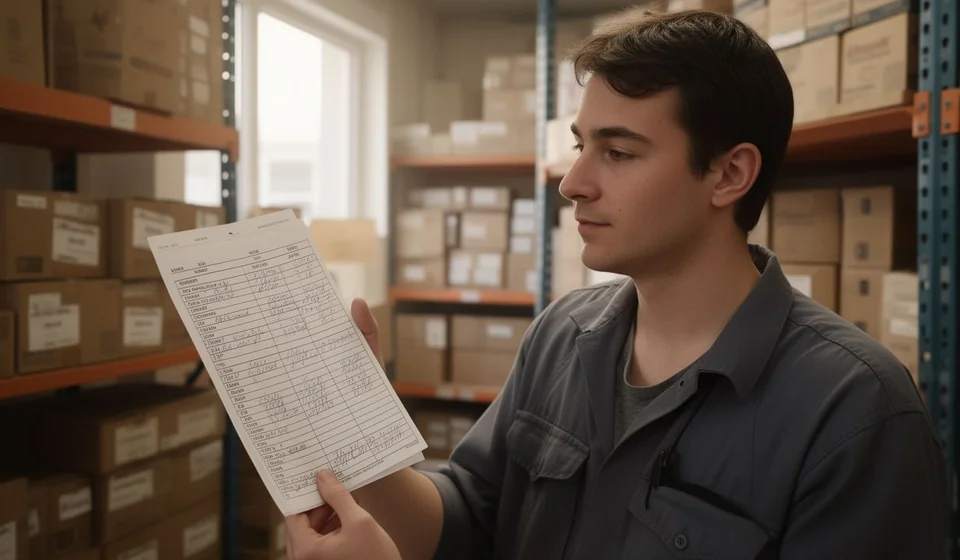
Kardex means, in plain words, a record or stock control card. In the daily routine of a warehouse, a storeroom or a retail business, the kardex is the document —first on paper, today usually in a spreadsheet or a software program— where all the incoming and outgoing movements of each product are recorded, so you can always know how many units you have, what the items that came in cost and what the remaining stock is worth.
People who ask "what does kardex mean?" usually hear the word for the first time in an accounting class, in a management manual or in warehouse work, and notice that everyone uses it as if it were obvious. You already have the short answer: kardex is the stock record of a product. The complete answer —where the word comes from, what it means in inventory management, what it means in accounting and what it does not mean— is what we develop throughout this article.
Word origin: an office story, not an acronym
A widespread belief says that "kardex" is an acronym or an initialism. It is not. The word was not formed by joining the initials of a phrase, as happens with terms like FIFO or VAT. Its origin is more practical and has to do with the history of office filing systems.
At the beginning of the twentieth century, companies in the United States began replacing bound ledger books with loose-card systems —the well-known card index—, which made it much faster to sort, consult and update information about customers, accounts and merchandise. That card system became popular under a brand name, Kardex, which became so well known that it ended up being used as a common noun for stock control cards and files, the same way other brand names turn into everyday words. Over time, the word travelled along with manuals, administrative systems and business schools to Latin America, where it settled as the natural term for talking about inventory records.
So there is no hidden Latin or Greek root to look for: kardex is a word of commercial origin and widespread use, closely related to the idea of a control card or index card. That is why it is sometimes written as "kárdex", with an accent, although the most frequent spelling in programs and documents is "kardex". Either way, it always refers to the same thing: orderly control of what comes in and what goes out.
What does kardex mean in inventory management?
In the inventory context, the kardex is the individual record or card of a product. The idea is that every item in the warehouse has its own kardex, as if it were its personal file: every operation that affects it is recorded there, and the final balance must always match the physical units sitting on the shelf.
A classic inventory kardex organises the information in columns:
- Date of each movement.
- Concept or detail: purchase, sale, return, adjustment, shrinkage or transfer.
- Receipts: the units that come in, usually through purchases or customer returns.
- Issues: the units that go out through sales, internal use, damage or shrinkage.
- Balance or stock on hand: the result left after each movement.
With that structure, keeping the kardex up to date answers in seconds the three basic questions of any business: how much I have, how much I am missing and how much I should order. If the kardex says there are 12 units of a product and the physical count finds 9, something is going on —a recording error, a loss or shrinkage— and it is worth investigating as soon as possible.
The kardex can be kept on a cardboard card, in a notebook, in an Excel sheet or inside an inventory program: the format changes, but the logic is the same. In fact, most modern inventory management systems are, at heart, electronic kardex records: they log every receipt and every issue and calculate the balance automatically, with the advantage of doing it for hundreds or thousands of products at once and updating the cost and value of the merchandise in real time.
What does kardex mean in accounting?
In accounting, the kardex adds another layer of meaning: it controls not only quantities but also values and costs. Receipts and issues are recorded at their cost, which makes it possible to value the inventory and to know how much of the company's money is tied up in merchandise.
To assign a cost to outgoing units, accounting uses inventory valuation methods, and the kardex is where they are applied. The most common ones are:
- Weighted average: each issue is valued at the average cost of the stock on hand. It is the most widely used method in retail trade.
- FIFO (first in, first out): issues are valued at the cost of the oldest merchandise, a logical criterion for perishable or seasonal products.
- LIFO (last in, first out): issues are valued at the cost of the most recent purchases. It is less common in Latin American practice.
Thanks to the kardex, the accountant can know not only how many units remain but also how much those units are worth and what the cost of goods sold was in a given period. That information feeds the financial statements: the balance sheet, in the inventory or stock account, and the income statement, in the cost of sales. It is also the basis for calculating income taxes and for supporting filings with tax authorities.
So when a company says it "keeps its kardex up to date", it is not talking about an administrative luxury: it is talking about a control that protects the most important asset of a trading business —its merchandise— and that keeps the books backed by a detailed, verifiable record of every movement.
A quick table: kardex by context
| Term | Context | Meaning |
|---|---|---|
| Kardex | Warehouse or storeroom | Record of receipts, issues and balance for each product. |
| Kardex | Accounting | Physical, valued record used to calculate costs, value the inventory and support the financial statements. |
| Kardex | Purchasing and sales | History showing how much was bought, how much was sold and how much is left to order. |
| Kárdex / kardex | Common spelling | Spelling variants of the same word; "kardex" is the most common. |
What kardex does NOT mean (and other common misunderstandings)
Part of the confusion around the word comes from what people believe it means when it actually does not. It is worth clarifying:
- It is not an acronym. As we saw, its letters do not hide any phrase: it is a word derived from the card index control systems used in the offices of the last century.
- It is not a specific piece of software. There are programs called "kardex" and kardex modules inside accounting systems, but the word names the record and the method, not a brand or a particular product. A kardex can be a cardboard card, an Excel file or a screen inside a system.
- It is not a tax or a tax procedure. The kardex helps with tax filing because it supports the cost of merchandise, but it is not a tax, nor a form, nor a document filed with the tax authority.
- It is not a mandatory accounting book in every country. Some legislations require it as an accounting auxiliary and others do not; but beyond the legal obligation, it is a universal good practice for safeguarding inventory.
- It is not an invoice or a sales document. The invoice records a transaction with a customer; the kardex records the effect of that transaction on stock. They are different, complementary documents.
Understanding what kardex is not helps you understand what it is: an orderly, reliable record that turns inventory into useful information for making decisions.
Why is the word kardex so widely used in Latin American trade?
Anyone who travels across Spanish-speaking countries notices that kardex is an everyday word in commerce, accounting and technical education, while other regions prefer "inventory record", "stock card" or "stores ledger". That Latin American popularity has several explanations.
The first is historical: card control systems reached Latin American companies in the first half of the twentieth century, when large trading houses, drugstores, hardware stores and warehouses adopted the card method to organise their merchandise, and the name came along with the method. The second is educational: for decades, technical careers in accounting, administration and commerce have taught the kardex as a basic tool, and generations of students learned it as the first step towards understanding inventories. The third is practical: in a region of small and medium-sized family businesses, where merchandise is often the main asset, the kardex turned out to be a cheap, simple and effective tool that anyone could keep with a notebook and a pencil.
That tradition is still alive. Millions of Latin American businesses still keep their kardex records on printed sheets or in Excel, and little by little they migrate to specialised programs that do the same job with fewer errors. The word stayed; what changes is the medium: from paper it moved to the spreadsheet and from there to management systems, but the core idea of the kardex —recording every receipt and every issue so you always know how much you have— remains intact.
Conclusion: the kardex is still the heart of inventory control
Answering "what does kardex mean?" is, at bottom, explaining the oldest and most current tool of stock control: a record of receipts and issues per product that, in accounting, also becomes the basis for valuing merchandise and calculating costs. It does not matter whether it is kept on cardboard cards, in a spreadsheet or on a system screen: whoever keeps their kardex up to date knows how much they have, what it is worth and how much they need to order.
If you want to put all this into practice without relying on notebooks or Excel formulas, at Kardex Tauro you will find an ally to digitise your business's stock control and keep every product recorded with its receipts, issues and balances up to date.