Kardex system: what it is and types
Kardex system: what it is and types
If your business handles inventory, you have probably heard the word kardex before. And you may also have wondered: what exactly is the kardex system, how does it work, and what types exist? It is one of the oldest inventory control methods and, at the same time, one of the most current: it began with cardboard cards and today lives in inventory software that updates in real time. Understanding it well helps you decide how to keep control of your warehouse, store, or company. In this article we explain what the kardex system is, how it differs from periodic inventory, how it works in practice, the types that exist by format (physical, electronic, or software) and by valuation method (weighted average, FIFO, and LIFO), and how to choose the right option for your business. At the end you will find a comparison table of valuation methods so you can see all the information at a glance.What is the kardex system
The kardex system is an inventory control method that records every incoming and outgoing movement of merchandise in a detailed, permanent way. The word kardex comes from the English expression "card index" and refers to the cards on which the movement of each product was originally recorded by hand: how many units came in, how many went out, and how many remained. Its defining feature is that inventory information never goes stale. Every purchase is recorded as an entry, every sale as an exit, and after each movement the available balance and its value are updated. That is why the kardex belongs to the perpetual inventory system: at any moment you can know how much stock you have of an item and what it is worth, without physically counting the warehouse. That is precisely the difference from periodic inventory. Under the periodic system, movements are not recorded one by one: the company does a physical count at the end of the period (monthly, quarterly, or yearly) and calculates the cost of goods sold by difference between beginning inventory, purchases, and ending inventory. Between counts, the business operates blind: it does not know for sure how much it has or how much it has lost to shrinkage, theft, or recording errors. The kardex solves that problem, because accounting records and actual stock stay aligned almost in real time.How the kardex system works
The logic of the kardex system is simple, but it demands consistency. Each product has its own card or record, and every movement that affects it is logged there. When merchandise arrives, the entry is recorded with its quantity and cost; when it leaves through a sale or internal use, the exit is recorded; and the balance is recalculated immediately. The card always reflects the latest situation of the item. A complete kardex record must include at least the following data:- Product identification: code, name, reference, unit of measure, and location inside the warehouse.
- Date and movement type: when the operation happened and whether it was an entry, an exit, a return, or an adjustment.
- Supporting document: invoice, delivery note, purchase order, or waybill number that justifies the movement.
- Entries (in): quantity and unit cost of the merchandise coming in.
- Exits (out): quantity and unit cost of the merchandise going out.
- Balance: available stock and its total value after each movement.
- Real-time control: you always know how much you have of each product and when it is time to reorder.
- Fewer losses: differences between the theoretical balance and a physical count reveal shrinkage, theft, or errors before they grow.
- Reliable financial information: inventory is one of the most important assets of a commercial business, and the kardex lets you value it correctly.
- Better purchasing decisions: histories show which products move fast and which have been sitting for months.
Types of kardex by format
Over time, the kardex system has taken three main forms. The most suitable one depends on business size, transaction volume, and available budget.Physical kardex or kardex card
This is the original version: cardboard cards kept in a file, where every movement of the product is written by hand. It was the standard for most of the twentieth century and is still used in very small businesses with few references. Its advantages are near-zero cost and simplicity, but it has serious limits: it is slow, prone to handwriting and arithmetic errors, hard to consult as the number of products grows, and vulnerable to loss or damage of the physical file.Electronic kardex or spreadsheet kardex
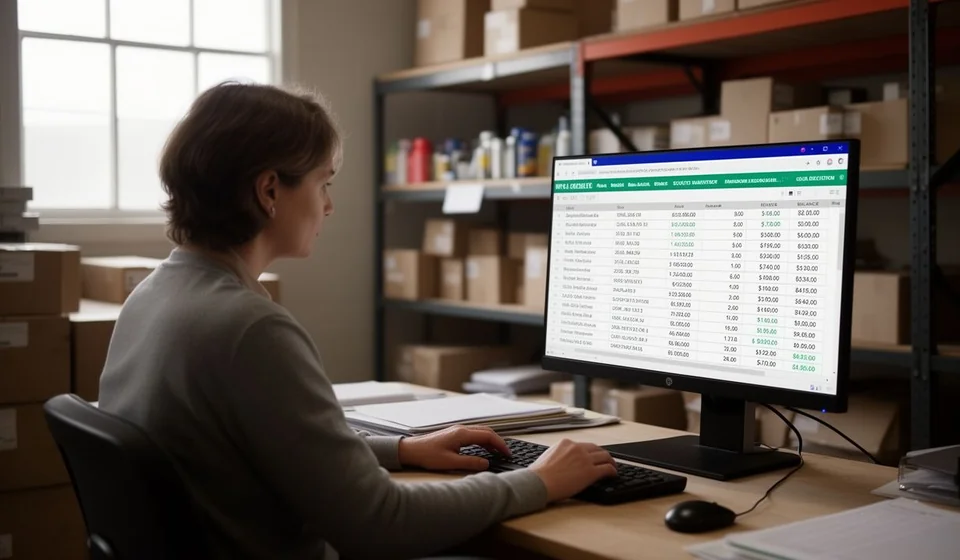
This means keeping the same record, but in a spreadsheet such as Excel or Google Sheets. Each product can have its own sheet or tab, with formulas that automatically update the balance as entries and exits are typed in. It is a major improvement over paper cards: calculations are faster, arithmetic errors drop, and reports are easier to build. However, it depends on someone keeping the file current, and it usually breaks down with multiple users, hundreds of references, or when the information must be integrated with invoicing and accounting.Kardex in inventory software
This is the most advanced option: an inventory management program that automates the kardex completely. When a sale, purchase, or adjustment is registered, the system updates stock, costs, and balances by itself, and the full history of any product can be reviewed in seconds. It also integrates inventory control with invoicing, purchasing, reporting, and low-stock alerts. For businesses with heavy transaction volume, several locations, or large teams, software is not a luxury; it is a necessity.Types of kardex by valuation method
Because the kardex also records the value of merchandise, each system adopts an inventory valuation method to assign cost to exits. The three most widely used methods in the world are weighted average, FIFO, and LIFO. Choosing one or another changes the cost of goods sold, the value of ending inventory, and therefore the profit the business reports.Weighted average cost
This method computes an average unit cost that is updated after each purchase. It divides the total value of the merchandise available by the total units available, and all exits are valued at that average cost until the next purchase. Short example: you buy 10 units at $100 and then 10 units at $120. The average cost is $110 per unit: (10 × $100 + 10 × $120) ÷ 20. If you sell 5 units, that sale costs 5 × $110 = $550, regardless of which physical lot went out first.FIFO: first in, first out
The FIFO method assumes that the first units to enter the warehouse are the first to leave. Exits are valued at the cost of the oldest lots, while ending inventory is valued at the most recent costs. Short example: you buy 10 units at $100 and then 10 units at $120. If you sell 12 units, the first 10 go out at $100 and the remaining 2 at $120: the cost of the sale is 10 × $100 + 2 × $120 = $1,240.LIFO: last in, first out
The LIFO method assumes the opposite: the last units to enter are the first to leave. Exits are valued at the most recent costs, while ending inventory is valued at the oldest costs. Short example: with the same purchases of 10 units at $100 and 10 units at $120, if you sell 12 units, the first 10 go out at $120 and the remaining 2 at $100: the cost of the sale is 10 × $120 + 2 × $100 = $1,400. It is worth noting that LIFO is not allowed under International Financial Reporting Standards (IFRS) in most countries, so its practical use is essentially limited to the United States, where local rules do accept it.Valuation methods comparison table
So the difference between methods is clear at a glance, here is the comparison of the three:| Method | How it works | When to use it |
|---|---|---|
| Weighted average | Averages the cost of all available units; every exit is valued at the updated average cost after each purchase. | When prices are stable or there are many low-value purchases; it is the simplest method and the favorite of most small and medium businesses. |
| FIFO | First units in are the first out; exits use the cost of the oldest lot. | When products spoil or expire (food, fashion, medicine) and when you want ending inventory to reflect current costs. |
| LIFO | Last units in are the first out; exits use the cost of the newest lot. | Mainly in countries where it is legal and inflation is high, to reduce taxable profit; not valid under IFRS. |