History of accounting
History of accounting
Every time a business records a sale, keeps track of its warehouse or calculates how much it earned in the month, it is applying, without knowing it, a practice with more than five thousand years of history. Accounting was not born with computers or modern taxes: it was born with trade itself, when human beings understood that producing and exchanging goods is not enough, and that someone has to keep count of what you own, what you deliver and what you receive. Knowing the history of accounting helps you understand why account books, inventories and financial records look the way they do today, and why they are still the heart of any business. In this article we walk through the accounting timeline: from the clay tablets of Mesopotamia and the papyri of Egypt, through Rome's income and expense books and the single-entry method of the Middle Ages, to the milestone that changed everything: the double-entry bookkeeping that Friar Luca Pacioli spread in 1494. We close the journey with the Industrial Revolution, the 20th century and today's digital accounting. If you are looking for information about accounting in Mesopotamia, accounting in Egypt, accounting during the Industrial Revolution or about Luca Pacioli, here you will find all the answers in one place.When did accounting begin?
Accounting predates money and is almost as old as writing. In the first farming communities, wealth was measured in grain, heads of cattle and cloth, and someone had to know how much was harvested, how much was set aside for sowing, how much was consumed and how much was traded. That need for control gave rise to the earliest recording systems known. Before written numbers existed as we know them, people counted with objects: stones, knots on ropes and small clay tokens. Each token represented one unit of a good and made it possible to preserve the memory of a transaction. When those tokens began to be pressed onto clay tablets, records stopped being a simple memory aid and became documents with evidentiary value.Mesopotamia: the first records on clay tablets
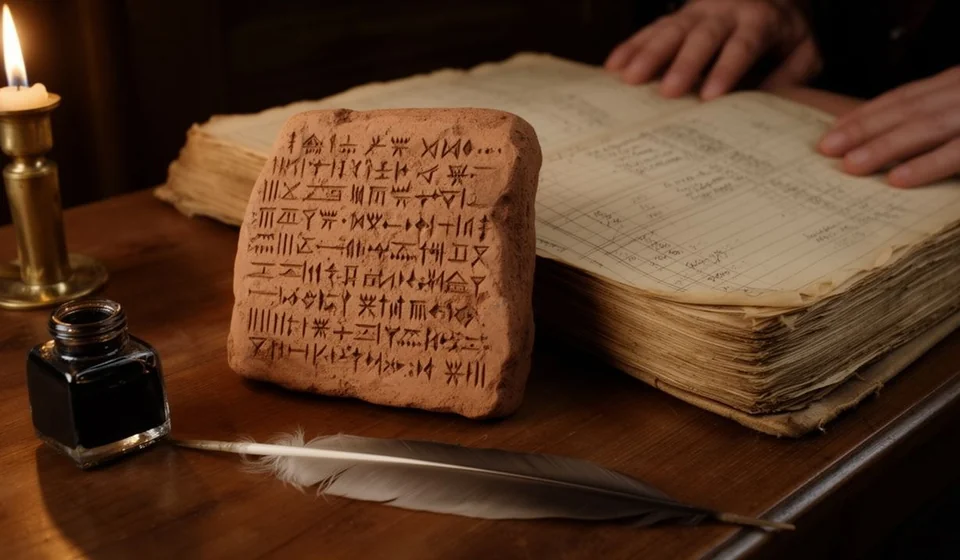
The documented history of accounting begins in Mesopotamia, the region between the Tigris and Euphrates rivers where civilizations such as Sumer, Akkad and Babylon flourished. More than five thousand years ago, the temples and palaces of that region already kept detailed accounts of grain, livestock, oil, wool and metals. Scribes recorded the inflows and outflows of the temple storehouses, the wages paid to workers and the offerings received. The medium was the clay tablet: a piece of wet clay written on with a stylus and then left to dry or baked to preserve it. Thousands of those tablets have survived to this day and show records that are, in essence, inventories and accounts: quantities of barley, herds, rations and tributes. In a barter economy where grain worked as a measure of value, keeping an exact count of what was stored was not a luxury: it was a condition for the community to survive.Egypt: scribes, papyri and the pharaoh's granaries
In ancient Egypt, accounting reached an impressive level of organization, driven by an economy centralized around the pharaoh and his temples. The scribes, highly respected officials who mastered writing and calculation, kept the records of the royal granaries: how much grain came in after the harvest, how much was distributed as rations among the workers and how much was reserved for years of scarcity. The Egyptians also recorded taxes, tributes and inventories of land, livestock and temple property. Their main medium was papyrus, a sheet made from a plant of the same name, far lighter and more practical than clay. Thanks to those papyri, we know that thousands of years ago clearly defined accounting roles already existed: someone who recorded, someone who safeguarded the goods and someone who answered to the state.Greece and Rome: the seed of account books
In Greece, the city-states developed the administration of public funds: magistrates had to record the revenues and expenses of the treasury and answer for them before the assembly. It was not yet a formal accounting system, but it planted an essential idea: whoever handles other people's resources must be able to prove, with records, where they were spent. Rome took that idea further and created structures that already resemble today's books. The head of the household had to keep a codex, or account book, noting the income and expenses of the home; one of those records, the codex accepti et expensi, is considered a direct ancestor of accounting books. In addition, Roman officials accounted for public funds, and censors periodically reviewed the property declarations of citizens for census and tax purposes. Accounting stopped being a private matter and became a tool of state control.The Middle Ages and single-entry bookkeeping
After the fall of the Roman Empire, long-distance trade declined and the economy once again revolved around land and manors. Monasteries and feudal estates kept simple records of harvests, rents and expenses. During that period single-entry bookkeeping prevailed: each transaction was recorded once, as a loose entry in a book, without the double recording that would become widespread later. It was enough to run an estate, but not for the commerce that was beginning to revive. From the 11th century onward, the growth of cities and trade fairs revived exchanges, and the Italian merchant republics, such as Venice, Genoa and Florence, became the financial center of Europe. Merchants needed more reliable methods for recording credits, debts, partnerships and profits. It was in that environment that double-entry bookkeeping matured in practice: Italian merchants were already using it in the 14th century, before anyone published it in a book.Luca Pacioli and double-entry bookkeeping (1494)
The name that links the history of accounting with mathematics is Friar Luca Pacioli, a Franciscan friar and Italian professor born in the 15th century. In 1494 he published in Venice his work Summa de Arithmetica, Geometria, Proportioni et Proportionalita, a mathematics treatise that included a section devoted to accounting. That chapter, known as De Computis et Scripturis, describes in detail the Venetian method of keeping books and is considered the founding text of modern accounting. Pacioli did not invent double entry: what he did was to systematize and spread in writing a practice that merchants already applied. His achievement was enormous, because he turned scattered, oral knowledge into a method that was explained, ordered and teachable. That is why he is considered the father of modern accounting, and why 1494 is remembered as the key year of its history. Among his contributions are rules that are still valid today:- Every transaction has at least two effects and must be recorded twice: once on the debit side and once on the credit side.
- Total debits must always equal total credits, which makes it possible to verify that the books are in order.
- Whoever starts a business must begin by preparing a detailed inventory of their assets, debts and rights.
- It is advisable to keep several complementary books: the memoriale or draft, the giornale or journal and the quaderno or ledger, direct ancestors of the books still used in accounting practice.
The Industrial Revolution: cost accounting is born
Between the mid-18th century and the 19th century, the Industrial Revolution transformed production. Factories replaced artisan workshops, large companies with many owners appeared, and management separated from ownership: owners provided the capital, but it was the managers who ran the business day to day. That separation created a new need: reporting clearly to partners and investors about how the business was going. In the factory, moreover, recording purchases and sales was no longer enough: someone had to know how much it cost to produce each unit. Cost accounting was born from that need, the branch that calculates the value of materials, labor and manufacturing overhead. The Industrial Revolution also encouraged the emergence of the first auditors and of periodic financial reports, and it consolidated accounting as a profession with its own method.The 20th century: standards, taxes and computers
In the 20th century, accounting matured as a science and as a regulated profession. Companies grew into corporations with thousands of shareholders, states created modern income and sales taxes, and to make information comparable and reliable, accounting principles and standards emerged: common rules that indicate how to recognize revenue, value inventory or present financial statements. Professional associations and standard-setting bodies were organized across countries, and auditing became mandatory for many companies. Technology also changed the way accountants work. In the first half of the century, typewriters, mechanical calculators and punched cards were used; in the second half, computers arrived, first processing payrolls and accounts receivable in large data centers and then, with personal computers and spreadsheets, putting accounting within reach of any business. Manual books began to coexist with accounting systems, automated charts of accounts and integrated inventory and invoicing modules.Accounting in the digital age
Today, accounting is experiencing its fastest transformation. Cloud accounting software makes it possible to record a sale, update the inventory and reflect the operation in the books almost instantly, from anywhere and on any device. Electronic invoicing has become mandatory in many countries, tax authorities receive information directly from business systems, and tasks that used to take days, such as reconciling accounts or closing the month, are now resolved in minutes with the help of automation. The 21st-century accountant has stopped being the person who only fills out forms and has become an analyst who interprets data and advises decisions. But it is worth remembering: no matter how advanced the software, the same principles Pacioli described in 1494 still work beneath every report. Technology changed the media, from clay tablet to papyrus and from paper to the cloud, but the essence of accounting remains the same: recording, controlling and being accountable.Accounting timeline
| Period | Main contribution | Key figure or group |
|---|---|---|
| Mesopotamia (around 3000 BC) | Earliest records on clay tablets: grain, livestock and tributes | Sumerian scribes |
| Ancient Egypt | Records on papyrus of granaries, taxes and inventories | Egyptian scribes |
| Greece and Rome | Income and expense books and public accountability | Roman magistrates, censors and administrators |
| Middle Ages | Single-entry bookkeeping in monasteries and estates; revival of trade | Merchants of Venice, Genoa and Florence |
| Renaissance (1494) | Systematization and spread of double-entry bookkeeping | Friar Luca Pacioli |
| Industrial Revolution (18th and 19th centuries) | Cost accounting, reports to investors and auditing | Industrial managers and engineers and accountants |
| 20th century | Accounting standards, modern taxes and the first computers | Professional associations and standard-setting bodies |
| Digital age | Accounting software, cloud, electronic invoicing and real-time data | Accountants and software developers |
Frequently asked questions about the history of accounting
- What is the origin of accounting? Accounting was born with trade and agriculture more than five thousand years ago, when the first civilizations of Mesopotamia began recording their harvests, livestock and tributes on clay tablets. Egypt, Greece and Rome developed it with increasingly organized records until account books were reached.
- Who is the father of accounting? Friar Luca Pacioli, the Italian mathematician who in 1494 published in his Summa de Arithmetica the first printed description of double-entry bookkeeping, is considered the father of modern accounting. He did not invent it, but he systematized it and spread it across Europe.
- When was double-entry bookkeeping invented? Double entry was already used in practice among Italian merchants in the 14th century. The historical milestone that made it famous is its publication by Luca Pacioli in 1494, when it was documented in writing and could be taught throughout Europe.
- What is cost accounting? It is the branch of accounting that calculates how much it costs to produce a good or provide a service, considering materials, labor and manufacturing overhead. It gained strength during the Industrial Revolution, when factories needed to know the real cost of each product.
- How did the computer change accounting? Computers automated repetitive tasks such as payroll and subsidiary ledgers; then accounting software and spreadsheets arrived, and today the cloud makes it possible to record transactions and update inventories in real time, with electronic invoicing connected directly to tax authorities.