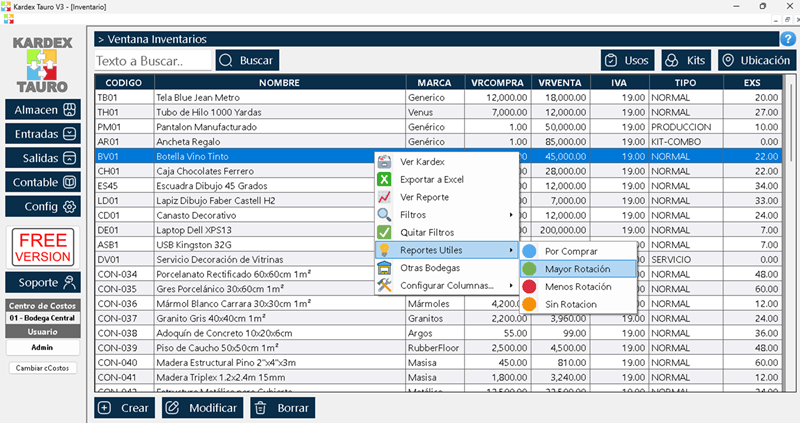
Automatic and real-time inventory

Automatic and real-time inventory
For most businesses, taking inventory still means the same thing it meant thirty years ago: counting. Counting boxes, jars, units and spare parts, writing the quantities down on a sheet or in a spreadsheet, and hoping nobody makes a mistake along the way. That method works until the business grows, products multiply, and a single day of sales turns the numbers into a puzzle. Automatic inventory and real-time inventory exist precisely to solve that problem: so that stock levels update themselves at the exact moment each movement happens, without relying on permanent manual counts. This article explains what an automatic inventory is, how it works, what it means for it to be in real time, which technologies make it possible, what its real benefits are for a business, and how to take the first steps toward automating it.What is an automatic inventory?
An automatic inventory is a stock control system that updates itself with every recorded movement: each sale, purchase, return, internal consumption or adjustment changes the product balance immediately, without anyone having to count it again or write it down by hand afterwards. Instead of trusting memory or paper ledgers, the business trusts a simple rule: everything that comes in adds up and everything that goes out subtracts, and the system does that math in seconds. It is also worth clarifying what it is not. Automating inventory does not eliminate physical counting entirely: a periodic physical count is still useful to confirm that what the system says matches what is actually on the shelves. What changes is the starting point: daily record keeping no longer depends on someone remembering to log each movement, because the system itself does it the moment the movement happens. The electronic stock card (stock ledger) of every product stays up to date and ready to consult.How does an automatic inventory work?
It works like a permanent scale for your stock: every operation automatically triggers the stock update by itself.- A sale: when the sold product is registered, the system deducts that quantity from stock in the same instant.
- A purchase or restock: when merchandise arrives and the inbound movement is logged, the balance goes up immediately.
- A return: a product that comes back is added to the available stock once again.
- Consumption, shrinkage or an adjustment: any outbound movement that is not a sale is also deducted and documented.
What is real-time inventory and why does it matter?
An automatic inventory records movements without manual intervention; a real-time inventory shows the result of those movements instantly. They are two sides of the same coin. When the two come together, the business has an up-to-date picture of its stock at any moment of the day: there is no need to wait for a count, a closing or a report that someone has to put together by hand. Having real-time inventory matters because selling and buying decisions are made with up-to-date information:- Sellers know on the spot whether there is stock to promise or whether it is better to offer an alternative.
- Buyers spot products that are out of stock or about to run out and replenish before sales are lost.
- Differences between what is recorded and what actually exists show up early, making it possible to investigate theft, loss or errors in time.
What technologies make automatic inventory possible?
Automating does not require a warehouse full of robots. Today the pieces you need are accessible and affordable, and they combine like this:- Inventory software: the heart of the system. It stores the stock card (stock ledger) of every product, applies the inbound-minus-outbound formula, and generates low-stock alerts and movement reports. It can run in the cloud or on the business's own equipment.
- Barcodes: a unique, printed identifier for each product. They are the key that tells the system which item is being moved, avoiding handwritten names or codes.
- Barcode scanners: devices that read the code in an instant and send the data to the software. Wired and wireless models exist, and they are used both at the point of sale and in the storeroom.
- Mobile apps: with a phone or a tablet you can scan, check stock, receive merchandise or log outbound movements from anywhere in the store, without expensive equipment.
- Integration with invoicing: when a sale is invoiced, inventory is deducted automatically. It is the most practical way to make sure that no movement goes unrecorded.
Benefits of an automatic, real-time inventory
- No more mismatches caused by forgetfulness: because every movement is recorded the moment it happens, the balances that do not add up because nobody logged a sale or an outbound movement disappear.
- Up-to-date information for selling and buying: knowing what you have, what is missing and what is running low allows you to serve customers better and replenish on time, without overbuying or running short.
- Less shrinkage and loss: catching the differences between records and reality quickly makes it easier to identify theft, damage or mistakes before they become large losses.
- Less time spent counting: your team stops spending hours on permanent counts and can focus on selling, dispatching and serving.
- Better customer service: answering with certainty whether an item is in stock, how many units are left and when more will arrive builds trust and avoids promising what cannot be delivered.
- Decisions backed by data: with turnover reports, slow-moving products and low-stock alerts, purchases and promotions are planned with information instead of gut feeling.
Manual inventory vs. automatic inventory
The difference between the two methods shows up in everyday operations:| Aspect | Manual inventory | Automatic inventory |
|---|---|---|
| Recording movements | Written by hand, often hours or days later, if it is written at all | Recorded immediately, with date, quantity and source document |
| Balance updates | Require counting and reconciling | Recalculated automatically with every inbound or outbound movement |
| Risk of error | High: forgotten entries, illegible handwriting, bad sums | Low: the system does the math |
| Team time | Hours spent counting and transcribing | Minutes spent scanning and checking |
| Stock visibility | Only after a count or a closing | At any time, from any device |
| Shrinkage detection | Late, often after months | Early: differences stand out in the reports |
Myths about automatic inventory
Some businesses still avoid automation because they repeat beliefs that are no longer true. The most common ones are these:- "It is only for large companies": false. A small shop, a hardware store or a small warehouse loses as much or more to mismatches as a large company, and today there are simple, affordable solutions designed precisely for small and medium businesses.
- "Implementing it is expensive and complicated": the investment can start with affordable software and a scanner, or even with your own phone; implementation can be done in stages, product by product, without stopping operations.
- "I need very advanced technology": with a printed barcode and an app that reads it with the phone camera you already achieve a large part of automation. Complexity grows only if the business grows.
- "If it does not add up, it is the system's fault": the system reflects what is recorded; that is why success depends as much on the team's habit of logging every movement as on the software you choose.
Steps to automate your inventory
- Organize your catalog: define the list of products you handle and give each one a unique code.
- Label your merchandise: print barcodes and place them on the products or on their locations, so that anyone can identify them without hesitation.
- Choose inventory software: look for one that fits your type of business, lets you record inbound and outbound movements, check stock from your phone and warn you when a product is about to run out.
- Enter a real opening balance: do a starting physical count and load it into the system so that your first reports are already reliable.
- Train your team: establish that every sale, purchase or outbound movement is logged immediately, and make the scanner or the app part of the daily routine.
- Review and validate with cycle counts: compare the system against the shelves from time to time, product by product, to correct small differences before they pile up.