Inventory software: how to choose the best

Inventory software: how to choose the best
For many small and medium-sized businesses, inventory control still depends on a notebook, on spreadsheets or, at best, on whoever runs the store remembering what is in stock. That method works while the company is small, but a moment arrives when no one knows for certain how many units of each product remain, when it is time to reorder, or which item is actually selling. That is where the need for inventory software appears. Choosing the right system is not trivial either: there are options for every taste and budget, and a poor choice can translate into months of wasted work. This article explains what inventory software is, which features are worth looking for, what benefits it brings to a small business and, above all, which criteria to use to choose the best one for your business.What is inventory software?
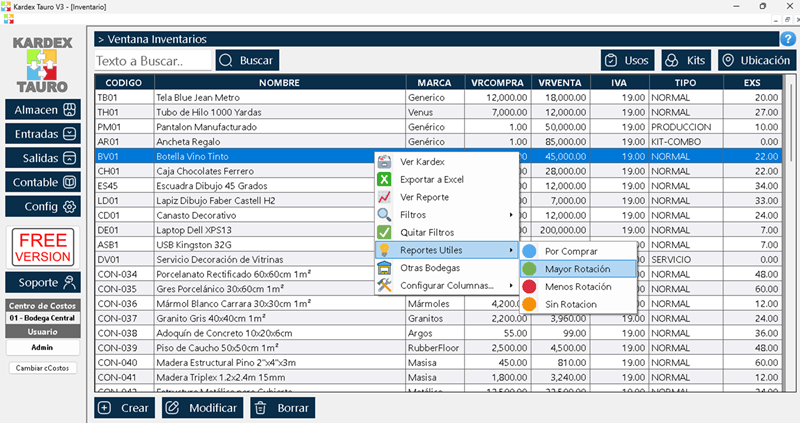
Inventory software — also called an inventory program or inventory system — is a digital tool that lets a business register its products and track their inflows and outflows in an organized way. Instead of writing entries by hand or on a spreadsheet, every movement is recorded in a central database: how much was bought, how much was sold, at what price, on what date and by whom. The heart of these programs is the stock ledger: the historical, valued record of each product's movements. When the software records a sale or a purchase, it automatically updates the stock ledger and, with it, the available balance. That way the business owner always knows how many units are on hand, what they are worth and how stock levels have evolved over time. Inventory systems can be local (installed on a computer) or cloud-based (accessed over the internet from any device). They also vary in scope: there are simple programs designed for a small shop and more complete platforms that integrate sales, invoicing, purchasing and accounting. What matters is that they all share the same purpose: keeping inventory information reliable and always available.Typical features of an inventory system
Although every program is different, a good inventory software package for small businesses usually includes the following features:- Product registration: build a catalog with code, name, description, category, unit of measure and prices for every item.
- Inflow and outflow control: record purchases, sales, returns, shrinkage, adjustments and transfers between warehouses or branches.
- Automatic stock ledger: keep a valued history of movements with balances updated in real time.
- Minimum stock alerts: warn when a product is about to run out so it can be reordered before stock runs dry.
- Reports: understand product turnover, best sellers, slow movers, total inventory value and profitability.
- Barcode support: record inflows and outflows by scanning the product's code with a reader: faster and less error-prone.
- Multi-user access: let several people (sales staff, warehouse keeper, manager) work with different permissions on the same information.
Benefits for a small business: leaving spreadsheets behind
The spreadsheet was a big step forward compared with paper, but it has clear limits once the business grows. With hundreds of product rows, several users and daily sales, the sheet becomes slow, error-prone and hard to maintain. Inventory software solves those problems:- Fewer errors: movements are recorded once and the system calculates balances and values automatically, eliminating typos, broken formulas and overwritten cells.
- Real-time information: the balance updates with every sale, so purchasing decisions are made with today's data rather than last month's.
- Less wasted time: tasks that used to take hours — matching entries, reconciling balances, preparing reports — are done in minutes with a click.
- Less financial loss: knowing what you have and what you lack avoids unnecessary purchases, forgotten expiry dates and stockouts that drive customers away.
- Better internal control: with defined users and permissions it is easier to detect differences, shrinkage or suspicious movements.
Spreadsheets vs specialized software: a comparison
Whether to keep using a spreadsheet or move to a specialized program is one of the most common questions. The answer depends on the size and complexity of the business, but the following comparison helps you decide:| Criterion | Spreadsheet (Excel) | Inventory software |
|---|---|---|
| Product records | Manual, prone to typos | Structured, with codes and categories |
| Balances and stock ledger | Formulas that break or get overwritten | Automatic real-time calculation |
| Multi-user work | Hard: duplicate files and confusing versions | Multiple users with permissions over a single database |
| Barcodes | Not natively supported | Direct scanning |
| Minimum stock alerts | Require rules set up by hand | Automatic notifications |
| Reports | Built by hand, with room for error | Generated instantly |
| Initial cost | Low (generic sheet) | Varies depending on the chosen plan |
| Scalability | Becomes unsustainable as you grow | Grows along with the business |
Criteria for choosing the best inventory software
Choosing the best inventory program does not mean buying the most expensive or the most famous one: it means choosing the one that best fits the reality of your business. Before comparing options, it helps to be clear about these criteria:| Criterion | What to ask yourself | Why it matters |
|---|---|---|
| Business size | How many products and movements do I handle per month? | A program designed for large warehouses will be costly and awkward for a small shop, and a very simple one will fall short if the business grows. |
| Product type | Do I sell items with expiry dates, sizes and colors, or products that need serial numbers? | It determines whether you need batch, expiry, variant or serial tracking. |
| Integrated invoicing | Does the system issue invoices or connect to my current invoicing tool? | It avoids entering each sale twice and keeps the inventory up to date automatically. |
| Price | How much am I willing to pay per month or per year? | The cost must be proportional to what the business can sustain, including renewal, support and updates. |
| Ease of use | Can my team use it without lengthy training? | A complicated system ends up abandoned or misused. |
| Support | What help channels does the provider offer, and during which hours? | When inventory stops because of a problem, fast support is worth more than any extra feature. |
| Online or offline | Do I have reliable internet at the point of sale? | If the connection fails, a system that works offline keeps sales from stalling. |
| Mobile access | Do I need to check or record items from a phone or tablet? | It makes physical counts in the warehouse easier and allows checking balances away from the store. |
Steps to implement an inventory program
Choosing the software is only half the job; implementation decides whether the system is used productively or left behind. These steps increase the odds of success:- Define objectives: decide what you expect to achieve (fewer stockouts, better expiry control, reliable reports) so the system is configured around those goals.
- Clean up the catalog: list every real product, remove duplicates and assign unique codes before loading the data.
- Take an initial physical inventory: count the real stock of each product; the system's opening balance is only reliable if it starts from an actual count.
- Load the information: enter products, opening balances, suppliers and prices, ideally with bulk import templates.
- Set up alerts and permissions: define minimum stock levels, users, roles and who authorizes adjustments or cancellations.
- Train the team: train the people who will record movements; most failures come from lack of use, not from software flaws.
- Run in parallel: operate for a few weeks recording in the system and comparing with the previous control to validate that everything balances.
- Go live and review: start formal operation and audit balances periodically with cycle counts.
