Stock control: what it is and how to apply it

Stock control: what it is and how to apply it
If your business handles physical products, there is one question that comes back again and again: what is actually in the warehouse, how much is it worth and when should we buy more? Answering it with reliable data, instead of estimates or the memory of whoever does the shipping, is exactly what stock control does. In this article we explain what it is, what it is for, why physical stock and recorded stock hardly ever match at first, which methods are most commonly used to control inventory and how all of this fits into a warehouse management system. At the end you will find a table with typical problems and their solutions, plus a worked example of how to calculate the reorder point with concrete numbers that you can adapt to your own business. If you want the short answer: stock control is the set of methods and procedures a company uses to know at all times what goods it has, in what quantity, where in the warehouse they are and how much they are worth. In other words, it is what stops the warehouse from being a black box whose contents are only known when someone takes the trouble to count everything.What is stock control
Stock, also called inventory, is the goods a company holds to sell or to use in its operation: finished merchandise, raw materials, supplies, packaging, spare parts and work in progress. Stock control is the discipline that watches over those goods and makes it possible to answer four basic questions at any moment:- What is there: identify each product in the warehouse, without confusion between similar references or products that were never coded.
- How much is there: know the exact, up-to-date quantity of each reference, not the quantity that is supposed to be there.
- Where it is: know which zone, rack or location holds each product, so it can be found and dispatched in minutes.
- What it is worth: have the monetary value of the inventory, a key figure for financial statements, insurance and purchasing decisions.
Physical stock and recorded stock
To understand stock control you need to distinguish between two realities that coexist in every company. Physical stock is what is really in the warehouse: the units you can touch, count and weigh. Recorded stock is what the documents and systems show: the stock card, invoices, delivery notes and the inventory software. In theory both figures should be identical, but in practice they drift apart for many reasons: deliveries that arrive with fewer units than invoiced and are never claimed, typing errors when recording a sale, damaged or expired merchandise that is thrown away without being written off, theft and internal losses, transfers between branches that are not documented, customer returns that are received but never entered into the system, and misplaced products that look as if they do not exist. When the record says there is stock but the shelf is empty, you have a shortage; when more merchandise appears than was recorded, you have an overage. Both are signs that control is failing. The job of stock control is precisely to close that gap until it is minimal. To achieve that, adjusting the number when a difference is found is not enough: you have to look for the cause. If a product loses units every week, the problem may be in dispatch, in receiving or in handling, and only correcting the balance in the system means covering a hole that will open again.What stock control is for: objectives
A well-applied stock control system pursues very concrete objectives:- Avoid stockouts: running out of a product means lost sales, customers who go to a competitor and rushed purchases at higher prices.
- Avoid overstocks: excess inventory ties up money that could be used elsewhere and increases the risk of obsolescence and expiry.
- Reduce shrinkage and losses: when real balances are known, losses from damage, theft or operational errors can be spotted in time.
- Know the value of the stock: knowing how much money the stored merchandise represents is essential for financial statements, taxes and insurance.
- Make purchasing decisions based on data: with reliable information you can decide when to buy, how much to buy and from which supplier, instead of ordering on gut feeling.
- Improve customer service: delivering orders complete and on time is impossible if you do not know for certain what is available.
Basic stock control methods
There is no single correct method: the choice depends on the size of the business, the type of product and the resources available. These are the basic methods used in almost any company:- Periodic inventory: the merchandise is fully counted on set dates, for example at the close of each month or year. It is simple and cheap to implement, but between counts the company operates without knowing its real balances and any error is discovered late.
- Perpetual inventory: every receipt and every issue is recorded the moment it happens, so the balance in the system reflects the stock at all times. It demands discipline in recording and, in practice, the support of a stock card or inventory software.
- Cycle counting: instead of counting everything at once, part of the warehouse is counted every day or every week, so all products are verified several times a year without stopping operations. It is the ideal complement to perpetual inventory.
- Reorder point: the stock level that, once reached, signals that a new order must be placed with the supplier. It is calculated from daily consumption, lead time and safety stock, as we will see in the example below.
- ABC classification: products are grouped by their importance in value or sales. A items are few but concentrate a large share of the value and demand strict control; B items have medium importance; C items are numerous, low in value and allow simpler control. This concentrates the effort where it has the most impact.
How to calculate the reorder point: a practical example
The reorder point answers a simple question: at exactly what moment should I order merchandise from the supplier so that it arrives before the stock runs out? The basic formula is: Reorder point = daily consumption × lead time in days + safety stock Let us work through an example with round numbers so the calculation is clear. Suppose a business sells 20 units of a product per day. Its supplier takes 15 days to deliver an order, and the company wants to keep a safety stock of 100 units to cover supplier delays or unexpected demand peaks.- Calculate consumption during the lead time: 20 units per day × 15 days = 300 units.
- Add the safety stock: 300 + 100 = 400 units.
What warehouse management is and how it relates
Warehouse management is the set of operational activities that organize the physical movement of merchandise inside the premises. If stock control is the information layer, warehouse management is the execution layer: it defines how each product is received, where it is stored and how it is dispatched. When both work in a coordinated way, you have a complete warehouse management system. There are four basic processes:- Receiving: when the merchandise arrives it is checked against the purchase order and the supplier's delivery note: quantities, references and the condition of the products are verified before accepting it, and the receipt is recorded.
- Putaway and location: each product is assigned a fixed, coded place inside the warehouse (zone, aisle, rack, position), so that anyone can find it without searching.
- Storage: products are kept organized, labelled and protected, and inventory rotation is applied, for example first in, first out, when there are expiry dates.
- Dispatch: orders are prepared by picking the merchandise from its location, quantities are verified and the issue is recorded so that the balance in the system stays up to date.
Tools for stock control
To put control into practice you need some kind of recording tool. The options range from the simplest to the most sophisticated:- Stock card (stock ledger): the individual record for each product, where receipts, issues and the balance are noted together with the date and value of each movement. It can be a physical card or a digital record, and it remains the conceptual basis of almost every inventory system.
- Spreadsheets: a well-designed sheet with balance formulas is a valid starting point for small businesses. Its limits appear with volume: typing errors, duplicate files and the difficulty of having several people work on the same file.
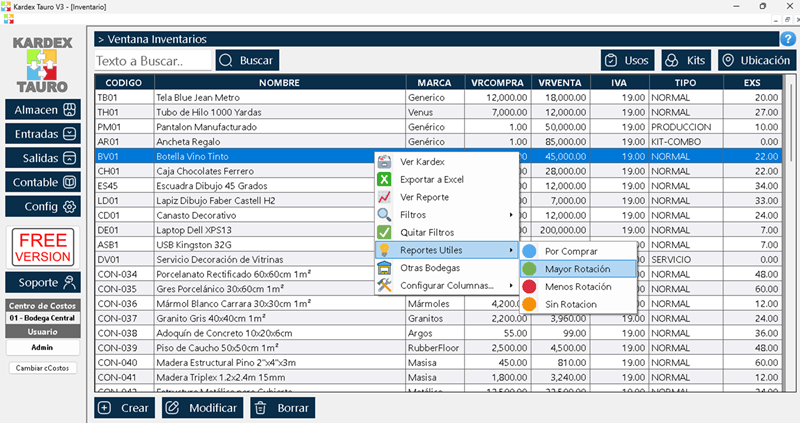
- Inventory software: it automates the recording of receipts and issues, integrates sales and purchases, calculates the value of the stock, alerts when the reorder point is reached and generates reports on rotation and differences. It is the recommended option when there are many products, several people involved or more than one branch.
Common problems, control methods and results
To close, here is a table summarizing the most frequent problems with their control method and the expected result:| Problem | Control method | Result |
|---|---|---|
| Nobody knows how much merchandise is in the warehouse | Perpetual inventory with cycle counting | Up-to-date balances and differences detected in time |
| Best-selling products run out | Reorder point with safety stock | Timely orders and fewer lost sales |
| Money tied up in products that do not move | ABC classification and rotation review | Purchases adjusted to real demand |
| Shrinkage and differences with no explanation | Periodic physical counts compared with records | Visible losses and correctable causes |
| Misplaced products and delays in dispatch | Warehouse management with fixed locations | Merchandise found in minutes and orders on time |
Stock control is not a luxury reserved for large companies: it is a necessity for any business that handles inventory, no matter how small. Getting started does not require big investments: you just need to define the products, record receipts and issues consistently, apply a simple method such as the reorder point, keep the warehouse tidy and review the numbers with periodic counts. Over time, those habits become valuable information for buying better, serving customers better and knowing the real value of the business. And when volume grows, a system that records every movement automatically will do the work for you: tools like Kardex Tauro are designed to turn stock control from a headache into a competitive advantage.
