LIFO Inventory Card (Last In, First Out)

LIFO Inventory Card (Last In, First Out)
If you run a small business with inventory, you have probably heard the terms LIFO, FIFO, or "average cost" when people talk about inventory cards, also known as kardex (stock ledger). They are not magic formulas: they are methods that answer one concrete question: when goods leave the warehouse through a sale or internal use, which price should be used to value them? In this article we explain in a practical way what the LIFO method is, how it is recorded on an inventory card, how to calculate it with a real numeric example, and what advantages and disadvantages it brings to a small company.
What is the LIFO method?
LIFO stands for "last in, first out." The method assumes that the most recently received units are the first ones to leave when a sale, a consumption, or any other outflow of goods is recorded. In Spanish-speaking countries it is known as UEPS (últimas en entrar, primeras en salir).
LIFO does not tell you how to physically arrange your warehouse: a company can deliver its oldest stock to customers, the goods sitting at the front of the shelf, and still value its outflows with this method. It is a costing convention, not a storage rule: it charges outflows with the cost of the most recent purchases and leaves the ending inventory valued at the cost of the oldest purchases.
LIFO becomes relevant in times of inflation: because the most recent purchases tend to be the most expensive, the cost of sales rises, accounting profit shrinks, and, where regulation allows it, the tax burden decreases. That apparent advantage, however, requires reviewing its effects before adopting the method.
What is an inventory card and how is LIFO applied to it?
An inventory card (stock ledger) is the chronological record of every movement of a product: each receipt, such as purchases, customer returns, or count surpluses, and each issue, such as sales, shrinkage, or internal use. It records quantities, values, and the balance remaining after each movement. In simple words, it is the life story of your inventory.
To apply LIFO, the card must separate goods into layers or purchase lots. Every time goods arrive at a different cost, a new layer opens. When an outflow happens, the most recent layers are consumed first and only then the older ones. If the sale is smaller than the newest layer, that quantity is deducted and the rest of the layer stays available for the next movement.
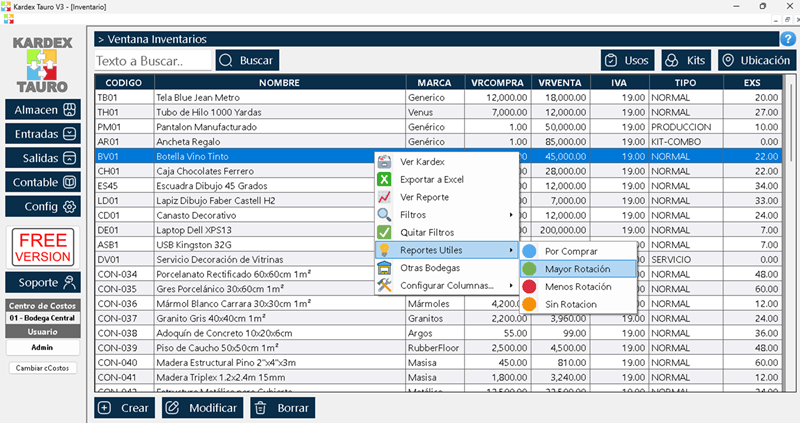
Keeping that control on paper or in a spreadsheet is fragile: one badly added row or one mistyped quantity breaks the balances and costs no longer match. That is why small warehouses usually rely on inventory software. Kardex Tauro, for example, is a system built in Colombia for companies with up to 50 employees: it records each purchase and immediately generates the inventory card movement for the product, with its updated balance and cost.
Practical example: LIFO inventory card step by step
Let us imagine a warehouse that sells a single product and works with Colombian pesos; to keep things simple, we leave out VAT and other taxes. During January, the following movements were recorded:
Table 1. Product movements during January
| Date | Movement | Receipts | Unit cost | Issues | Balance in units |
|---|---|---|---|---|---|
| Jan 4 | Purchase lot 1 | 100 | $10,000 | – | 100 |
| Jan 10 | Purchase lot 2 | 100 | $12,000 | – | 200 |
| Jan 15 | Sale | – | – | 120 | 80 |
| Jan 20 | Purchase lot 3 | 80 | $13,000 | – | 160 |
| Jan 28 | Sale | – | – | 100 | 60 |
Let us see how the two sales are valued under LIFO. On January 15, 120 units leave. The most recent ones come from lot 2, purchased at $12,000: the 100 units of that lot are taken in full, and the remaining 20 units are deducted from lot 1, which cost $10,000. The cost of the sale is therefore 100 × $12,000 + 20 × $10,000 = $1,400,000.
On January 28, 100 units leave. The most recent layer is lot 3, at $13,000, with 80 units, which is consumed in full; the 20 missing units come out of lot 1, at $10,000. The cost of this sale is 80 × $13,000 + 20 × $10,000 = $1,240,000.
At the end of the month, the total cost of sales was $2,640,000 and the ending inventory held 60 units from lot 1 at $10,000 each, that is, $600,000. Notice the key detail: under LIFO, ending inventory keeps the oldest costs, which in times of inflation are the lowest, so it ends up undervalued compared with the market; that difference shows up on the balance sheet.
LIFO, FIFO, and average cost: differences at a glance
Let us compare LIFO with FIFO (first in, first out) and with the weighted average cost, the method most small companies prefer because of its simplicity:
Table 2. Comparison of valuation methods
| Criterion | LIFO | FIFO | Average cost |
|---|---|---|---|
| Outflows are valued using | the most recent costs | the oldest costs | a weighted average cost |
| Ending inventory holds | the oldest costs | the most recent costs | the average cost |
| In times of inflation, cost of sales is | high and profit lower | low and profit higher | in between |
| Reflection of the real physical flow | may drift from actual rotation | close to the usual flow | does not track lots |
| Recording complexity | high: requires layer control | medium | low |
With the data from our example, under FIFO the cost of sales would have been lower and the ending inventory would have been worth more; with average cost, the result would have fallen somewhere in between. Choosing a method is not a minor formality: it changes reported profit, inventory value, taxes, and the information banks and investors receive.
Advantages and disadvantages of LIFO
Advantages:
- In inflationary contexts, the cost of sales gets closer to the current replacement cost, because outflows are valued with the most recent purchases.
- It can defer taxes in jurisdictions where tax regulation allows it, by reducing accounting profit.
- It is reasonable for non-perishable goods, such as spare parts, tools, or raw materials that do not lose value over time.
- By matching revenue with costs from the same period, it shows more realistic margins in economies with volatile prices.
Disadvantages:
- Ending inventory stays valued at old costs, possibly far below its replacement value.
- It demands rigorous lot or layer control; without a disciplined inventory card, mistakes multiply.
- It can drift away from the real physical flow of the warehouse when the oldest goods are the ones dispatched first.
- In several countries LIFO is not accepted under IFRS for accounting purposes, and many tax laws do not admit it for income tax reporting either; its use depends on each country's regulation.
Does LIFO make sense for a small company?
The answer depends on the country, the type of product, and how prices behave. For a small shop or distributor, LIFO is usually more of a headache than a benefit: it demands very strict layer-by-layer record keeping and, in most markets, it is not accepted for accounting or tax purposes. FIFO and average cost are simpler, more widely accepted, and give the owner useful information for decision making.
More important than the method chosen is the quality of the record keeping. No method works if the inventory card is out of date, if purchases are recorded late, or if balances do not match what is physically on the shelf. Daily recording discipline is the real foundation of inventory control.
Conclusion
LIFO is a valuation method with a clear logic: the most recent purchases fund the first outflows. Understanding it helps you read financial statements, talk to your accountant, and decide with good judgment, even if you never apply it in your own business. For most small companies, average cost or FIFO turns out more practical and less risky.
If you run a small warehouse or store in Colombia, you do not need endless spreadsheets to keep your inventory card up to date. Kardex Tauro, built for companies with up to 50 employees, records each purchase and automatically generates the corresponding inventory card movement, updating balances and the product's average cost. Request a demo, bring order to your inventory, and make decisions with reliable information: your accountant and your wallet will thank you.