How to Know Which Products Are Missing from Inventory

How to Know Which Products Are Missing from Inventory
There is a scene that repeats itself far more often than it should in small businesses: a salesperson checks how many units of a product are available, the system answers that there are fifteen, and yet, when they walk to the shelf, the space is empty or barely three units remain. That gap between what the records say and what is actually in the store is a stock shortage, and as long as it goes undetected, the business loses money in silence, day after day.
Figuring out which products are missing is not a task reserved for large corporations or logistics experts. It is a simple management habit: compare the stock the system reports with the figure from a physical count, and review every difference before it becomes a bigger problem. This article explains how to do it step by step, which causes are the most common, what consequences ignoring them brings, and how to prevent them in a small company.
What a stock shortage is and why it appears
A shortage is the negative difference between the stock the software records for a product and the quantity actually found in the warehouse or at the point of sale. If the system shows twenty units of an item and the count finds fourteen, there is a shortage of six units, regardless of whether that merchandise was sold without being recorded, lost, or damaged.
Shortages almost never have a single explanation. In a small company, the most common causes are:
- Unrecorded sales: the merchandise is handed to the customer, but the sale is never invoiced or entered, so the system never deducts those units from stock.
- Theft and losses: external or internal theft takes merchandise out of the store without leaving a trace in the records.
- Unrecorded shrinkage: products that break, expire, spill, or get damaged and are thrown away without noting the event. Loose units that pile up over time.
- Shipping errors: when preparing an order, more units than invoiced are delivered, or a different product from the one the customer paid for.
- Receiving and return errors: less merchandise arrives than the supplier's invoice states, or customer returns are accepted but never added back into inventory.
Identifying the cause matters, because each origin is fixed in a different way: an unrecorded sale is solved with invoicing discipline; a shipping error, with controls when preparing orders; shrinkage, with timely adjustment records.
Step by step: how to detect the products that are missing
First: do a reliable physical count. There is no need to count the entire business in a single day. You can move forward by sections or by product categories, during low-traffic hours, using a printed or digital form where each person writes down the real quantity they see. Whenever possible, the count should be done by someone other than the person who authorizes merchandise withdrawals, so errors do not repeat out of habit.
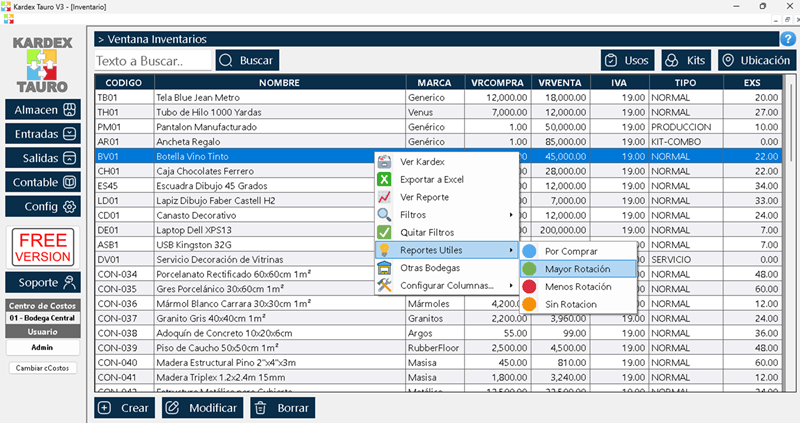
Second: compare the count against the stock in the system. In Kardex Tauro, the stock ledger is the stock reference for each product: every entry and exit of each item is recorded there. When the count is finished, compare the physical figure with the stock the system reports and write down the difference, product by product. A table like the following helps you visualize shortages and their likely cause:
| Product | Stock per system | Physical count | Shortage | Likely cause |
|---|---|---|---|---|
| Rice per pound | 25 | 21 | 4 | Unrecorded sales |
| Vegetable oil 500 ml | 12 | 9 | 3 | Unrecorded shrinkage |
| Bar soap | 18 | 15 | 3 | Shipping error |
| Whole milk | 10 | 7 | 3 | Theft or loss |
Third: investigate each difference before adjusting. It is worth reviewing the period's documents: sales invoices, delivery notes, return notes, and shrinkage records. Often the shortage appears because a sale was delivered but never invoiced, because an order was shipped with extra units, or because an adjustment was left pending. Only when no reasonable explanation is found should the difference be treated as a loss.
Fourth: record the difference immediately. In Kardex Tauro, negative differences from counts are recorded as shrinkage, so the stock ledger is adjusted and the information reflects the reality of the business again. Leaving the difference "for later" only guarantees that the next count carries the same error and that the figures lose credibility.
Fifth: look for patterns. If a product is short month after month, or shortages are concentrated in one section, one shift, or one specific salesperson, it is no longer a coincidence: there is a structural cause to address, such as a weak shipping procedure, a warehouse without access control, or a promotion that was carried out without invoicing.
What happens when shortages are not detected in time
The first risk is the most obvious: selling what you do not have. If the system says a product exists but it is physically not there, the business accepts orders it cannot fulfill, the customer waits for a delivery that is delayed or cancelled, and trust built over months is damaged in a single purchase. What is more, the rush to "find" the merchandise at the last minute usually ends in costly purchases or substitutions the customer never asked for.
The second risk is the accounting imbalance. When actual stock does not match the recorded stock, the cost of sales is calculated incorrectly, the inventory value on financial statements is not reliable, and the cash register does not match the movements. Small discrepancies pile up until they become large differences that no one can explain.
The third risk is poorly calculated purchasing. With wrong data you buy too much, freezing cash in merchandise that does not turn over, or you buy too little, and empty shelves become permanent exactly in your fastest-moving products.
And the fourth, perhaps the most costly, is the silent loss of profitability. Every unit that leaves the business without being invoiced, recorded, or adjusted is money lost forever. It does not appear in any report, it is not reflected in the cash register, and no one notices it, but month after month it reduces the business's real profit.
How to prevent shortages in day-to-day operations
Preventing is cheaper than correcting, and in inventory management prevention is built with simple but consistent habits:
- Invoice and record every sale. In Kardex Tauro, the sales invoice deducts stock and generates the product's stock ledger automatically, so the system always reflects what goes out the door. Off-the-books sales or merchandise handed out "as a favor" without invoicing are the first seed of a shortage.
- Schedule cycle counts. Instead of waiting for the year-end full inventory, count one section every week or every two weeks. A short, frequent count finds problems while they are still small.
- Record shrinkage right away. Every breakage, expiration, or damage is noted the same day, with its cause and its person in charge, so the system stock never claims more than what actually exists.
- Verify shipments and receipts. The person preparing an order counts against the delivery note before handing it over, and the person receiving merchandise checks it against the supplier's invoice. A second person reviewing brings errors down to almost zero.
- Limit access and assign responsibility. Not everyone needs to enter the warehouse. With controlled access, assigned keys, and a clear person in charge per area, any loss is located quickly.
- Reconcile often and analyze causes. Comparing the stock ledger against physical stock periodically, keeping a record of the shortages found, and always asking why they happened allows you to fix processes, not just replace units.
No business eliminates shortages completely: there will always be a product that gets damaged, a human error, or an unforeseen event. The difference lies between companies that detect them within days, because they count frequently and compare against a reliable system, and those that discover them months later, when the loss is already large and no one remembers what happened. With a disciplined count, with every operation recorded, and with the stock ledger up to date as the stock reference, knowing which products are missing stops being a mystery and becomes an everyday decision: the decision not to let inventory lie.