What Is the Replenishment Level?

What Is the Replenishment Level?
The replenishment level is the number of units of a product that should be on hand in your inventory so you know exactly when to place a new order with your supplier. In plain words, it is the stock figure that, once reached, tells you it is time to buy again, because if you wait longer, the product may run out before the merchandise arrives. There is no single level for the whole business: each item has its own, calculated from three figures that every small company already has: how many units you sell per day, how long the supplier takes to deliver, and how much extra stock you want to keep as protection.
This figure is key to inventory control because it turns into an objective decision something many owners solve by gut feeling: should I buy now or wait another week? If inventory falls below the replenishment level, the business loses sales for lack of product; if it stays far above it, cash sits idle in the warehouse. The level marks the middle ground: the stock with which you can still sell normally while the supplier prepares and delivers the new order.
What is the replenishment level for?
Knowing the replenishment level of each product answers the questions that repeat every day in a small business: when do I buy? Can I wait, or is it time to order? Am I buying too much or too little? Once the number is calculated, the answers stop depending on memory or intuition. Specifically, it lets you:
- Avoid running out of product: you order while there is still stock to sell, not when the shelf is already empty.
- Avoid tying up extra money: if stock is well above the level, the order can wait without risk.
- Order early the items from slow suppliers: the longer the delivery time, the higher the level must be.
- Plan several purchases at once: by spotting which products are close to their level, you can consolidate orders and make better use of each buying trip.
Replenishment level, reorder point and safety stock: don't confuse them
In everyday business language, replenishment level and reorder point are used as synonyms, and it is not unusual for two shops to call the same number by different names. The difference lies more in the function than in the calculation. The reorder point works as the buying signal: the number of units in stock that, once reached, triggers the order to the supplier. It answers the question "when should I buy?".
The replenishment level, on the other hand, is the level of stock the business wants to restore so it feels covered: it covers the demand that will occur while the order arrives and adds a margin against delays or busier-than-expected weeks. Besides marking when to buy, it helps decide how much to order: if the policy is to replenish up to a maximum level per product, the order quantity comes from subtracting current stock from that maximum level. Safety stock, meanwhile, is the cushion: the lowest quantity that should never be reached under normal conditions.
The following table summarizes the most practical differences:
| Concept | Question it answers | Main use |
|---|---|---|
| Replenishment level | What stock level should I restore to operate safely? | Set the stock target and decide how much to order to get back to it |
| Reorder point | When should I place the purchase order? | Compare against current stock to know whether to buy today |
| Safety stock | How much stock protects me from delays and surprises? | Cushion that prevents stockouts while the order arrives |
How to calculate the replenishment level
The formula is simple and is applied product by product:
Replenishment level = (average daily demand × replenishment days) + safety stock
Each component means the following:
- Average daily demand: the units sold on a typical day; it is obtained by dividing the issues of a period, for example a quarter, by the days in that period.
- Replenishment days: the time the supplier takes from the moment the order is placed until the merchandise is ready for sale, including delivery and the time to receive and shelve the product.
- Safety stock: the extra units that cover supplier delays, incomplete orders or weeks with higher-than-expected sales.
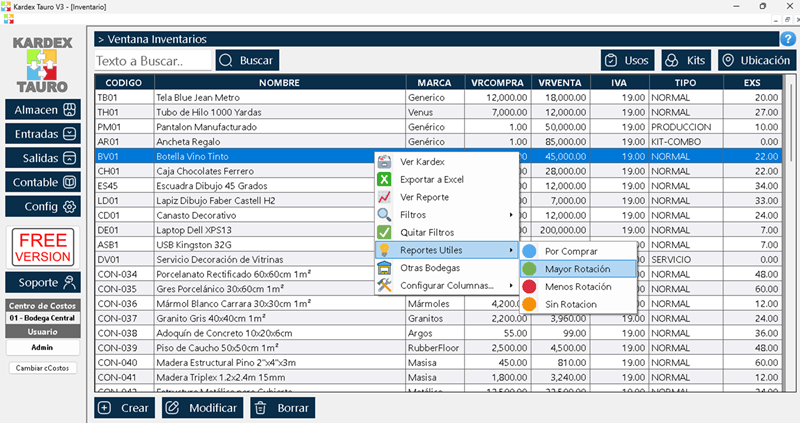
Demand is the most valuable figure when it comes from a real record. This is where the stock movement history of the stock ledger comes in: the stock card of each product keeps every receipt and issue with its date, and from it you can calculate how many units go out per day on average, without relying on what the owner remembers. Recording those operations in a program like Kardex Tauro makes the job easier: each issue is noted when the sale or consumption is recorded, and afterwards you only need to review the item's historical movements to obtain the real demand of the last few months.
Worked example: calculating the replenishment level
Let us run the calculation with three products from a grocery store. Cooking oil sells an average of 12 units per day; the supplier takes 5 days to deliver, and the store keeps a safety stock of 20 units. The replenishment level is (12 × 5) + 20 = 80 units: when the oil's stock card shows 80 units or less, it is time to order. The same procedure applies to the other products:
| Product | Daily demand | Replenishment days | Safety stock | Replenishment level |
|---|---|---|---|---|
| Cooking oil 1 L | 12 units | 5 days | 20 units | 80 units |
| Laundry detergent 1 kg | 8 units | 7 days | 15 units | 71 units |
| Canned tuna 170 g | 15 units | 4 days | 10 units | 70 units |
Notice the detergent: it sells less than the tuna, but its level is similar because the supplier takes almost twice as long to deliver. That is the value of the formula: it is not about buying when you "feel" stock is low, but about letting each variable do its job. The formula can be repeated for the whole catalog, starting with the fastest-moving items or the ones that represent the most money. Over time, levels are adjusted: if the supplier improves its deliveries or the product sells more, the level drops or rises with those changes.
How to use the replenishment level to know when to buy
Having the number calculated is useless if you do not use it. The rule is simple: review the stock of each product on a fixed schedule and compare it with its replenishment level. If current stock is equal to or lower than the level, place the order; if it is above, wait. To put it into practice:
- Check the product's current balance in the stock ledger, after recording the day's sales and receipts.
- Compare it with its replenishment level: if the balance is at or below the level, the item enters the buying zone.
- Decide how many units to order according to your policy: a fixed lot agreed with the supplier, or the quantity that returns inventory to its maximum level.
- Record the merchandise when it arrives as an entry in the stock ledger, and the review cycle starts again.
If the business cannot check the warehouse every day, do it weekly: with the week's sales recorded, identify the products that ended at or below their level and place a single order with everything needed. What matters is that the review relies on the real balances of the stock ledger, not on what the shelf "looks like" it has.
Common mistakes when setting the replenishment level
- Estimating demand from assumptions: using a rough "I sell about ten a day" instead of reviewing the real issues in the stock ledger leads to wrong levels; the movement history is the correct source.
- Applying one level to the whole warehouse: this leaves fast-moving products unprotected and slow movers overstocked; the level is calculated per item.
- Never updating the levels: demand changes with seasons and suppliers change their lead times; review them at least every quarter.
- Confusing the level with the order quantity: the level says when to buy; how many units to order depends on the lot, the available space and the agreement with the supplier.
- Ignoring the real delivery time: if the supplier said five days but takes ten, a level calculated with five will leave the shelf empty; use real lead times plus some margin.
The replenishment level is one of the simplest and most useful figures in inventory management: with three data points that any business already knows, it turns merchandise purchasing into an orderly decision. To make it work you need a calculation based on real demand and a periodic review of balances. The stock ledger history — the one built by recording every movement in Kardex Tauro — is the starting point for both: it keeps the evidence of how much is sold, how much comes in and how much remains, and with it any small business can set its levels, buy at the right moment, and protect both its sales and its cash.
