How to control spare parts inventory

How to control spare parts inventory
In an auto repair shop or an auto parts store, inventory does not look like the inventory of an ordinary retail business: a parts business can easily handle more than a thousand references, from filters and bearings to brake pads and countless small parts that arrive in nearly identical boxes. With so many products sharing the same shelves, records and reality drift apart quickly: the system says there are five brake pad sets, but the bin only holds two. Controlling that inventory is what separates a business that serves its customers well from one that loses sales because of misplaced or poorly recorded parts.
The good news is that control does not require magic, just a clear code for every part, an orderly record of everything that comes in and goes out, and the discipline to review stock levels regularly.
Why spare parts are so hard to control
If you have already tried keeping control with notebooks or loose spreadsheets, you have surely recognized some of these symptoms:
- Many similar references: a 6203 bearing and a 6204 bearing look almost the same but are not interchangeable: a one-digit difference can end up as the wrong part handed to a customer.
- Fit by vehicle and brand: one part may fit several models, and the same model may use different versions depending on the year or the engine. Without that information on record, every inquiry depends on someone's memory.
- Small parts: bolts, washers and seals lose their labels, get mixed in the same drawer and no one knows what is inside.
- Very different turnover rates: some parts sell several times a week and others wait for months on the shelf.
- Constant receipts and issues: every purchase, sale or installation is a movement that must be recorded the same day.
When these symptoms pile up, the result is money tied up in parts that cannot be found, duplicate purchases and stockouts exactly when the customer needs the part most. The solution starts by giving every part a unique identity and a fixed place.
Code every part with a reference and a group
Every spare parts inventory control system starts with the code. Each part must have a unique reference that distinguishes it from any other, no matter how similar. A good approach is to combine a family prefix with a sequential number: FIL for filters, ROD for bearings, PAST for brake pads, COR for belts, BUJ for spark plugs. That way, FIL-001 is always the same product and nobody has to describe it fully to order it.
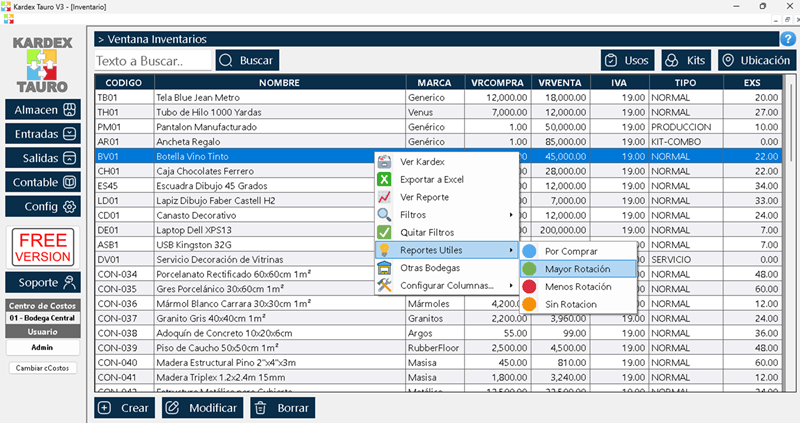
The code alone is not enough: each part must also belong to a group so it can be queried and counted easily. Kardex Tauro lets you create each product with its code and its group, so the record is ready from day one. That is how parallel inventories, where each employee keeps notes their own way, disappear.
A basic part record captures at least these fields, which then show up in the inventory table:
| Reference | Description | Fits | Location | Stock |
|---|---|---|---|---|
| FIL-001 | Oil filter | 1.6 and 1.8 gasoline cars | A-03 | 24 |
| PAST-118 | Front brake pad set | Light pickups and SUVs, 2015 model onward | B-01 | 9 |
| ROD-6203 | 6203 deep groove ball bearing | Electric motors and water pumps | C-02 | 31 |
| COR-090 | Timing belt | 1.4 to 1.6 engines per manufacturer spec | A-05 | 4 |
| BUJ-NGK | Spark plug | 1.6 and 2.0 gasoline engines | C-01 | 40 |
Look at the Fits field: it records which vehicles, brands or engines the part serves, using information validated with the supplier or the manufacturer's spec sheet. That compatibility is recorded manually for each product; no system figures it out on its own. But once it is documented, anyone on the team can answer with confidence.
Organize the shelves so the code is honored
A perfect code is useless if the part is not where it should be. Every part needs a fixed, known location: a shelf or a drawer labeled with the product's own code. In the table above, A-03 means aisle A, shelf 3. A part with no assigned location is a lost part.
- Small parts: keep them in labeled drawers or boxes, labeled outside and inside, never loose in a shared bin.
- Fast movers: keep the parts that sell most near the counter or dispatch point, so you do not cross the warehouse for every sale.
- Slow movers: reserve the top shelves or the back of the warehouse for parts of uncommon models, always identified.
- Returns: have a separate area for returned or pending-review parts; do not mix them with available stock.
This organization also speeds up counting: when everything has a place, counting is just verifying quantities.
Control receipts: every purchase must be recorded
Inventory starts moving when a purchase arrives from the supplier. If the receipt is not recorded the same day, the system stock stays below reality and someone will buy more of what is already in the warehouse. Every purchase must create a record with date, supplier, reference, quantity and unit cost.
In practice: receive the goods, check them against the supplier's delivery note or invoice and record the purchase. Kardex Tauro records purchases and updates each product's stock with them, so the inventory reflects what came in right away. Checking the document part by part prevents an incomplete box or a wrong reference from contaminating the inventory for weeks.
Control issues: sales and installations
If receipts feed the inventory, issues empty it, and they are the movements most often forgotten. In a shop, a part leaves when it is sold at the counter or installed in a vehicle under repair, and in both cases the issue must be recorded the same day.
The best practice is to link the issue to the document that originated it. When you invoice a parts sale in Kardex Tauro, the invoice automatically deducts the stock of the products sold and generates the corresponding stock ledger movement. For internal installations, record the issue the moment the part is used, even if the charge to the customer is included in labor.
Set a minimum stock for your fastest movers
Not all parts deserve the same attention: the fastest movers sustain the business. For each of them you should define a minimum stock, that is, the quantity below which you must buy again. The basic calculation adds the average demand during the supplier's replenishment time plus a safety margin.
| Part | Monthly sales | Supplier lead time | Suggested minimum stock |
|---|---|---|---|
| FIL-001 Oil filter | 30 | 1 week | 15 |
| PAST-118 Brake pads | 12 | 2 weeks | 8 |
| BUJ-NGK Spark plug | 20 | 1 week | 10 |
| COR-090 Timing belt | 5 | 3 weeks | 5 |
For slow-moving parts, the rule is not to stock up: buy against a customer order or in minimum quantities, because every idle unit is tied-up capital. Reviewing the stock of fast movers once a week is enough to get ahead of stockouts.
Count, adjust and repeat
No system fully eliminates the difference between what is recorded and what is real: some parts get damaged, lost or returned without notice. That is why control ends with periodic counts. For parts, cycle counting works well: each week, one or two product families are fully counted, so the entire inventory is verified several times a year without closing the business.
When a count finds a difference, the important thing is not only to correct the number but to understand why it happened: an unrecorded issue? a mistyped purchase? If the cause is fixed, the problem does not come back.
Controlling spare parts inventory is continuous improvement: coding every part well, keeping it in its place, recording every receipt and issue on time and watching the level of what turns over fastest. With an orderly record like the one Kardex Tauro provides, the owner of a repair shop or an auto parts store decides with reliable figures what to buy, when, and how much money is really invested in the shelves.