What Is In-Transit Inventory?

What Is In-Transit Inventory?
In-transit inventory is the merchandise that has already been purchased from a supplier but has not yet arrived at the business's warehouse. The purchase order has been issued and the supplier has accepted it, or the order is already on its way with a carrier, but during that time the product is not at the company's facilities: it cannot be sold, it cannot be counted on the shelf, and it must not be recorded as received. In a small business, this period can last from a few hours, when the supplier is nearby, to several weeks, when the goods travel from another city or the shipment is coordinated with a delivery company.
For the owner of a small business, in-transit inventory creates a double situation: the money is already committed or even paid, but the product is not generating a single sale yet. In other words, there is cash on the way, and until that money becomes product available in the warehouse, the business cannot rely on it to serve its customers. Understanding what in-transit inventory is and how to tell it apart from the inventory already on hand is the first step toward keeping purchases from turning into surprises: neither stockouts nor delivery promises that cannot be kept.
Why merchandise on the way matters
When a small business places a large order, the temptation is to treat that purchase as if it were already part of the inventory, because the money has already left or is already committed. However, until the merchandise is physically in the warehouse, it cannot do the only thing inventory does: sell. This distinction matters for several concrete reasons:
- The money is tied up: the resources invested in the order are not available for other business needs, such as payroll, utilities, or new purchases.
- The product is not available to sell: a customer who asks for it today will have to wait; if no one recorded the incoming order, the business may promise something that does not exist yet.
- Stock counts do not include it: when doing a physical inventory or checking the warehouse balance, in-transit merchandise does not appear, because it has never been received.
- The cost of running out of stock is decided weeks earlier: if the order was placed late or miscalculated, the shortage is felt exactly when the merchandise should be arriving.
That is why keeping track of what was ordered but has not arrived is just as important as tracking what is already on the shelves. A purchase does not end when the order is signed: it ends when the merchandise enters the warehouse and is ready for sale.
How to track in-transit inventory
Tracking in-transit inventory does not require sophisticated tools: it requires discipline with three elements that every small business already manages: the open purchase order, the delivery dates, and communication with the supplier.
The purchase order is the document that records what was ordered, from whom, in what quantity, and at what price. Until the merchandise arrives, that order must remain open and visible, because it is the official record that a pending commitment with the supplier exists. Closing it before receiving the goods is the most common mistake: traceability is lost, the order is forgotten, and nobody claims the delivery when it is due.
The promised delivery date is the second figure to watch. Alongside each order, it is wise to write down the date the supplier committed to deliver and to review regularly the orders whose date has passed or is close. An order that should have arrived two weeks ago will not materialize on its own: you have to call, write, and demand a new date. At this point, communication with the supplier is the most valuable control tool that exists, because the supplier is the one who knows whether the merchandise has shipped, is held up, or had a production problem.
When the order leaves the supplier's warehouse, it is worth asking for the tracking number of the shipment. It is not about chasing every package, but about knowing at what point of the journey the merchandise is and having concrete information to check if the delivery is delayed.
Merchandise status: ordered, in transit, and received
A simple way to visualize in-transit inventory is to classify each purchase according to its status. The following table summarizes the three states merchandise goes through, where it is in each one, and what the company should record:
| Merchandise status | Where it is | What to record |
|---|---|---|
| Ordered | Still at the supplier; it has not shipped and has no firm dispatch date | The open purchase order, with quantities, dates, and agreed conditions |
| In transit | It has left the supplier and is on its way: with the carrier, on a trip, or in the delivery process | The same purchase order, now with an estimated arrival date and a tracking number if available |
| Received | Physically in the warehouse, verified against the order, and ready for sale | The receipt of the merchandise into inventory, which updates stock and the stock ledger record of each product |
The practical rule is simple: if the merchandise has not been received, it is not stock; it is a commitment on the way. Recording each status correctly prevents two very common problems in small businesses: pay and forget (when the order is lost because nobody followed up) and counting twice (when merchandise on the way is mentally added to the inventory already in the warehouse).
What happens when the merchandise arrives
The moment of receiving is what turns in-transit inventory into available inventory. When the carrier delivers the order, the person in charge must verify that the quantities match the purchase order, check that the products did not arrive damaged or incomplete, and record the difference if something is missing or extra. Only after that verification does the merchandise enter the inventory: from that moment it counts as stock, it can be sold, and it appears in the product's stock ledger record.
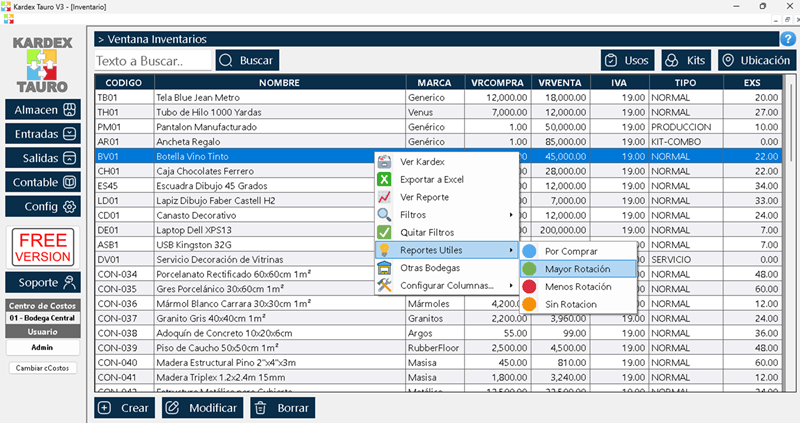
In Kardex Tauro, this process is supported by two pieces that work together: purchase orders, where the order placed with the supplier is recorded, and the product receiving process, which is used when the merchandise arrives at the warehouse. It is important to be clear that merchandise only affects stock when it is received: while the order is open and the product has not entered, it does not add units to the available inventory, no matter how much money has already been invested in it.
The difference between in-transit merchandise and merchandise already in the warehouse
The difference between both types of inventory can be summarized in one word: availability. Merchandise in the warehouse can be sold today, can be dispatched, can be counted, and generates income right away. In-transit merchandise can do none of that: it only represents a promise that, if everything goes well, there will be product in the future.
This difference has practical effects on daily decisions:
- Sales: a customer cannot take home merchandise that is on a truck; they can only take what is in the warehouse.
- Counts and reports: in-transit inventory does not appear in stock balances or physical counts until it is received.
- Turnover indicators: including merchandise that has not arrived yet in the calculations distorts the figures and makes it look like the business sells slower than it really does.
- Purchase planning: whoever confuses what was ordered with what is available tends to overbuy, because they believe they have less than they actually have.
Practical tips for the small business
To finish, these are the practices that separate businesses that control their in-transit inventory from those that simply wait for orders with their fingers crossed:
- Record every purchase as an open purchase order the moment the order is placed, not when the invoice arrives.
- Write down the promised delivery date and review it weekly; if the date has passed, claim immediately.
- Do not treat as received what has not arrived: merchandise is only inventory when it is physically in the warehouse.
- Verify against the order upon receiving: count, check for damage, and record differences before accepting the delivery.
- Receive the merchandise the same day it arrives so that stock and the stock ledger record reflect reality.
In-transit inventory is, at heart, money working for the business before it arrives: if it is watched with clear purchase orders and controlled delivery dates, it turns into sales the moment the merchandise reaches the warehouse. With tools like Kardex Tauro, where the order is recorded as a purchase order and stock is updated when products are received, a small business can always know what it ordered, what is still to arrive, and what it truly has available to sell.