How to Control Purchase Prices
How to Control Purchase Prices
In a commercial business, profit is decided twice: when you sell and, long before that, when you buy. A product can have the best selling price in the area and still leave losses if it entered the warehouse with a miscalculated cost, a freight charge nobody added, or a discount nobody took advantage of. Buying cheap is not a matter of memory or luck: it is a process controlled with orderly records and comparisons made on data.
This article explains how to keep a price history by product and by supplier, how to compare quotes without being fooled by the list price, how to negotiate by volume with real arguments, and how to record the correct cost when the goods arrive, including freight and discounts. All that work ends in a single figure: the average inventory cost, which Kardex Tauro updates automatically every time a purchase is recorded.
Why the purchase cost defines the margin
The margin of a product is the difference between the price it sells for and the cost it was bought at. If the cost is miscalculated, the margin is an illusion: a business can be selling a lot and earning little, or even losing money, without realizing it. An error of $1,000 per unit does not look serious, but multiplied by thousands of units a year it becomes the difference between a healthy profit and a difficult year.
Beyond the margin, the purchase cost defines competitiveness. Those who know their real cost can calmly decide whether it is worth lowering a price to match the competition or whether that price war would leave them selling below cost. Those who do not know it can only guess. That is why controlling purchase prices brings three concrete benefits:
- Protected margin: every sale is known in advance, before making it, to leave profit or not.
- Well-founded pricing decisions: you can compete without putting the operation at risk.
- Better cash planning: knowing how much the next purchase will cost makes it possible to schedule payments and avoid surprises in accounts payable.
The price history: the starting point
To control a price you must know it. And knowing it means having recorded, for each product and each supplier, how much was paid in the last purchase, how much has been paid in recent months, and what the best price achieved was. Without that history, every quote is evaluated blindly, and the buyer's memory, which usually favors the last purchase, replaces the data.
A practical way to organize it is a simple table like this one:
| Product | Supplier | Last price | Best price | Date |
|---|---|---|---|---|
| Cooking oil 5 L | Alimentos del Valle | $86.500 | $84.200 | Aug 20, 2026 |
| Wheat flour 25 kg | Alimentos del Valle | $118.000 | $112.000 | Aug 20, 2026 |
| Wheat flour 25 kg | Granos del Sur | $115.000 | $109.500 | Aug 18, 2026 |
| Brown sugar 50 kg | Granos del Sur | $148.000 | $143.000 | Aug 15, 2026 |
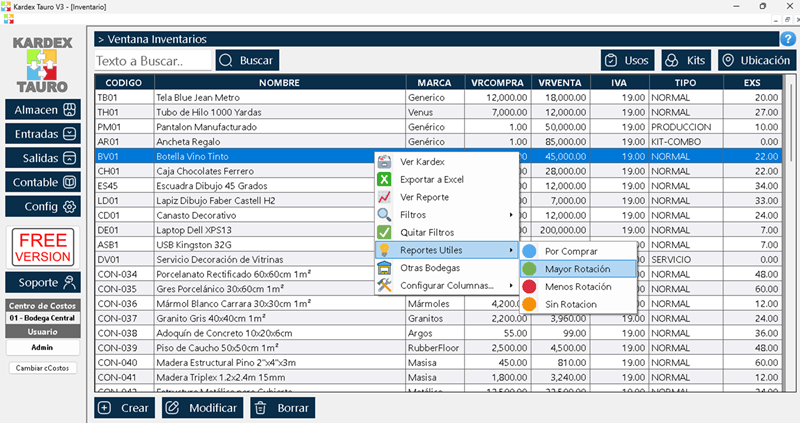
The example shows, among other things, that flour is cheaper at Granos del Sur than at Alimentos del Valle. That fact is worth money: every time flour is quoted, the record says what the best price was and with whom it was achieved. In Kardex Tauro, suppliers are managed as third parties: each purchase is linked to its third party and generates the corresponding account payable, so the price history can be complemented with the real terms and payments of each supplier.
Comparing quotes: the list price is not the final cost
Comparing quotes only by the list price is the most common mistake. Two quotes for the same product can show different unit values and yet the most expensive one on the list can turn out to be the cheapest in the end, or the other way around. The difference lies in the terms: freight is included or charged separately, the volume discount exists or not, and the payment term allows selling before paying or requires paying in cash.
To compare well, ask for the quote in writing, with a clear validity period and terms, and bring everything to the same ground: the total cost of the order. The following table compares two quotes for an order of 200 units of the same product:
| Quote | Unit price | Freight | Discount | Total order cost |
|---|---|---|---|---|
| Supplier A | $5.200 | $60.000 | — | $1.100.000 |
| Supplier B | $5.000 | $180.000 | -$40.000 | $1.140.000 |
Supplier B offers a lower unit price, but the total cost of its order is higher once the freight is added and the discount is deducted. If the business had decided only by the unit price, it would have paid $40,000 more. Comparing the total cost of the order, not just the list value, is what separates a good purchase from one that only looks good.
Negotiating by volume with arguments
The price history is also the best negotiation tool. When the buyer knows how many units of a product were purchased in the last six months, from which supplier and at what price, he can sit down to negotiate with arguments instead of pleas. A supplier listens differently to a customer who says I buy a lot than to one who proves, with records, that he buys from them every month.
Some useful practices: consolidate the purchases of the same product with a single supplier when its price is competitive; build a purchasing calendar for steadily moving products, so that orders are larger and less frequent; and ask for volume terms, such as an extra discount, included freight, or a longer payment term. That said, volume only pays off if the goods are going to move: buying more than needed to take advantage of a discount, with money tied up in the warehouse, can cost more than the discount itself.
Recording the correct cost when the goods arrive
The moment that affects the inventory cost the most is the receipt of the purchase, because that is where the value at which the goods enter the inventory record is defined. That value is not only the one on the invoice: if the business paid freight, that expense is part of the cost of the goods; if the supplier granted a discount, that benefit reduces it. Recording only the invoice and forgetting the freight leaves every unit undervalued, and that undervaluation travels with the product all the way to the cost of sales.
An example with numbers:
| Item | Value |
|---|---|
| Invoice value (200 units) | $1.000.000 |
| Freight paid to bring the goods | $80.000 |
| Commercial discount granted | -$50.000 |
| Total purchase cost | $1.030.000 |
| Cost per unit | $5.150 |
If the freight is not recorded, the cost per unit stays at $4.750 instead of $5.150: every unit enters the inventory with a value lower than the real one. When Kardex Tauro records the purchase, it adds the units and the total value to the inventory and recalculates the average cost of the product immediately; typing the correct values at the moment of the receipt is enough to keep the whole system properly valued.
The effect on the average inventory cost
The average cost is calculated by dividing the total available value, what was there plus what came in, by the total units. If the business had 150 units valued at $720.000 and a purchase of 200 units for $1.030.000 comes in, the available value becomes $1.750.000 and the units become 350. The new average cost is $5.000 per unit, a midpoint between the previous cost and the cost of the last purchase.
That figure is what is used to value the issues and to calculate the cost of sales. That is why a well-negotiated purchase not only saves money today: it lowers the average cost, improves the margin of the following sales and makes it possible to offer better prices without losing profit. A poorly recorded purchase has the opposite effect and distorts the results of the period, even if the invoice was paid in full and on time.
Controlling purchase prices is, in the end, a three-step discipline: keep the history by product and supplier, compare quotes by total cost, and record each receipt at its real value. With those three habits, decisions such as how much to buy, from whom and at what price stop being guesses and become informed decisions that protect the margin of the business.