Maximum Inventory

Maximum Inventory
Holding more merchandise than you sell is not a luxury: it is a decision that costs money every day the goods stay on the shelf. Every business needs stock to serve its customers without running out, but it also needs to know at what point buying more stops making sense. That point is the maximum inventory: the top quantity of a product that it is not worth exceeding.
Setting a ceiling for each reference may sound like something only large warehouses do, but it is actually the opposite: the smaller the business, the less room there is for money to sit idle in the storeroom. A hardware store, a stationery shop or a corner grocery can figure out in a short time how much of each item it makes sense to hold. This article explains what maximum inventory is, why it is worth respecting, and how to calculate it with simple data.
What maximum inventory is
Maximum inventory is the largest quantity of a product that the business should keep in stock under normal conditions. It is not a physical limit of the warehouse, although available space helps define it: it is an economic limit. It answers a concrete question: how much of each reference is it worth holding?
Above that ceiling, merchandise stops working for the business. Every extra unit takes up space, required money to be purchased, and waits to be sold at an uncertain future date. Below the ceiling, on the other hand, inventory does its job: it lets the business meet demand normally and replenish what is sold before it runs out. So each product has a ceiling, which is the maximum inventory, and a floor, which is the safety stock; between the two moves the useful inventory, the one that actually works for the business.
Why it matters to respect the maximum level
Accumulating more stock than needed has several consequences, and almost all of them are avoided with a well-defined ceiling:
- Tied-up money. Every peso spent on merchandise that does not turn over stops being available to pay suppliers, wages or utilities. An oversized inventory is money stored in boxes that produces nothing.
- Wasted space. The storeroom has limited capacity: if one product takes up too much room, others wait and work becomes slower and more prone to mistakes.
- Expiration, damage and obsolescence. Food expires, cleaning products lose their appeal and seasonal goods go stale. The higher the inventory, the greater the chance that part of it ends up as losses.
- More control work. Counting, organizing and reconciling large amounts of stock takes hours away from the very people who should be serving customers. Inflated inventory multiplies the effort without multiplying sales.
How to calculate maximum inventory
Maximum inventory is not invented or copied from another business: it is calculated from the real demand of each product and from the way the business buys. The idea is simple: the ceiling should be enough to cover expected sales between one purchase and the next, plus a safety margin for surprises.
If the business buys once a month, the ceiling should be close to one month of demand plus a reserve; if it buys every week, the ceiling can be lower because replenishment arrives soon.
Step by step
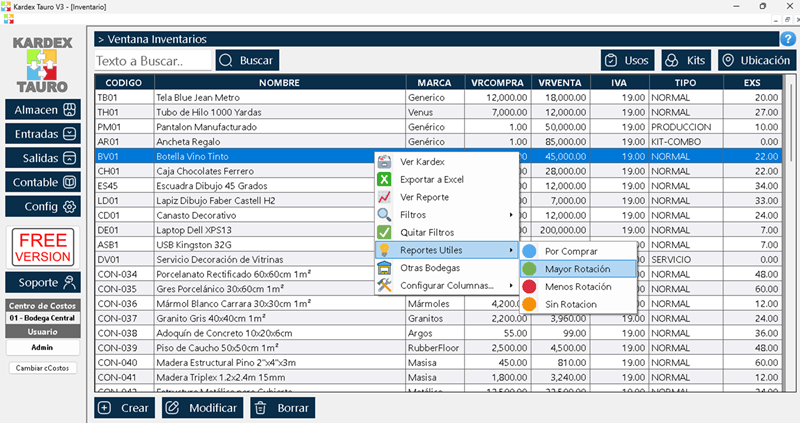
- Calculate monthly demand. With the sales history recorded in the stock ledger —for example, the one you can keep with Kardex Tauro— you get a reliable average: if 360 units of a product were sold in six months, demand is 60 per month.
- Define the period between purchases. The business buys every week, every two weeks or every month, depending on the supplier and cash flow. That interval is the basis of the calculation.
- Estimate demand for the period. If you buy every two weeks and monthly demand is 60 units, around 30 will be sold during the period.
- Add the safety stock. A reserve is added to cover the weeks when sales rise or the supplier is late. With 20 units of reserve, the example comes to 50.
- Compare with available space. If the storeroom cannot hold the result, adjust the ceiling to the real capacity and review the purchase frequency.
The practical formula looks like this: maximum inventory = demand for the period between purchases + safety stock. If monthly demand is 60 units, the business buys every month and wants a reserve of 20, the ceiling will be 80. That figure guides the next order: if there are 35 units in stock today, you order 45, no more.
An example with numbers
The following table shows how the ceiling is set for four products in a neighborhood grocery store with suppliers that deliver weekly or every two weeks:
| Product | Monthly demand | Suggested maximum inventory | Why |
|---|---|---|---|
| Cooking oil 1 L | 120 units | 140 units | Covers more than a month of sales and the supplier delivers weekly, so it never runs out without taking up extra space. |
| Rice 1 kg | 240 units | 280 units | High and steady sales; the ceiling allows volume buying without the risk of the product sitting in storage. |
| Laundry detergent 500 g | 80 units | 100 units | Medium turnover; one hundred units cover five weeks and leave shelf space free for other references. |
| Canned tuna 170 g | 40 units | 60 units | Slow turnover; a short ceiling is better to avoid tying up money in an item that sells little. |
The ceiling is not the same for every product: a fast-moving item can take a high figure without problems, while a slow-selling one should keep it low even if the supplier visits rarely.
How to use the maximum level when buying
Maximum inventory is only useful if it is checked before every order. The rule is simple: the quantity to buy is the difference between the ceiling and what is already in stock, including what is pending to arrive. If the ceiling is 80 units and there are 35 in the storeroom, the order must be 45 at most. If the current stock is already above the ceiling, the right decision is not to buy and to let sales bring the level down before the next order.
A few recommendations to put it into practice:
- Check each reference. Before placing the order, compare the stock of every product against its ceiling; that way you buy only what is missing and avoid ordering out of habit.
- Be wary of opportunity buys. A volume offer only makes sense if the product turns over fast enough to sell the excess within a reasonable time. Exceeding the ceiling once in a while is acceptable, as long as you know when that merchandise will be sold.
- Adjust the ceiling when demand changes. A promotion, a peak season or a new customer justifies a temporarily higher ceiling; when sales drop, the ceiling returns to its previous level.
Maximum inventory and safety stock: two limits that work together
The two inventory limits are often confused. Safety stock is the minimum quantity the business keeps as a reserve so it does not run out of a product if sales rise or the supplier is late. Maximum inventory is the top quantity that should not be exceeded. Between the minimum and the maximum lies the healthy zone:
| Aspect | Safety stock (minimum) | Maximum inventory |
|---|---|---|
| What it prevents | Running out of product and losing sales | Accumulating too much and tying up money |
| When it is reviewed | When stock gets close to that figure, it is time to order | Before each order, to decide how much to buy |
| What happens if it is ignored | Stockouts and unhappy customers | Surpluses, expirations and occupied space |
| How it is set | With demand variation and supplier delays | With demand for the period between purchases plus safety stock |
The two numbers complement each other: the minimum says when to order and the maximum, how much to order. Whoever manages both avoids the two classic problems: running short and running over.
Putting a ceiling on the money in the storeroom
Setting maximum inventory is not a one-time exercise: it should be reviewed from time to time and adjusted if a product changes its sales pace or the supplier takes longer. The key is deciding based on data instead of hunches.
Keeping a record of ins and outs, for example with a stock ledger like the one you can manage with Kardex Tauro, gives you the evidence of how much of each reference is sold and how often it is replenished. With that history you set realistic ceilings, and purchasing stops being a lottery and becomes a calculated decision. Maximum inventory is, in the end, a way to bring order to the money of the business: neither shortages that drive customers away nor excess that goes to sleep in the storeroom.