Inventory for Wholesale Trade

Inventory for Wholesale Trade
Wholesale selling looks, at first glance, simpler than retail: fewer customers, larger orders and less time at the counter. But anyone who runs a distribution business knows that this apparent simplicity hides a deeper challenge: in wholesale, every inventory error is multiplied by volume. A single unit miscounted in a neighborhood shop hurts little; a batch poorly recorded in a warehouse can cost a lot before anyone notices. The difference is not in the product being sold but in the scale at which it is handled.
This article is written for distributors and wholesale businesses with up to fifty employees that want to move from notebooks and spreadsheets to orderly control. We review why wholesale inventory behaves differently, what its typical challenges are and how to address them with practical tools: per-product stock ledger records, sales invoices that discount stock, control of accounts receivable and deliveries, and purchase orders.
Why wholesale inventory differs from retail
In a retail store inventory turns in units: one or two boxes per customer, and stock changes gradually. In a distribution business, by contrast, movement comes in waves. A single sale can take dozens of boxes of one product out of the warehouse in a single morning, and one purchase can refill the shelves in an afternoon. When changes are that abrupt, mental records or late entries stop working: one delivery that is never recorded is enough for the system to show stock that is no longer there.
Wholesalers also work with lower per-unit margins than retailers. Profit does not come from what each item earns, but from how many items leave the warehouse. That means there is no room to lose units: if the margin on one box is small, losing ten boxes to a recording error cancels many sales that were made for nothing.
Finally, wholesalers sell a great deal on credit. Retailers receive most of their payments in cash; distributors, instead, deliver the goods today and collect in fifteen or thirty days. That mix turns operations into a constant crossing between goods leaving and money not yet coming in, and it explains why inventory and accounts receivable must be managed together.
Wholesale challenges and how to control them
These are the challenges that appear again and again in distribution businesses, with the practical way to control each one and the tool that solves it.
| Wholesale challenge | How to control it | Tool |
|---|---|---|
| Large volumes in the warehouse | Record every entry and withdrawal by product and by warehouse | Per-product stock ledger with warehouses or cost centers |
| Batch purchases | Plan each purchase against the current balance and what has been sold | Purchase orders that leave a trace |
| Volume pricing | Keep the price according to the negotiated quantity | Product record with differentiated costs and prices |
| Credit customers | Invoice the sale and record the debt at the same time | Invoice that discounts stock and records accounts receivable |
| Large dispatches and deliveries | Check against the invoice before the goods leave | Delivery control linked to the sales document |
| Low margins | Know the real cost of each product before setting prices | Stock ledger updated with the cost of every entry |
The rule is simple: no movement should stay outside the records, not a box coming in, not one going out, not one being returned. When every movement has a document, challenges stop being guesswork and become information.
The per-product stock ledger, the foundation of wholesale control
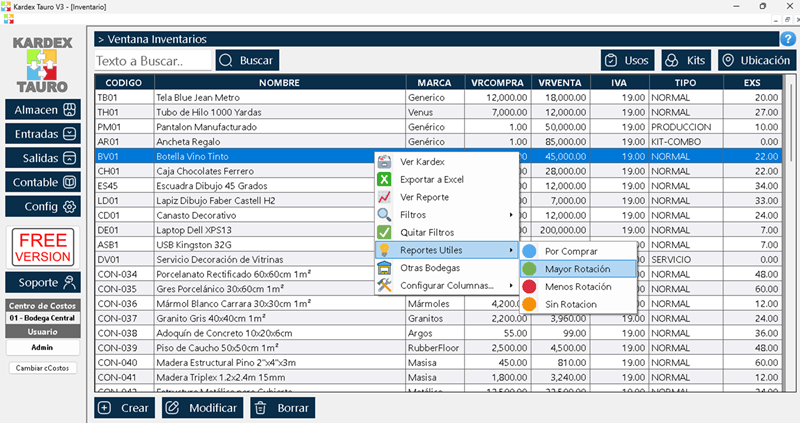
In wholesale trade it is not enough to know how much stock there is in total: you need to know how much there is of each reference, in each warehouse and at what cost it came in. The per-product stock ledger is the record that lists in order all the entries and withdrawals of a single reference: the date, the document, the quantity, the unit cost and the remaining balance. With that record up to date, a distributor can say without hesitation how many units remain of each product and what was paid for them.
That level of detail is what allows good wholesale decisions: knowing when it is time to buy another batch, when a reference is running out and when money is idle in products that do not move. A wholesaler without a per-product stock ledger manages from memory; with one, it manages with data. The record should also separate warehouses or cost centers, because stock in the main warehouse is not the same as stock in the dispatch area or in a separate sales point.
Invoicing well: the sale that discounts and the debt that remains
In a distribution business the sales invoice does two jobs at once. On one hand it deducts the units sold from the product stock: if fifty boxes of an item were sold, the stock ledger balance drops by fifty at that same moment. On the other hand, when the customer buys on credit, the invoice records the account receivable: how much the customer owes, since when and with what due date. Doing both in a single step avoids the classic mistake of selling in one place and recording in another.
This is where a system designed for these businesses makes the difference. Kardex Tauro handles sales invoices that discount stock and record accounts receivable at the same time, so inventory and customer balances always tell the same story. For the wholesaler that is valuable: the goods leaving and the money owed stay tied to the same document, with no notebooks to reconcile at the end of the month.
Buying in batches with purchase orders
A wholesaler purchases are large and infrequent, which is why they hurt more when they go wrong. Buying too much leaves money sitting in the warehouse; buying too little leaves customers waiting. The purchase order solves that dilemma: it is the document made before buying, where the supplier, the product, the quantity and the agreed price are recorded. When the goods arrive, they are received against that order and what was requested is compared with what was delivered.
For inventory control, the purchase order is a clean entry: goods come into the stock ledger with a known cost and with a document to answer to if something does not add up. In wholesale, where a single order can be hundreds of units, receiving against a purchase order is the difference between knowing what arrived and guessing it.
Controlling large deliveries and dispatches
In a distribution business the riskiest moment is not the sale at the office but the dispatch at the warehouse door. A large order is assembled, loaded and delivered to several points; along the way a box can easily be left behind, a reference swapped or a customer given less than what was paid for. That is why delivery control must be tied to the invoice: what leaves the warehouse must be exactly what the document says, no more and no less.
The routine that works is simple. First, assemble the order against the invoice. Second, check the contents before dispatch, reviewing reference by reference. Third, record any difference before the vehicle leaves, not after. Fourth, have the customer sign a proof of receipt. Each of those steps protects a margin that, being low, forgives no distractions.
Wholesale versus retail at a glance
The key differences can be summarized as follows:
- Retailers turn units; wholesalers turn boxes and entire batches.
- Retailers rarely grant credit; wholesalers live on accounts receivable.
- Retailers know customers by name; wholesalers know them by company and payment history.
- Retailers earn from the margin of each sale; wholesalers earn from the volume they move.
- Retailers can fix an inventory error in days; wholesalers often only discover it at the month-end count.
That last difference is the one worth attacking: wholesalers should not learn about their errors once a month, but see them on the very day they happen, when they can still be corrected.
Where to start putting wholesale inventory in order
There is no need to change the whole operation overnight. Order comes in steps. First, create the stock ledger for the fastest-moving products and keep it current with every entry and withdrawal. Second, invoice all sales through the system so every withdrawal discounts stock and every credit sale stays in the receivables. Third, receive purchases against purchase orders. Fourth, review every week the products that are running out and the accounts receivable that are becoming overdue.
Kardex Tauro brings those pieces together in a single program: per-product stock ledger, sales invoices that discount stock, accounts receivable, warehouses and cost centers, and purchase orders. For a distribution business with up to fifty employees, that combination is enough to handle large volumes without losing detail. Wholesale inventory is not difficult to control: it simply demands that every box has its record and that every record is made at the moment. Whoever achieves that turns the warehouse into the best salesperson of the business.