How to Know How Much Material a Production Order Needs
How to Know How Much Material a Production Order Needs
When a small workshop or factory receives a large order, the first practical question is not how long production will take, but how much material must be bought or set aside to fulfill it. Getting that figure wrong has two equally expensive sides. If the calculation falls short, production stops halfway while waiting for supplies that never arrived; if it overshoots, money stays frozen in the warehouse as material that may not be used for weeks. For a small business, where working capital is tight and every cent counts, neither situation is acceptable.
The good news is that knowing how much material a production order needs does not require complicated formulas or giant spreadsheets. It does require order: having the recipe of every product documented, deciding how many units will be manufactured, multiplying correctly, adding the expected waste and comparing the result with what is already in stock. This article explains those steps one by one, with a complete numerical example, so that anyone in the workshop can do the calculation in a few minutes using reliable data.
The basis of the calculation: the recipe of every product
Every manufactured product has a recipe, even if the workshop has never written it down. A table needs boards, screws, varnish and sandpaper; a garment needs fabric, thread, buttons and interfacing; a batch of bread needs flour, water, yeast and salt. That ordered list of components, with the exact quantity of each one needed to make a single finished unit, is what industry calls a bill of materials, or BOM. Without that list no calculation is possible: if every operator makes products by eye, nobody can say how much material a one-hundred-unit order requires or how much extra was spent on the last order.
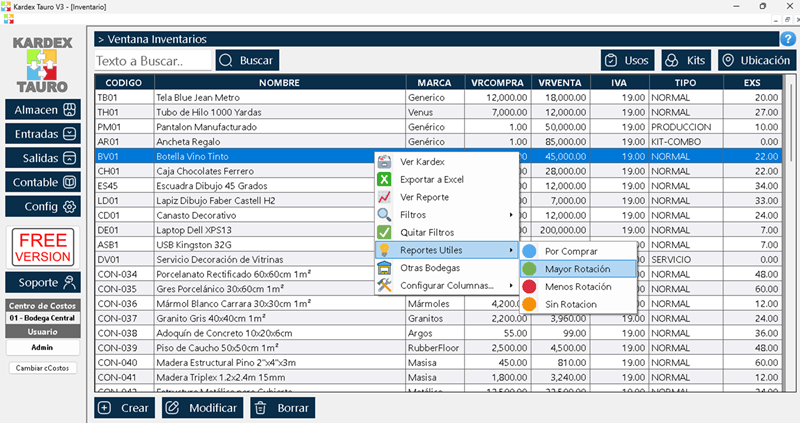
That is why the first step is to document every product the workshop manufactures: write down its components and the quantity per unit, and keep that information up to date when the design or the supplier changes. In Kardex Tauro that recipe is stored in the Kits window, where each component of a Line of Production product is assigned with the exact quantity required to build one unit of the finished product. Once the recipe is registered, material calculation stops depending on whoever happens to be on shift.
Step 1: decide how many units will be manufactured
The second essential figure is the batch size. Every production order must answer a specific question: how many finished units must come out of this order? That number can come from a customer order, from a sales forecast or from the decision to restock a product that is running out. The important thing is that it is an explicit, approved number, because all the following calculations and the material purchase depend on it.
It is also worth checking whether the batch should be split into stages. Manufacturing everything at once may seem efficient, but if the product has low turnover or the customer receives partial deliveries, it may be better to issue the order in stages and calculate the materials of each stage separately. What should never be done is to start production without knowing how many units are wanted: if the batch is not defined, material consumption cannot be planned or controlled either, and the order ends up costing more than budgeted.
Step 2: multiply the recipe by the batch size
With the recipe and the batch defined, the core calculation is a multiplication: the quantity of each material per unit is multiplied by the number of units to be manufactured. For the result to be reliable, the recipe and the batch must use the same units of measure, and the quantity per unit must be realistic: measured in real production runs, not padded with a hidden just-in-case margin, because that margin ends up making purchases more expensive.
Suppose a carpentry workshop receives an order to manufacture 120 wooden stools and the recipe of each stool is the following:
| Product to manufacture | Material | Quantity per unit | Quantity for the batch (120 units) |
|---|---|---|---|
| Wooden stool | Lumber (boards) | 2.0 m | 240 m |
| Wooden stool | Screws | 8 units | 960 units |
| Wooden stool | Varnish | 0.15 L | 18 L |
| Wooden stool | Sandpaper | 0.25 sheets | 30 sheets |
The last column is the result of multiplying the third one by 120: 2.0 meters of lumber per unit gives 240 meters for the batch; 8 screws per unit gives 960; 0.15 liters of varnish per unit gives 18 liters; and 0.25 sheets of sandpaper per unit gives 30 sheets. This total is the theoretical material: what the recipe says will be consumed if everything goes perfectly. Since in practice things rarely go perfectly, the next step is missing.
Step 3: add the expected waste
Every real process loses material: cutting lumber leaves scraps, fabric is wasted at the edges, flour spills or sticks to the containers, and screws get damaged or lost. That percentage lost under normal operating conditions is the expected waste, also called shrinkage, and it must be added to the calculation from the beginning. Ignoring it is the most common cause of material purchases that fall short in the middle of an order.
Expected waste is expressed as a percentage applied to the theoretical quantity. In the stool example, if the workshop knows from experience that cutting, drilling and sanding loses about 5% of the lumber and the varnish, the calculation looks like this: 240 meters of lumber times 1.05 gives 252 meters; 18 liters of varnish times 1.05 gives 18.9 liters, rounded up to 19 liters. Screws and sandpaper are handled in whole units and sheets, so they are rounded up: 960 screws become 1,000 if the supplier sells them in boxes of 1,000, and 30 sheets of sandpaper become 32 to have a margin.
The waste percentage is not invented: it comes from comparing, over several previous orders, what was requested against what was actually consumed. A workshop that has never measured it can start with a prudent margin and adjust it over time; the goal is for the theoretical calculation to get closer and closer to the real consumption.
Step 4: compare the need with the stock on hand
The total need that was calculated is not the same as what must be purchased. Before ordering a single screw from the supplier, the available stock of each material must be subtracted. If there are 80 meters of lumber in the warehouse, only 172 meters are missing from the 252 meters the batch requires. If 400 screws are available, 560 of the 960 needed are missing. This comparison, material by material, avoids the two typical mistakes: buying too much because the warehouse was not checked, or running short because the same material was counted twice.
That is why a well-made production order not only says what will be manufactured and in what quantity: it also makes it possible to know, before starting, whether the components are enough or whether a purchase must be issued. When the recipe is registered and stock levels are up to date, the question about being short on material is answered in minutes, not when production has already stopped waiting for supplies.
A habit that is repeated on every order
Knowing how much material a production order needs is not a one-time exercise: it is a habit repeated on every order and it improves with every repetition. When the recipe is documented, the batch is defined, waste is measured and stock is up to date, calculating materials takes a few minutes and purchasing mistakes become the exception. When the company works with an inventory program, that habit is supported by real data: Kardex Tauro, for example, automatically links raw material consumption to the specific production order, so each material issue stays associated with the order that caused it and deducts stock when the consumption is recorded.
That record does more than keep the warehouse up to date: over time it allows comparing how much material the recipe said would be spent against how much was really spent. That comparison is what fine-tunes the waste percentage, detects processes that lose more than normal and turns material calculation into a control tool instead of a guessing game. To put it into practice in the workshop, these basic rules are worth following:
- Document the recipe of every product with the quantity per unit and update it when the design, packaging or supplier changes.
- Define the batch before calculating and, if you change it halfway, recalculate all the materials.
- Measure the real waste of several orders and use that percentage, not an invented one.
- Always subtract the stock on hand before ordering material from the supplier.
- Compare the real consumption of each order against the recipe to validate that the data is still correct.
Five rules that, applied consistently, keep a production order from stopping for lack of material or leave the warehouse full of supplies nobody ordered.
