Bookstore inventory

Bookstore inventory
Running a bookstore looks simple until a customer asks about a title and you have to answer in seconds: is it in stock, which shelf is it on and how many copies are left? A bookstore carries thousands of different references and, unlike most shops, hardly any of them repeat in large quantities: there are usually a few copies of many titles. That is why a bookstore inventory does not look like the stock of a grocery warehouse or a clothing store. Here the unit of control is the individual copy, and each copy belongs to a title with its own data: author, publisher, edition, ISBN and price. Without an orderly record of that information, decisions as simple as how much to order, what to return or how much to pay each publisher turn into guesswork.
This article explains what a bookstore should control, how to organize the information for each title and why recording stock in and out every day keeps the business from losing money on printed paper nobody sees.
Why a bookstore needs stock control
The margin on a book is narrow and the capital tied up on the shelves is high. A copy that sits unsold for months is not just a cosmetic problem: it is idle money that earns no return and takes up space that a faster-selling title could use. When you do not know for certain what is in the store, three things happen at once: you order titles that are already in the back room, you stop ordering titles that do sell, and returns pile up late because nobody spotted the unsold copies in time.
Proper control lets you measure how fast each title moves, prepare for the busy seasons with data and clearly separate your own merchandise from the stock received on consignment, which has not been paid for and will eventually have to be returned or settled.
What information every title needs
In a bookstore inventory the product is not "a book" in general but one precise reference: a specific title, from a specific publisher and a specific edition. To control it, each reference should carry at least the following data:
- Title and author: the natural way to identify a book when searching for it or showing it to a customer.
- ISBN: the unique code that identifies the edition. Two editions of the same title can have different ISBNs and must be treated as separate products.
- Publisher: used to organize the inventory, to prepare orders and to settle accounts with each supplier.
- Selling price and cost: the cover price and what each copy actually cost, because not all stock arrives under the same conditions.
- Stock on hand: how many copies are available for sale right now.
That data is entered once, when the title first comes into the system. From then on, every movement —a purchase, a sale, a return to the publisher or a counting adjustment— updates the stock automatically and leaves a history of what happened to that title.
Consignment stock and returns: the flow that defines a bookstore
A large share of the books a bookstore receives arrives on consignment: the publisher delivers the merchandise without charging for it right away, and the bookstore pays only for what it sells, returning the rest after an agreed period. That model, so comfortable for cash flow, is also the main source of disorder if it is not recorded. Two inventories now live side by side on the shelf: the store's own copies, already paid for or invoiced, and the consigned copies, which still belong to the publisher until they are sold.
If the bookstore does not keep an exact count of how many copies of each title it received on consignment, how many it sold and how many it must return, it ends up overpaying the publisher or returning too few, and the mistake is only discovered at settlement time, when it is hard to fix. The same applies to returns for damage: a battered copy discarded without being recorded is a cost nobody claims in the books. Recording every receipt with its source —purchase, consignment or replacement— and every issue with its reason —sale, return or adjustment— makes it possible to know at any moment how much is owed to each publisher and what merchandise is pending return.
A useful stock table for the day-to-day running of a bookstore can look like this:
| Title | Publisher | Copies in stock | Selling price |
|---|---|---|---|
| Math 5, student workbook | Ediciones Horizonte | 38 | $ 8.00 |
| The Garden of Questions (novel) | Editorial Alba | 6 | $ 13.50 |
| School Dictionary of the Language | Group Letras | 12 | $ 11.00 |
| History of Colombia, volume 2 | Ediciones Horizonte | 3 | $ 17.00 |
| Stories to Read with the Family | Editorial Alba | 9 | $ 6.50 |
| Natural Science Guide 7 | Group Letras | 0 | $ 7.50 |
The last row in the example says as much as the others: an out-of-stock title, visible at a glance, is the signal to reorder before the next season arrives or to return the remaining consignment balance.
The school season: the peak that tests your records
For many bookstores, the year splits between the school season and the rest of the months. In the weeks before classes begin, demand concentrates on set textbooks and required reading: parents arrive with lists of specific titles and publishers, and the store that does not have the exact title loses the sale. That season requires preparation weeks in advance: comparing school lists against stock, ordering the missing titles early enough and receiving the merchandise before the flow of customers leaves no time even to record.
The typical risk of the season is disorder: sales are fast and heavy, and if every issue is not recorded at the moment, within two weeks the figure in the system has nothing to do with what is actually on the shelves. Once the peak ends, the second half of the cycle begins: returning the unsold textbooks to the publishers within the agreed dates, so the store is not left with merchandise that will lose its relevance until the next school year.
Physical counts and adjustments
However disciplined the daily record may be, a bookstore inventory must be checked against reality on a regular basis. A physical count means walking through the shelves, section by section or category by category, and comparing the copies counted with the ones in the system. Differences appear for many reasons: a customer who leaves a book on the wrong shelf, a copy lent out that never came back, damage that was not reported or a typing error in a sale. When the count finds a difference, it is corrected with a documented adjustment, and that correction leaves a record of when and why the stock changed.
In a bookstore with few employees, the count does not have to be done all at once: it can be planned by zone —fiction one month, school texts another, comics and children's books another— so the whole store is verified over the course of the year without interrupting sales.
Keeping the daily record with an inventory program
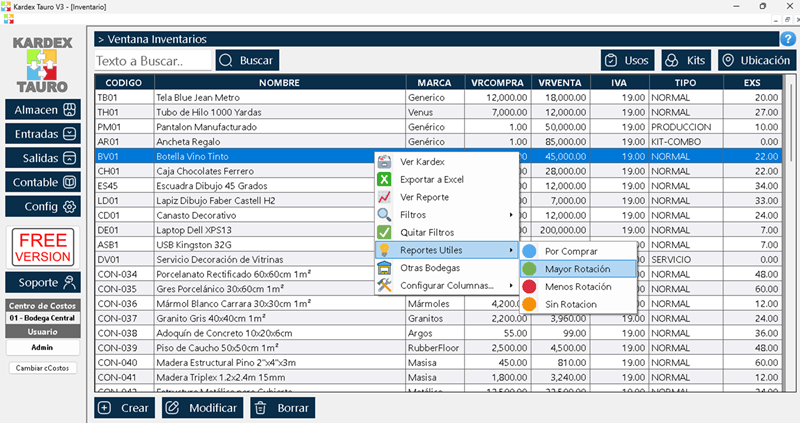
Keeping this control in notebooks or spreadsheets works up to a certain size. When the bookstore grows past a few hundred titles, seasonal sales take off and consignments multiply, it makes sense to rely on a program that does the repetitive work. Kardex Tauro is software designed for small businesses: it records merchandise receipts and issues and keeps stock up to date per product, so every title in the bookstore has its own record with its code, its group and its copy balance.
When purchases from publishers are entered, the program updates the average cost of each title, and when a sale is invoiced, the copy is deducted from stock and the corresponding stock ledger movement is generated, with no extra steps for the salesperson. It also lets you organize inventory into groups —fiction, school texts, children's books, stationery— and run periodic physical counts by section, comparing what was counted with what was recorded.
An orderly bookstore is not the one with the fullest shelves but the one that knows what is on each of them, what it is worth and who it belongs to. With a daily record of receipts and issues, a periodic count and a program such as Kardex Tauro keeping stock current, the bookstore owner gets back the most valuable thing: knowing exactly what he or she has before ordering or returning anything.