How to Manage Inventory in a Pharmacy

How to Manage Inventory in a Pharmacy
Running a pharmacy is not like running an ordinary shop. Every product has an expiry date, the boxes that arrive from the distributor belong to different batches, and the money sitting on the shelves only comes back when the merchandise moves. A missing antibiotic when a prescription arrives is a lost sale; an analgesic over-ordered in advance that expires in the back room is capital that simply evaporates. That is why knowing how to manage inventory in a pharmacy is not an office chore: it is what determines whether the business stays well stocked, orderly and profitable, or whether it works blind.
Managing inventory, in practice, means keeping an orderly record of every inflow and outflow of merchandise so that three questions can be answered at any moment: what is on the shelves, how many units of each product are available, and which batch they come from. When those answers are up to date, buying, selling and serving customers become far safer decisions.
Step 1: classify the products before recording anything
The first step is not buying software or printing labels, but organizing the catalogue. Two groups that behave very differently coexist in a pharmacy. The first is medicines, which are best identified by their active ingredient and strength rather than by brand: for example, "acetaminophen 500 mg tablets" or "ibuprofen 400 mg." If the same active ingredient is sold in several presentations (tablets, syrup, drops), each presentation needs its own record, because the packaging, the price and the turnover speed are different.
The second group covers everything that is not a medicine: personal care, hygiene, supplements, devices and convenience items. They do not require the same expiry-date monitoring, but they take up space and capital, so they must also be recorded. Each product gets a code and a clear unit of measure (box, unit, blister or bottle), so that a count, a purchase and a sale always refer to the same package. That tidy catalogue is the foundation for everything else.
Step 2: record purchases with batch and expiry date
Most merchandise in a pharmacy comes in through purchases from distributors. When the order arrives it must be checked against the supplier's invoice: confirm that everything requested is there, that the packages are in good condition and, in the case of medicines, that the batch number and the expiry date are printed and legible. That few-minute check avoids headaches that become expensive weeks later.
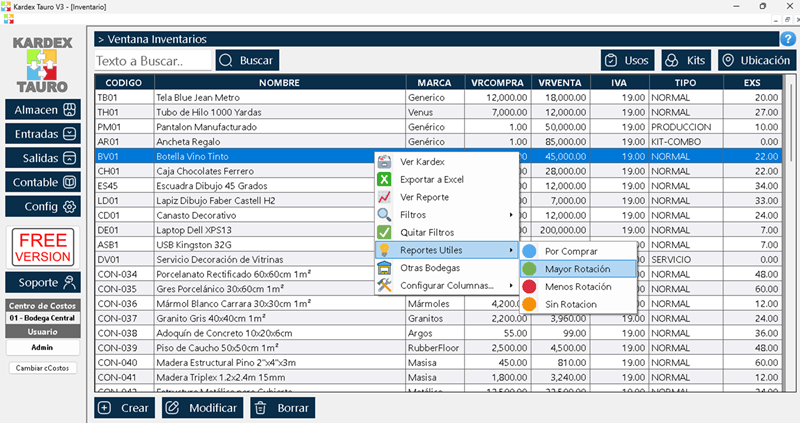
The purchase record must capture, besides quantities and prices, the batch and expiry date of every medicine. That detail is not an administrative luxury: it is what later allows you to know which box must be sold first and how many units remain from a specific batch. Kardex Tauro lets you record both fields when the goods come in and automatically groups stock by batch, so a product query shows how many units belong to each batch and which one expires first.
Recording the purchase also keeps the cost of the merchandise up to date. When an order arrives at a price different from the previous one, the product's average cost is updated with the new value. That way, the margin shown in every sale is calculated on a real, recent cost, not on the price paid three months earlier.
Step 3: let the sale deduct the stock automatically
The natural way out of inventory is the sale at the counter. This is where the system should do the heavy lifting: when a sale is invoiced, the sales invoice deducts the stock and generates the corresponding stock ledger movement in the same act. Nobody has to subtract units in a notebook or remember to update a spreadsheet at the end of the day; the inventory stays synchronized with the store's actual sales, with no dependence on the memory of the person at the register.
A registered sale also leaves a trail: if a difference appears later, it is possible to review what was sold, to whom and when. The stock ledger thus becomes the reliable history of everything that has come in and gone out, and any inconsistency can be traced back to its origin.
Step 4: dispatch by batch with the FEFO criterion
In a pharmacy it is not enough to know how many units are on hand: you also need to know which ones must be sold first. The recommended criterion for products with an expiry date is known as FEFO, which stands for First Expired, First Out: what expires first leaves first. An expired product cannot be sold or given away; it becomes loss, so every unit dispatched in time is money saved. That is why the person at the counter should take from the shelf the merchandise closest to expiry and leave behind the stock that has more life ahead of it.
An example with numbers helps to understand the flow. The table below summarizes the movements of one medicine over a quarter, with two different batches on the shelf:
| Date | Document | Details | Units in | Units out | Stock |
|---|---|---|---|---|---|
| 10-Jan | Purchase | Batch A-2310, expires in June | 100 | 0 | 100 |
| 20-Jan | Purchase | Batch B-2401, expires in April | 50 | 0 | 150 |
| 05-Feb | Sales invoice V-0112 | FEFO dispatch: batch B goes out first | 0 | 30 | 120 |
| 12-Mar | Sales invoice V-0157 | Batch B runs out; sales continue with batch A | 0 | 90 | 30 |
Look at the last row: to sell 90 units, the rest of batch B (20 units) was dispatched first, and then 70 units of batch A, which expires later. In the end, 30 units remain, all from batch A, and batch B ran out completely before expiring. Applying FEFO this way requires having the expiry date of every batch recorded from the moment of purchase and being able to see it at the moment of sale, because the decision about which box to take is made in seconds, in front of the customer.
Step 5: run periodic physical counts
No record is worth anything if it is not checked against the reality of the shelves. Physical counts are the X-ray of the business: you count the units on the gondola, in the back room and in the refrigerator, and compare them with the stock recorded in the system. In a small pharmacy, counting by sections works well: one week the syrups and pediatric section, another week the analgesics, another week the back room; or run a full count every three to six months, depending on sales volume.
In Kardex Tauro the stock of each product can be checked instantly, which turns the count into a quick verification exercise rather than a guessing game. When a count shows a difference, the first thing is to investigate before adjusting: a purchase may have gone unrecorded, a sale may have been invoiced incorrectly, an order may have been picked wrong, or there may have been a theft. The difference is documented with its cause and the balance is adjusted, leaving evidence for the next review.
Step 6: document shrinkage
Even when FEFO is applied well, expired medicines, damaged packages and misplaced units will always show up. Those outflows do not correspond to any sale and must be recorded separately, with their cause: expiry, damage, theft or count adjustment. Documenting shrinkage is not a punishment: it is information. If a product keeps appearing in the expired-goods report, the conclusion is simple: too much is being ordered, and the next purchase must be more conservative.
Those records also help when talking to the supplier: returns of merchandise close to expiry are negotiated better when you have clear data on what was received, when and in what condition.
A simple flow that sustains itself
Managing a pharmacy's inventory then comes down to a five-step flow: receive the merchandise and record the purchase with its batch and expiry date; let the sales invoice deduct the stock; dispatch with the FEFO criterion; count physically on a regular basis; and document every loss with its cause.
Kardex Tauro brings that flow together in a single tool: it records entries and exits, shows the stock of each product, deducts inventory with every sales invoice, updates the average cost with every purchase and groups merchandise by batch. It is a practical way for a neighborhood pharmacy, or a small chain with little staff, to stay in control without becoming an accounting department. The result shows up at the counter: fewer shortages, fewer expired products, and a business that knows exactly what it has, every day.