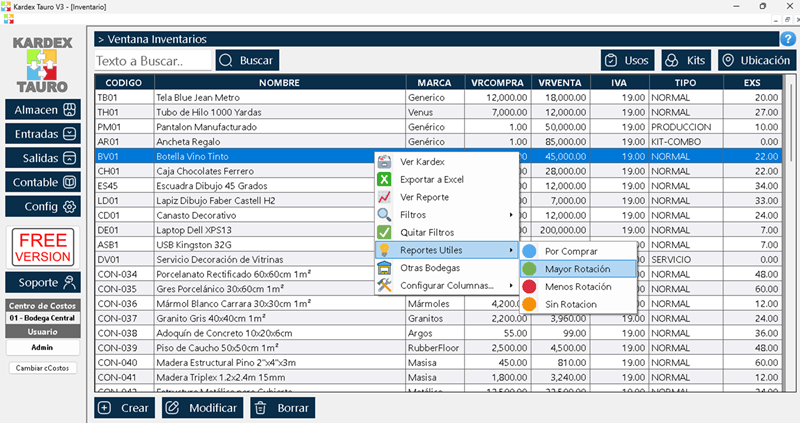
How to Control Suppliers and Inventory

How to Control Suppliers and Inventory
For a small business, suppliers and inventory are two sides of the same problem. A stockout almost never starts in the warehouse, but in a poorly planned purchase or a supplier that did not deliver; excess cost, in a purchase that was never compared with other offers; and a supplier that keeps failing ends up costing money in idle stock and lost sales. Controlling inventory, then, starts with controlling suppliers: who they are, what is bought from them, under what conditions, and whether they deliver what they promise.
Register every supplier properly
All supplier control starts with having every supplier clearly identified. In Kardex Tauro, suppliers are managed within the third-party records: the central database where the company keeps the information of its customers, suppliers, employees and carriers. Each one gets its own record classified by type, and the system keeps the history of every transaction carried out with it.
The most common mistake is living with "ghost" suppliers: they are paid under one name and merchandise is received under another, and nobody remembers the correct tax ID or who takes the orders. That carelessness becomes expensive when claiming a warranty, returning merchandise or reconciling an invoice. Practical rule: if a supplier is not registered, do not buy from them. Keeping the record takes a minute and saves weeks of arguments.
What a supplier record should contain
A useful record is not a form to fill in for the sake of it: it is the memory of the business about who it buys from. At a minimum, it should hold the information that today lives only in the owner's or the buyer's head:
- Identification and contact data: company name, tax ID, phone, email, address and the person who takes the orders.
- Payment conditions: whether purchases are cash or on credit, with the agreed term and any early-payment discounts.
- Delivery times: how many days it takes to dispatch each type of product, so you can plan without running out of stock.
- Products bought from them: with the usual references, to request quotes faster and compare better.
- Notes: ordering channels, business hours, return policies and special agreements.
That information changes over time: that is why the record is updated at every negotiation and reviewed at least once a year.
Evaluate suppliers with criteria, not by habit
Many small businesses always buy from the same supplier out of inertia, without asking whether it is still the best option. Evaluating is not distrusting: it is verifying, with data, that the supplier is still a good choice in price, quality and service. Kardex Tauro supports that evaluation in two ways: it lets you send quotes to suppliers to request prices, terms and conditions from several at the same time and compare the offers before deciding, and it keeps the history of each third party to see how much has been bought from them.
The criteria that matter are few, and it pays to keep them in mind on every purchase:
- Price: not only the unit value, but the total cost including freight, taxes and packaging.
- Quality: the product arrives in good condition and always meets the same specification.
- Punctuality: delivery within the promised time, because a delay becomes a stockout.
- Commercial conditions: payment terms, discounts and return or warranty policies.
- Service: speed in responding, solving claims and replacing defective merchandise.
A very concrete warning sign is returns: if a supplier generates repeated returns, it is transferring its problem to your inventory. Returns to suppliers are recorded and are a valuable indicator for that evaluation. When a pattern of failures appears, the next large order should go to an alternative supplier.
The purchase order: the agreement in writing
Buying over the phone or by message leaves the business without support: there is no way to prove what was agreed. The purchase order exists for that: to put in writing what was ordered, how much, at what price and under what conditions. In Kardex Tauro, the purchase is formalized with the purchase order, which records the supplier, the products with their quantities and values, and the agreed conditions; the document is created, approved, and only then printed and sent to the supplier, with space for signatures and stamps.
That approval matters more than it seems in a small company: it forces someone with authority to review the purchase before committing money. The recommended flow is simple:
- Create the purchase order with the products, quantities and agreed prices.
- Approve the order to authorize the purchase.
- Print it and send it to the supplier as the official document.
- Receive the merchandise against that same order.
- Record the payment or schedule it within accounts payable.
Receiving against the order: count before you accept
Receiving is where supplier control connects directly with inventory. When the merchandise arrives, someone must check against the purchase order that each product arrived, in the ordered quantity and in good condition. Receiving is done with the "Receive Purchase" button, available on the approved order: the system shows the products with the requested quantities and the person receiving confirms how much of each one arrives, receiving everything, part or nothing.
When confirmed, the system updates stock, records the movements in the Stock ledger and changes the order to "received"; if the supplier delivers in several shipments, partial receipts are used and the order remains pending for the balance. The golden rule is not to record more than what arrived: if 48 units arrived and 60 were ordered, you receive 48 and claim the shortage. Recording what never arrived inflates inventory and unbalances the Stock ledger.
A registered purchase also updates the cost
Receiving merchandise is not only adding units: it is updating how much each one is worth. When a purchase is recorded through the purchasing module, the system generates the movement and automatically updates the product's average cost. That way, the cost used later to value the merchandise sold reflects what was actually paid in the latest purchase, and the business knows whether it is making or losing money on each sale.
And if the purchase is on credit, the same record is reflected in accounts payable: the system controls the debts with suppliers, and each account moves through clear statuses as it is paid down or settled. Knowing how much is owed and to whom, and paying on the agreed dates, avoids running out of merchandise because of unpaid debts or paying late fees. Purchase control and cash control end up being the same control.
Do not depend on a single supplier
Dependence on a single supplier is one of the quietest risks of a small business: if it runs out of stock or raises prices, the business is left without merchandise overnight. It is wise to have at least two options for key products: the main supplier, with whom you keep volume and the best price, and a proven backup, so the first purchase does not happen in an emergency.
Keeping the backup is not expensive if it is used wisely: quoting both periodically, splitting some orders and keeping the history allows you to compare with data and negotiate better. When the main supplier knows there are alternatives, its prices and service tend to improve on their own.
A practical example
A hardware store that sells paint, rollers and accessories could keep a table like this one and update it after every purchase or receipt:
| Supplier | Product | Delivery time | Conditions | Evaluation |
|---|---|---|---|---|
| Comercializadora del Norte | Latex paint | 2 days | 15-day credit, 2% early-payment discount | Excellent: price and punctuality |
| Suministros Rápidos | Rollers and brushes | 24 hours | Cash | Good: fast, prices slightly high |
| Ferretería Central | Latex paint (backup) | 5 days | 30-day credit | Fair: sometimes delivers late |
| Distribuidora El Puente | Tape and sandpaper | 3 days | Cash | Needs improvement: frequent returns |
With that table, the buying decision stops being an act of faith: if the main supplier has no paint, you know the backup delivers in five days and you buy in advance; if one accumulates returns, you reduce its share and test a replacement. Evaluating suppliers is, in the end, a way of controlling inventory without chasing every shortage after it happens.
Every stockout, excess cost or miscalculated debt with a supplier ends up affecting inventory and cash flow. That is why control does not start on the shelf: it starts in the supplier record, continues in the purchase order and ends with verified receiving. Whoever controls their suppliers with order and records, controls their inventory almost without noticing.