Reorder point: formula, example and how to set it product by product

Reorder point: formula, example and how to set it product by product
The reorder point is the stock level at which you should place a new purchase order to replenish a product. It is not a theoretical suggestion: it is the exact moment at which, if you order today, the supplier will deliver just as you still have merchandise left to sell, with no stockouts and no surplus taking up space. When a store owner decides to "order when it starts running out," that decision is really being left to memory and the mood of the day. And memory fails: one busy week, a supplier who changes their lead times, and the best-selling product hits zero without anyone noticing in time.
In this article you will see what the reorder point is, the formula to calculate it with a complete numeric example solved step by step, what happens when you order too early or too late, and how to set it product by product based on sales speed. By the end, you will have a concrete plan you can apply this very week, without any complicated tools.
What is the reorder point
The reorder point, also called the reorder level, is the inventory level that triggers a new purchase order. It works like an alarm: while stock is above that level you do nothing; as soon as the balance drops below it, it is time to replenish. It answers when, not how much: how many units to order is a different question, answered by your purchase lot size, available space and supplier terms. The reorder point only tells you the moment.
Think about the journey of a product. Every day you sell a certain number of units. When you place an order, the supplier does not deliver the next day: days, sometimes weeks, pass between ordering and receiving the goods. That time is called the lead time. During the lead time the store keeps selling, so you need stock on hand to cover those sales. On top of that, sales are not exact: there are good days, supplier delays, partial deliveries, counts that go wrong. Safety stock is the cushion that absorbs those variations. The reorder point combines both things: what you will sell while the order arrives, plus a margin of protection.
A quick example. Picture a hardware store that restocks the same day every month because that is the way it has always done it. One month, the supplier takes two extra days and sales spike because of a construction project in the neighborhood. Result: the shelf of the star product sits empty for four days. With a reorder point set from data, that store would have ordered a few days earlier, because the order would depend on the real stock level, not on the calendar. That is the difference between managing by dates and managing by levels.
The reorder point formula
The classic formula is:
Reorder point = (daily consumption × supplier lead time) + safety stock
Each variable is measured like this:
- Daily consumption: how many units you sell or use per day, on average. Divide the sales of a period (30, 60 or 90 days) by the number of days. Use physical units, not money: the formula cares about the boxes and bottles leaving your warehouse, not the dollar value of what was sold.
- Supplier lead time: the days between placing the order and the merchandise being in your warehouse, ready to sell. Do not use the time frame the salesperson promises in the catalog: measure the real time of your recent orders, because that is where the surprises show up.
- Safety stock: extra units that cover supplier delays, sales spikes and counting errors. It is your insurance against a stockout, and its size depends on how variable your sales are and how reliable your supplier is.
Keep the same units throughout the formula. If daily consumption is in units per day, lead time must be in days, and the result comes out in units. Mixing weeks with days, or units with dozens, is the fastest way to get a reorder point that makes no sense and that nobody understands when it fails.
Worked numeric example
Take a grocery store that wants to organize replenishment for four products with different sales speeds. For each one, daily consumption was measured from the last 90 days of sales, along with the supplier's real lead time, and a safety stock was set according to how variable the sales are. The results look like this:
| Product | Daily consumption | Lead time (days) | Safety stock | Reorder point |
|---|---|---|---|---|
| Rice 1 kg | 12 units | 5 | 30 units | 90 units |
| Cooking oil 1 L | 8 units | 4 | 24 units | 56 units |
| Ground coffee 500 g | 5 units | 10 | 20 units | 70 units |
| Laundry detergent 3 kg | 6 units | 3 | 18 units | 36 units |
Let us check the coffee calculation step by step, because it combines a long lead time with a high safety stock:
| Item | Calculation | Result |
|---|---|---|
| Average daily consumption | 450 units sold in 90 days ÷ 90 | 5 units per day |
| Consumption during lead time | 5 units per day × 10 days | 50 units |
| Safety stock | Coverage for 4 extra days of sales or delay | 20 units |
| Reorder point | 50 + 20 | 70 units |
The reading is simple: when coffee drops to 70 units, place the order. The first 50 units cover the sales of the 10 days the supplier takes, and the remaining 20 are the cushion in case delivery is late or the week sells more than usual. If the order arrives on time, the balance will be close to 20 units: exactly where it should be. Apply the same reasoning to the other three products: order rice when it reaches 90 units, oil at 56 and detergent at 36.
The same formula lets you react when something changes. If the coffee supplier announces that delivery will go from 10 to 15 days, you do not need to wait for a stockout to act: the new reorder point is (5 × 15) + 20 = 95 units. One line updated in your product table, and your ordering rule is aligned with reality again.
What happens if you order too early or too late
Ordering before the balance hits the reorder point seems harmless, but it has a cost. Every box that arrives early is frozen money: you already paid for it, it takes up space in your warehouse, and it does not generate sales until its turn on the shelf comes. If the product expires, like food, cosmetics or medicine, every extra day on the shelf brings the loss closer. And money tied up in inventory is money you cannot use to pay suppliers, restock what sells fast, or take advantage of a buying opportunity.
Ordering after the reorder point is worse, because that is where the stockout appears: the empty shelf, the customer who walks to the store across the street, the sale that never comes back. When the supplier finally delivers, you do not recover the customer who already bought elsewhere; you only restock for the next cycle. If the stockout repeats with the same product, customers learn not to look for it at your store. With a well-set reorder point, the order is triggered with plenty of time, and a stockout only happens if the supplier and the cushion fail at the same time, which is much rarer.
| Signal | Ordering too early | Ordering too late |
|---|---|---|
| Cash | Frozen in boxes that have not sold yet | You lose the sale of the customer who could not find the product |
| Space | Warehouse full of products that do not turn | Empty shelves and gaps in the aisles |
| Risk | Expiry, damage or obsolescence | Customers get used to buying somewhere else |
| Result | More inventory than needed | Fewer sales than possible |
The correct reorder point walks the edge: high enough for the order to arrive before you run out of stock, and low enough to avoid piling up extra inventory. The formula gives you that number from data, not from gut feeling.
How to set the reorder point product by product
Not every product deserves the same treatment. Setting a single reorder point for the whole store is like using one shoe size for everyone: it fits almost nobody. The key is sales speed: fast-moving products are watched more closely because a mistake in them shows up immediately in sales and at the register.
- Fast movers: the products you sell the most. Watch them more: a precisely calculated reorder point, daily or every-other-day balance checks, and safety stock adjusted to the real variability of sales. A stockout here hurts twice, because this is the product that pays the rent.
- Medium movers: weekly review. The point is calculated the same way as for the rest, but a one-week difference in the order is not catastrophic, so the control can be less frequent.
- Slow movers or expensive items: the cost of keeping them idle is high, so safety stock should be smaller and the point tighter. Here the typical mistake is the opposite: over-ordering out of fear of running out, and ending up with dead capital in a product that sells twice a month.
- Perishables: safety stock cannot be generous, because the surplus is lost to expiry. Better a lower point and more frequent orders, even if that means paying more freight.
- Seasonal products: the reorder point is not fixed: it goes up before the peak season and down after it. A product that sells 3 units a day in January and 30 in December cannot have the same point all year; if it does, it runs out exactly when it sells the most.
The practical rule: recalculate the reorder point every time something changes. If a product doubles its sales, its point doubles; if a new supplier takes twice as long to deliver, you need to order earlier. Leaving the points frozen for a whole year is the recipe for the formula to lose all its value and for you to depend on the warehouse worker's eye again.
Typical mistakes when calculating the reorder point
- Using the annual average consumption when there is seasonality: the average hides the peaks. If December sells three times as much, the annual average will make you order late exactly in the season that brings in the most revenue. Measure consumption over the recent period that reflects the current time of the year.
- Ignoring the supplier's real lead time: the supplier promises 48 hours, but the last delivery took 9 days. If your formula uses the 48 hours, the stockout is guaranteed. Measure from the moment you order until the merchandise is on your shelf, in real business days, and do not forget the time your own staff takes to receive and put away the goods.
- Forgetting to add safety stock: the formula without the cushion only works in a world without delays or surprises. In the real world, a two-day delay with zero cushion means an empty shelf. Safety stock is not a luxury: it is the part of the formula that covers the unpredictable.
- Not recalculating when the supplier changes: every supplier has its own lead time, minimum lot, visit frequency and delivery track record. You switched suppliers and kept the old point: that point no longer means anything, because the most important variable of the formula changed while the number stayed frozen.
- Treating every product the same: "order when 50 are left" for the whole catalog leaves the products that sell 12 a day without stock and fills the warehouse with the ones that sell 2 a month. The reorder point is, by definition, an individual number per product.
The reorder point in day-to-day operations
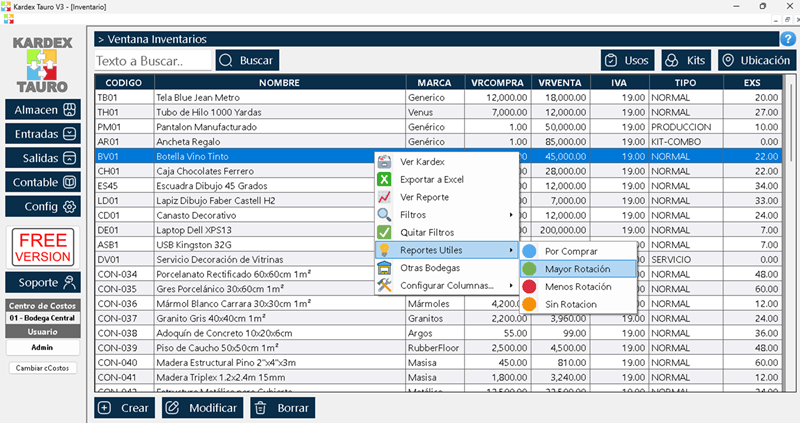
The formula is the easy part. The hard part is keeping the data current: the reorder point only works if the balance you compare against it is real. If your records say 80 units remain and there are actually 45, you will always order late, no matter how well the point was calculated. That is why the discipline of recording every entry and exit is worth more than any formula: software like Kardex Tauro records every entry and exit so that the formula starts from real data instead of estimates made from memory.
With the points defined, daily operations become a short list of comparisons: which product crossed its reorder point today? With a program like Kardex Tauro, the balance of each product updates with every recorded movement, and checking against the reorder point takes seconds, not an afternoon of manual counting. And when the order arrives, recording the receipt confirms that the cycle closed and that the point is still right for the current sales pace.
Your plan for this week
You do not need anything complex to get started. Do this in order:
- Pick the five best-selling products in your business.
- Calculate each one's daily consumption from the last 30 to 90 days of sales.
- Measure the real lead time: check when you placed your last order and when the merchandise arrived.
- Set safety stock as the extra days you want to cover, for example 20% or 30% of the consumption during the lead time.
- Apply the formula and write down each product's reorder point on a visible table.
- Review the points every month and every time a supplier or a season changes.
The reorder point does not remove the uncertainty of business, but it does remove the avoidable part: running out of stock because you did not notice in time. With the formula, good movement records and periodic review, replenishment stops being a gut feeling and becomes a calculated decision, product by product.
