Minimum and maximum stock: how to set levels to avoid stockouts and overstock

Minimum and maximum stock: how to set levels to avoid stockouts and overstock
Every business that sells goods lives between two fears: running out of a product right when a customer asks for it, or holding too much product that does not move while the money stays frozen on the shelf. Owners of small stores know both scenarios well. The first one is solved by buying more; the second one is solved by buying less. The problem is that both answers cannot work at the same time, which is why the business needs numbers instead of gut feelings.
Those numbers are the minimum and maximum stock for each product. Together they define a working range: above the minimum you have room to keep selling while the supplier delivers, and below the maximum you are not wasting space or cash. Setting them well is not paperwork: it is the decision you make every time you place an order, and it is the difference between having cash available and having it turned into stacked boxes.
What minimum stock means
Minimum stock is the quantity below which you start risking stockouts. Put simply, it is the point at which, if you do not order now, you will run out of goods before the next purchase arrives. You do not need theory to understand it, just an example.
Say you sell around three bottles of cooking oil a day and your supplier takes eight days to deliver an order. While that order is on its way, you will keep selling: in eight days you will move about 24 bottles. If today you have ten bottles on the shelf, you will hit zero halfway through and spend four days with empty space and customers asking questions. The minimum exists precisely to prevent that: it must cover the consumption of the days it takes the supplier to restock, plus a small buffer in case the delivery is late or sales run stronger than usual.
- Selling below the minimum means saying no to customers who were already at your door.
- It also means emergency purchases at the last minute, which almost always cost more and come from a different supplier.
- And when stockouts repeat, the customer learns to look for the product somewhere else, and that habit is not won back with a discount.
What maximum stock (maximum inventory) means
Maximum stock is the ceiling: the quantity you should not exceed even when the supplier offers a good price, because beyond it the product stops working for you and starts working against you. Every extra unit takes up space, and space in a small store costs the same whether it is full or empty. But the most treacherous cost is not the square footage: it is the money.
When you overbuy, that cash stops being available for everything else: the employee's wages, the rent, replenishing a product that is actually selling fast, or simply a cushion for an unexpected expense. On top of that comes physical risk. A bag of rice that gets damp, a jar that expires, a package damaged by sitting stacked for months: all of it is money you bought and will never recover. Maximum inventory protects you from yourself at the very moment it is hardest to resist: when the salesperson calls with a deal.
How to calculate them: two simple rules
You do not need a supply chain engineer to get started. Two rules are enough, and over time you adjust them with your own data.
The first rule sets the minimum. Calculate your daily consumption by dividing what you sold of the product last month by 30 days. Multiply it by the days your supplier takes to deliver, then add a safety margin of 15 to 25 percent, or the equivalent of a few extra days of sales. The result is your minimum stock. The logic is straightforward: that number covers everything you will sell while the order is in transit.
The second rule sets the maximum. Add your usual purchase lot to the minimum stock: the quantity you normally order each time, which almost always matches the supplier's case size or presentation. If your business buys little and often, you can also use one or two months of consumption as the maximum reference. That gives you a ceiling that lets you order confidently every time you hit the minimum, knowing the whole order fits in your storage without going overboard.
- Pull the real consumption of the last three to six months, product by product. Do not invent the number: use your recorded sales.
- Measure each supplier's real delivery days, not the ones they promise. If they promise three and take six, work with six.
- Choose the margin per product: tight for cheap goods that turn fast, more generous for those that take longer to restock.
- Set the minimum and maximum, write them in your inventory records and run with them for a month.
- Adjust: no number comes out perfect on the first try, which is why step five is part of the method.
Example with five products moving at different speeds
The best way to see it is with real numbers from a small neighborhood store. Below are five products with very different sales speeds, their delivery times, and the minimum and maximum that result from applying the rules. Notice that the minimum always covers the consumption during the delivery time plus a buffer, and the maximum adds the usual purchase lot.
| Product | Monthly consumption | Supplier delivery | Approx. daily consumption | Suggested minimum stock | Suggested maximum stock |
|---|---|---|---|---|---|
| Rice (2.2 lb bag) | 300 units | 6 days | 10 units | 75 units | 225 units |
| Cooking oil (1 L bottle) | 90 units | 8 days | 3 units | 30 units | 90 units |
| Canned tuna (6 oz can) | 120 units | 12 days | 4 units | 60 units | 108 units |
| Laundry detergent (17.6 oz pack) | 45 units | 10 days | 1.5 units | 20 units | 44 units |
| Tomato sauce (jar) | 18 units | 15 days | 0.6 units | 12 units | 24 units |
Why each product needs different levels
Let us walk through two rows so the table does not stay as dead text. The cooking oil sells 90 bottles a month, about three a day. With an eight-day delivery, 24 bottles go during the order; the minimum of 30 adds a six-bottle buffer, roughly two extra days of sales. Since its usual purchase lot is 60 bottles, receiving the order takes inventory from 30 up to 90, which is exactly the maximum. The whole cycle stays inside the range.
Now look at the tomato sauce: it sells less than one jar a day. If you applied the same mental recipe as the oil, you might think ten jars is plenty, but its supplier takes 15 days. During that time about nine units go, so a minimum of 12 is barely enough to make it to delivery day. Slow products with slow suppliers hide the most stockouts, because the eye says there is plenty while the math says there is not. That is why it pays to record the levels and let the number decide.
Do not obsess over decimals or perfect rounding. A minimum of 12 or 15 plays the same role if your supplier is reliable; what matters is the order of magnitude and periodic review. For perishable goods or short-lived trends, trim the maximum to what you sell in a few weeks, even if the supplier's lot is bigger.
When the system tells you that you hit the minimum
Reaching minimum stock is not bad news: it is the signal that it is time to order. That is the exact point where you place your replenishment order with the peace of mind that you still have goods to sell while it arrives. The practical problem is that, with hundreds of SKUs, nobody is going to count them one by one every morning.
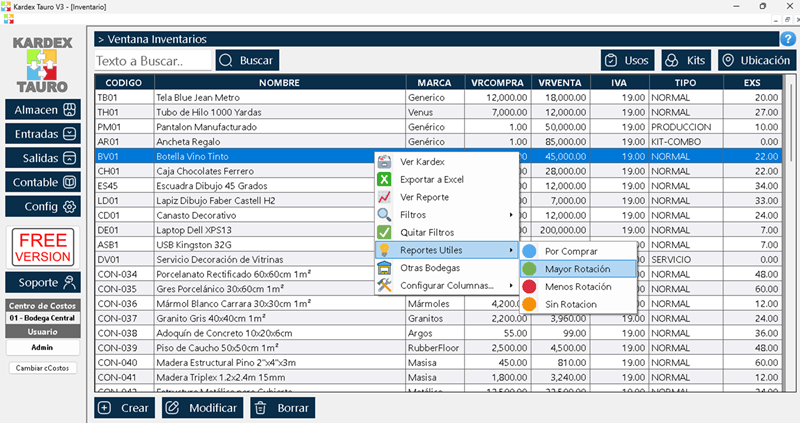
That is where organized records come in. If you keep your inventory in a stock ledger system, as you can with Kardex Tauro, the program can warn you when a product reaches its minimum level, and you only deal with the ones that truly need it. The alert saves you from two classic mistakes: panic buying when the shelf is already empty, and impulse buying when someone thinks it "looks low" without checking the numbers.
When the alert arrives, the procedure is simple: confirm that consumption is still as expected, check whether a season is coming up, and order the usual lot. With the maximum set properly, you know in advance that the order will not leave your storage overflowing: you just approach the ceiling, and the next minimum alert comes when inventory drops again.
How the maximum prevents overbuying
Overbuying almost never starts with bad intentions. It starts with a salesperson offering a 15 percent discount if you take double, or with the idea that buying a lot at once takes the problem off your plate. Maximum stock forces you to ask an uncomfortable question before accepting: how many weeks of sales does this deal represent, and does it fit in my store?
If your maximum for canned tuna is 108 cans and the supplier offers 200 with a discount, the price per can drops a few cents, but you pay the difference in space, cash and risk. Those are 92 cans above your ceiling that will sit on the shelf for more than two months, and if consumption drops for any reason, that lot becomes a problem you also paid for in advance. The practical rule is simple: a volume discount only makes sense when the lot fits inside your maximum, or when you are sure faster turnover will justify it within a few weeks.
Money has a single life in a small business: either it is working in sales or it is sitting still. Every dollar invested in slow-moving goods is a dollar not available to pay the payroll, the rent or the next order of the product that actually sells. Maximum inventory is the tool that keeps that balance, and it shows up more in the bank account than on the shelf.
Reorder point, safety stock and minimum stock: relatives, not twins
It is easy to confuse minimum stock with two other concepts that sound similar, but it is worth being clear about each one, even if you use them as a single number at first.
- Minimum stock is your operating rule: the level below which you order so you do not run short. It is the one you use day to day.
- The reorder point is the more precisely calculated level that triggers the order when inventory drops to it; in simple businesses it usually sits very close to the minimum, which is why they get mixed up.
- Safety stock is the extra cushion that protects you from variability: an unusually strong sales week or a late delivery. It is part of the minimum when you add a margin, but it can also be managed as a separate layer.
For a small business that is starting to organize its inventory levels, you do not need to separate the three with surgical precision. Use the minimum with its margin included as your buying signal, and later, if a specific product keeps failing you because of demand spikes, add extra safety stock to that product alone and you are done. The important thing is not to assume they are freely interchangeable: the minimum with a margin is already a practical version that merges reorder and safety into a single number that is easy to explain to whoever runs the store.
Review the levels against your real sales
No minimum or maximum lasts forever. Sales change with the season, suppliers change their lead times, and products change position in the catalog. A level that was perfect in January can be off by March, when rice consumption goes up or the supplier starts taking three extra days. That is why the golden rule is to review your levels every one to three months, and always after a big change: a new product, a different supplier or a peak season.
Reviewing is data work, not memory work. With an up-to-date stock ledger, like the one you keep in Kardex Tauro, you compare in minutes the real consumption of the last few months against the levels you have set, and you adjust the numbers that drifted. Without reliable records, the review becomes opinions; with records, it becomes a one-afternoon decision each month that prevents stockouts and overstock for the rest of the year.
Start simple: set minimums and maximums for your twenty most important products, run for a month and correct. You are not chasing mathematical perfection; you are chasing not running short when the customer shows up and not drowning in goods when the supplier calls. With those two numbers in place, purchasing stops being a guessing game and becomes a procedure that anyone in charge of the store can follow.