IAS 2: what the standard says about inventory (explained for small businesses)

IAS 2: what the standard says about inventory (explained for small businesses)
If your business buys or makes products to sell, inventory is probably one of the largest items on your balance sheet. Yet few small business owners can say exactly what should be recorded as inventory, which costs may be added to its value, and when that value should be written down. IAS 2 is the international standard that answers those questions. Understanding it is not only an accountant's concern: it is a practical tool for knowing what the goods in your warehouse are really worth, how much profit your operation is generating, and how reliable the reports you receive every month are.
In this article we explain, in plain language and with a numerical example, what IAS 2 regulates, which costs form part of the value of your inventories, which ones stay out, how inventory is measured at each closing and why all of this ends up affecting your profit and your taxes. By the end, you will understand why a properly maintained valued stock record, a stock ledger, is not just paperwork: it is the starting point of trustworthy financial statements.
What is IAS 2 and why should a small business care?
IAS 2, International Accounting Standard number 2, is the standard that governs the accounting treatment of inventories within the IFRS framework. It defines what counts as inventory, which costs make up its value, how inventories must be measured after initial recognition, and what information a company must disclose about them in its financial statements. In practice, it is the guide that answers the question every trader asks: at what amount should I be carrying the goods I have in stock?
Although it was designed to apply to companies of any size, its principles are the same ones used by the IFRS for SMEs in its treatment of inventories, and many local accounting frameworks are inspired by it. That is why understanding IAS 2 is useful even if your company is not required to apply full IFRS: the concepts of cost, net realizable value and write-downs appear, with local nuances, in almost every accounting framework in the world.
It is also worth clarifying what falls outside its scope. The standard does not apply to financial instruments, to biological assets related to agricultural activity that are measured at fair value, or to construction contracts, which have their own rules. For a typical small business, the essential point is that IAS 2 deals with goods held for sale, work in progress, raw materials and supplies consumed in production.
What counts as inventory?
For the standard, inventories are assets held with one of three purposes: to be sold in the ordinary course of business, such as the merchandise of a store or the finished goods of a factory; to be in the process of production for that sale, such as semi-finished goods; or to be consumed in production or in rendering services, such as raw materials, packaging and supplies. In a trading company, inventory is usually the merchandise purchased for resale; in a manufacturer, the story is longer, because value travels from raw material to finished product.
The golden rule for telling inventory apart from other assets is to ask how the company expects to recover that value. If it expects to turn the item into cash by selling it, or by using it to produce what it sells, within its normal operating cycle, it is inventory. That is why a machine is not inventory: although it takes part in production, the company does not plan to sell it in the ordinary course of business, so it is accounted for as property, plant and equipment.
Which costs do form part of the value of inventory
The central point of IAS 2 is that inventory is not recorded at the amount on the supplier's invoice, but at all the costs necessary to bring the product to the point where it is ready to sell. This is called the cost of inventories, and the standard organizes it into three groups: cost of purchase, cost of conversion and other directly attributable costs.
Cost of purchase
This is the cost of buying the merchandise and bringing it to the location and condition in which the company will sell or transform it. It includes the purchase price; import duties and other non-recoverable taxes, that is, taxes the company cannot claim back or offset; transport, handling and insurance; and any other cost directly attributable to the acquisition. Trade discounts, rebates and similar items are deducted from the total. If your company imports goods, the international freight, insurance and duties are part of the cost of the inventory, not an expense of the period.
Cost of conversion
This is the cost of turning raw materials into finished products. It includes the direct labor involved in production and both fixed and variable production overheads, allocated in a systematic way. Fixed production overheads are those that do not change with the volume produced, such as the rent of the plant or the depreciation of machinery; variable overheads, such as power or indirect materials, do change with that volume. The standard requires fixed overheads to be allocated on the basis of the normal production capacity, not on the actual output of an unusually low month, so that idle capacity costs are not absorbed into inventory. Conversion cost can also include, in some cases, the labor and costs of other processes, such as designing a product for a specific customer.
Other costs to bring inventory to its selling condition
The standard allows any other cost to be included, as long as it is necessary to bring the inventory to its present location and condition for sale. The classic example is the cost of designing and developing a product made to a customer's specifications, or the cost of special packaging without which the product cannot be delivered. The test is simple: if that outlay were not necessary to have the product ready to sell, it does not belong in inventory.
Which costs do not belong in inventory
Knowing what to exclude is as important as knowing what to include. The standard clearly rejects four groups of costs:
- Abnormal waste of materials, labor or other production costs, meaning amounts that exceed what is considered normal for the process.
- Storage costs, unless that storage is a necessary step of the production process before moving to the next stage.
- General administrative overheads that do not contribute to bringing the inventory to its selling condition.
- Selling costs, such as commissions, advertising and distribution of the finished product.
This has a direct practical consequence: paying for warehouse space to store finished goods that are already ready to sell does not increase the value of inventory; it is recognized as an expense of the period. The same applies to head-office costs or the commissions of the sales team: however valuable they are for the business, they are not part of the value of the goods.
Measurement after recognition: the lower of cost and net realizable value
So far we have talked about how the initial cost of inventory is formed. But inventory stays on the balance sheet until it is sold, and during that time its value may stop being recoverable. IAS 2 therefore requires that, at each balance sheet date, inventory be measured at the lower of its cost and its net realizable value, known by its acronym NRV.
What is net realizable value? It is the estimated selling price in the ordinary course of business, less the estimated costs of completion and the estimated costs necessary to make the sale. It is an entity-specific estimate, not a generic market value: it depends on what that particular company expects to receive and to spend. If NRV is lower than cost, the company will not recover what it invested, and the difference must be recognized immediately as a write-down, instead of waiting for the loss to materialize when the sale happens.
A numerical example: cost against net realizable value
Let us see how the rule works with two products that cost the same amount but have different futures.
| Item | Product A | Product B |
|---|---|---|
| Recorded cost of inventory | 100 | 100 |
| Estimated selling price | 120 | 160 |
| Less: estimated costs of completion | (20) | (10) |
| Less: estimated costs to sell | (15) | (20) |
| Net realizable value (NRV) | 85 | 130 |
| Final amount in inventories (the lower) | 85 | 100 |
Product A is the case that justifies the rule. It cost 100, but the company estimates it will recover only 85 after completing and selling it. Since the cost will not be recovered, the inventory is written down to 85 and the difference of 15 is recognized in the period as a write-down, reducing that month's profit. Product B, on the other hand, has an NRV of 130, higher than its cost. Here the rule prevents a very common mistake: inventory is not revalued upward, because the standard does not allow recognizing gains from holding inventory. Product B stays at 100, and the profit will be recognized only when it is sold.
The standard also covers the opposite situation: if in a later period circumstances change and NRV recovers, the write-down can be reversed, but only up to the amount of the original cost. Inventory should never be carried above what it cost.
Why this affects your profit and your taxes
The value of ending inventory appears on the balance sheet as an asset, and its change from one period to the next enters the income statement through the cost of sales. The basic formula shows it: beginning inventory plus purchases minus ending inventory equals the cost of goods sold. If ending inventory is overstated, cost of sales looks smaller and profit looks larger than it really is; if it is understated, the opposite happens. That is why a valuation error in inventory is not a warehouse detail: it distorts profit, equity and the decisions you make based on those numbers.
The write-down to net realizable value has an additional effect: it turns a latent loss into a recognized loss of the period, reducing accounting profit before the product is even sold. And here comes the point that generates the most questions: the accounting standard is not the tax rule. In many countries, the tax deduction for inventory write-downs has its own conditions, and the tax base is determined under rules that may differ from financial reporting. It is entirely possible that your accounting income statement and your tax return tell different stories about the same inventory. So, before assuming that an accounting adjustment is automatically tax-deductible, review the case with your accountant.
The connection with the valued stock record (stock ledger)
All this theory only becomes useful if the company knows, at all times, how many units it has and at what cost. That is exactly the role of the valued stock record, the stock ledger: the record that tracks the entries, the exits and the balance of each product, in quantities and in values, in chronological order. With an up-to-date stock ledger, the cost of sales can be computed under the method the company applies, such as weighted average cost or first-in, first-out (FIFO), which are the cost formulas the standard admits; it also makes it possible to detect shortages and shrinkage in time, and to review product by product whether its net realizable value is still above cost.
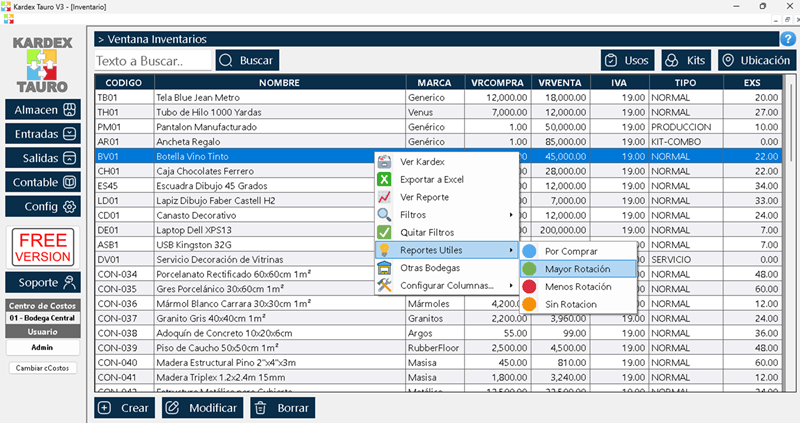
Keeping that control by hand, in notebooks or in scattered spreadsheets, is slow and prone to errors, especially as the number of references grows. That is why many small businesses use an inventory program that feeds the valued stock record automatically with every purchase, sale or return. A tool such as Kardex Tauro helps keep that record in quantities and values without depending on files that go out of date, so that the cost of sales and the ending inventory value come from one reliable source. The standard tells you what to measure; a well-kept stock ledger tells you how much you have and what it cost you.
In summary
IAS 2 is not a distant standard written for large corporations. It tells any business that sells or produces goods what to include in the value of its inventory: the cost of purchase, the cost of conversion and the costs needed to make the product ready to sell. It also tells you what to leave out: abnormal waste, unnecessary storage, administrative and selling costs. And it asks for an exercise of honesty at every closing: compare the cost of each inventory with its net realizable value and recognize immediately the losses that are already foreseeable. That exercise protects your profit from surprises, improves the quality of your financial statements and gives you solid ground to apply for credit, set prices and make decisions. Master these concepts, rely on good inventory control, with tools like Kardex Tauro, and let accounting technique work in favor of your business.
This article is for educational purposes and does not replace the advice of your accountant.