Goods receiving: an 8-point checklist to avoid losing money at the dock

Goods receiving: an 8-point checklist to avoid losing money at the dock
Receiving goods looks like the simplest step in your operation: the order arrives, the boxes come off the vehicle, you sign and put everything away. In practice it is one of the moments where businesses lose the most money, because it is exactly where inventory is born. What you do not check in that half hour does not show up in a week: it shows up a month later, when the supplier no longer answers the phone and the invoice is already paid.
This article gives you an 8-point checklist for receiving goods with no gaps: what to have on hand before the first box is opened, what to count, what to inspect and what to sign. Every point is designed for a small or medium warehouse, with no quality inspectors or fancy equipment: you only need order, a document and twenty well-spent minutes.
Why receiving is where money is lost (or saved)
In any business that sells physical products, inventory is born at receiving. Before that moment, the goods belong to the supplier and are in transit; after the signature, they are yours and they show up in your accounts payable. That change of ownership makes receiving the only point where you can reject, return or discount something without fighting for it later. Once that moment passes, any difference becomes a claim: and claims take time, get forgotten, or die when the supplier says «it left the warehouse like that».
Put numbers to a common case. You receive 100 units of a product, the carrier drops off 4 boxes and you sign without opening them. Weeks later, during a stock count, you find that one box held 20 units instead of 25. By then the supplier has invoiced all 100, you have already paid, and the box went down as received in good order. Nobody pays for those 5 missing units: you do, twice, because you also over-ordered to cover a shortage that never existed.
The golden rule: receive first, pay later
One rule summarizes this whole article: receive first, pay later. The most expensive mistake in business is not buying badly: it is signing without checking. Your signature on the delivery note, the invoice or the carrier's document has consequences: it certifies that you received that quantity, in that condition, at that price. When you sign without looking, you hand the supplier and the carrier proof that everything arrived perfect, even when it did not.
This is not about distrusting everyone. Receiving well is free, and receiving badly is expensive. Checking does not offend anyone, and a serious supplier expects the customer to count the goods: it is the only way both sides sleep well at night. What really hurts is the money lost for not looking.
The 8-point goods receiving checklist
Print this table, put it in your receiving area and use it on every delivery. Eight points, in order, and none takes more than a couple of minutes.
| Done | Point | What to do in practice |
|---|---|---|
| ☐ | 1. Have the purchase order and the supplier's invoice or delivery note on hand | Without these documents there is no way to know what was agreed. Have them printed or on screen before the vehicle arrives. |
| ☐ | 2. Physically count the boxes and packages against the transport document | The carrier is responsible for packages, not units. If boxes are missing, note it on their document before they leave. |
| ☐ | 3. Open and count units against the purchase order | The supplier's delivery note can carry mistakes. The purchase order is the contract: count units against it, not packages. |
| ☐ | 4. Check the condition of packaging and product: damaged, damp or dented | Set damaged goods aside and photograph each issue next to the document. Do not mix them with healthy stock. |
| ☐ | 5. Check expiry dates and batch numbers, when applicable | For food, cosmetics or supplies with expiry dates, record batch and date. Decide whether to accept what expires soon. |
| ☐ | 6. Verify prices, discounts and terms against what was agreed | Compare the unit price on the invoice with the purchase order. A pricing «mistake» repeats on every order. |
| ☐ | 7. Sign only for what was received as conforming, noting shortages and issues | If something does not match, do not sign «received in full satisfaction». Write the issue on the document itself and keep a copy. |
| ☐ | 8. Record the receipt into inventory the same day | Goods received but not recorded do not exist for your stock. Enter them the same day, with real quantities and costs. |
Before the first box is opened: points 1 and 2
Point 1 is the purchase order. If the delivery arrives and you do not have the purchase order at hand, you are receiving blind: you cannot tell whether they sent what you ordered, at the agreed price, under the agreed terms. Keep the document close, on paper or on your phone, and compare it with the invoice or delivery note the supplier brings. If the data does not match (product, quantities, prices), that is the moment to ask questions, not later.
Point 2 looks obvious and is the one most people skip: counting the boxes as they come off the vehicle. The carrier does not know the contents of your order: their responsibility ends at the packages they deliver. That is why the box count is done against the transport document, in front of the driver, and any shortage is written on that document before they sign. If you let the carrier leave without that note, your claim for missing packages has no evidence.
Use the unloading time to look at the boxes:
- Boxes re-packed or taped with tape different from the usual one.
- Boxes that feel odd in weight or make strange sounds when moved.
- Crushed, damp or stained packaging.
- Broken seals or locks on the vehicle.
Box open: units, condition and expiry dates (points 3 to 5)
Point 3 is where most businesses lose money without realizing it: opening and counting units against the purchase order, not against the supplier's delivery note. The delivery note is written by the seller and can contain errors in their favor: inflated quantities, products you did not order, different prices. The purchase order is the document you control. If the supplier sends 48 units and the order said 50, the order wins: the difference gets noted and claimed. If you receive hundreds of units and cannot count everything the same day, prioritize: always count 100 percent of what is expensive and what turns fast, and do not sign the rest as conforming until it is counted.
Point 4 is the condition of what arrives. A dented box can hide damaged product, and damp packaging can ruin healthy goods overnight. Physically separate anything damaged, damp or dented into a holding area, photograph each affected piece next to the delivery document and write down the detail. That photo and that note are your only proof if you later need a replacement or a discount.
Point 5 applies to everything that expires or is tracked by batch: food, beverages, cosmetics, medicines, materials with a shelf life. Check the expiry date of each batch and record it together with the quantity received: that tells you what leaves the shelf first and what must be shipped before the rest. If the supplier sends product that expires soon, decide at receiving whether you accept it with a discount or send it back; deciding later is much harder.
Prices, terms and the signature: points 6 and 7
Point 6 is thirty seconds of arithmetic that almost nobody does: comparing the unit price on the invoice with the purchase order and checking discounts, freight and taxes. Price errors rarely happen only once: if the supplier overcharges on this order and nobody notices, chances are it will repeat on the next ones. Checking today saves you from claiming every month.
Point 7 is the signature, and it deserves your full attention. When everything matches, sign normally. When it does not, you have two options: refuse to sign and hold the goods while it is sorted out, or sign noting the issue on the document itself. The second one is the common and valid practice: write «received 45 of 50 units» or «2 boxes missing» next to your signature and ask for a signed or stamped copy. Never sign «conforming» and keep the claim only in your memory: memory is not evidence.
Recording the receipt: point 8, the most profitable one
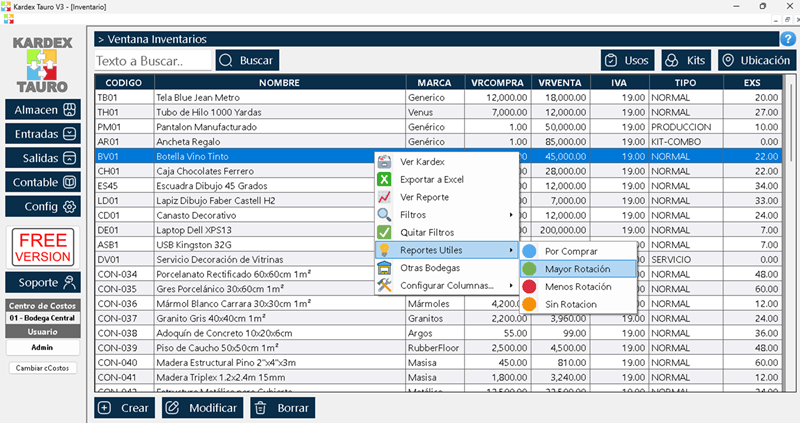
Point 8 is what turns receiving into inventory. Until the goods you received are recorded, your stock says one thing and reality says another: the system shows fewer units than you have, you over-order to cover a shortage that does not exist, and you sell with wrong numbers. Recording the receipt the same day, with the verified real quantities and their cost, keeps your stock honest: counts match, purchases are planned on true data and the cost of goods sold is calculated right. Recording the entry as soon as it is verified stops your stock from lying, and doing it inside a stock ledger system such as Kardex Tauro leaves the traceability ready: who received, on which day, at what cost and against which order.
If you receive goods every day, make it a routine: the receipt is recorded the same day, or the person responsible explains why not. One careless hour at receiving is paid back with days of reconciliation later.
What to do with discrepancies: shortages, overages and damage
A delivery that arrives perfect is what you hope for, but it is not the norm. Boxes go missing, extra units show up, product arrives damaged; the difference between losing money and not losing it is the procedure, not luck. With any discrepancy, the order is always the same: note it, notify, and agree on the solution.
| Discrepancy | What you do | What to expect from the supplier |
|---|---|---|
| Shortage | Write the missing quantity on the delivery document and notify in writing. | Replacement of the difference or a credit note for its value. |
| Overage | Do not mix it into stock: check whether it is an error or an extra shipment. | Instruction to return it, with shipping on them, or invoice it separately. |
| Damage | Separate, photograph and quantify the damage before storing anything. | Replacement, discount on the invoice or credit note. |
Deadlines matter. Notify the discrepancy in writing within the first 24 to 48 hours: many suppliers have claim windows that, if you let them pass, leave you with no rights at all. Your message includes the date, the order number, the detail of the difference and the photo, if there is one. Then agree on the way out: replacement of the goods, a credit note or a discount on the next invoice. And do not overpay: pay for what you received as conforming and keep the disputed balance documented.
Let us summarize. Receiving is the only moment in the purchasing cycle where you can fix things without a fight. With eight points (documents at hand, packages counted, units verified against the order, condition checked, expiry dates noted, prices compared, signature with issues noted and receipt recorded the same day) the moment of receiving stops being a lottery and becomes a procedure. The day you record a verified receipt in your stock ledger, you will go to sleep knowing that what your inventory says is true; tools such as Kardex Tauro are built so that receipt is recorded on the spot, with every number verified. Receiving well costs nothing; receiving badly costs a lot. Choose which side of that account you want to be on.
