Inventory for a minimarket or corner store: simple control that works
Inventory for a minimarket or corner store: simple control that works
Running a minimarket or a corner store is not the same as managing a large supermarket, but it has a challenge few people talk about: the assortment grows every week, sales are many and small, and almost all the control lives in the owner's head. When the store starts out, with thirty or forty products, memory is enough. You know how much rice is left, how many sodas are in the cooler and which carton of milk is close to expiring. But once the assortment passes one hundred and fifty or two hundred items, mental control starts to fail: what we thought we had runs out, what we thought was sold is still there, and the day's shortage cannot be explained anywhere.
The good news is that keeping inventory control in a corner store does not require becoming an accountant or filling endless forms. It requires five simple rules, applied with consistency. This article explains them one by one, with the daily, weekly and monthly routine of a real storekeeper, so that control takes a few minutes a day and prevents the losses almost nobody talks about.
Why the corner store loses money without noticing
Before talking about methods, it helps to look at the typical problems of a minimarket face to face. The first one is the assortment: hundreds of small items with low prices but fast turnover: bread, milk, soda, cookies, cigarettes, cleaning supplies. Each one seems unimportant, but together they represent most of the money and the space. With such low prices, it only takes a few of them getting lost for the day's profit to disappear.
The second problem is expiration. In a corner store, foods with short dates live side by side: dairy, juices, cold cuts, sliced bread. A single expired carton of milk left on the shelf is not only lost money: it is a terrible image for the customer who sees it or, worse, buys it by mistake. The third problem is cash. In the minimarket, sales money gets mixed with household expenses, the family groceries and the change from the cooler, and at the end of the day nobody knows how much was really sold.
The fourth problem is suppliers who leave goods on credit or on the fly: the delivery driver hands over the merchandise, writes it in his notebook and comes back to collect a few days later. That is normal practice, but if the storekeeper does not record that delivery the same day, he loses track of what he owes and what he received. And the fifth problem is the quietest one: the family. The owner takes a product from the shelf, a son drinks a soda, a candy is given to a neighbor, and none of that is recorded. It is not malice: it is the lack of rules. At the end of the month, the inventory does not match and nobody can explain why.
Rule 1: everything that comes in gets recorded the same day
The first rule is the most important and the simplest: everything that enters the store is recorded the day it enters, without exception. It does not matter if it was a cash purchase at the wholesaler, an order that will be paid in fifteen days, or the goods the soda distributor left on credit. If it comes in, it gets recorded: which product, how many units and at what price.
This sounds obvious, but in practice it is the first thing that gets abandoned. The delivery driver arrives at lunchtime, when the store is full; the storekeeper receives the merchandise on the fly, puts it on the shelf and swears he will write it down tomorrow. Tomorrow three more deliveries arrive and the driver's note gets lost. Weeks later, when the driver comes to collect, the arguments start about how many boxes there were and what price was agreed. Recording it the same day, right after receiving it, avoids that kind of argument and gives the storekeeper the upper hand when he is right.
For this you do not need a fancy system: an entry notebook, a spreadsheet or a phone are enough. What matters is consistency and that the note includes the date, because the purchase price changes from one delivery to the next and that data is what allows calculating the real profit later.
Rule 2: big outflows get recorded too
The second rule is the sister of the first one and almost nobody follows it: outflows that are not sales also get recorded. There are three main ones. Returns to the supplier: product that arrived damaged, dented or close to expiring and goes back; if it is not recorded, the inventory says it is still in the back room and the supplier says he already picked it up. Family consumption: what is taken, eaten or used from the store for the house must be recorded, even at cost, because otherwise that consumption shows up as a shortage and a loss. And shrinkage: expired or damaged product taken off the shelf.
On shrinkage, it is worth being blunt: expired product does not stay on the shelf and is not fixed by changing the date by hand. It is removed the same day it is found and the loss is recorded. Writing it down hurts, but that pain is what pushes you to buy better, rotate better and stop over-ordering. A store that never records a loss is not a perfect store: it is a store that does not know how much it loses.
Rule 3: the cooler and the dairy get checked daily with FEFO
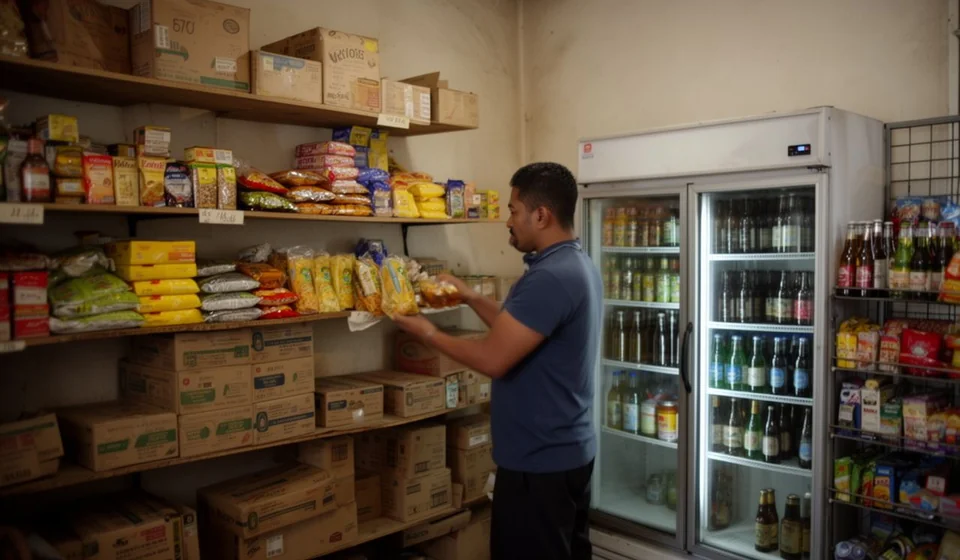
The cooler is the heart of the minimarket: sodas, beers, dairy, juices and cold products concentrate a large share of daily sales and, at the same time, the most urgent expirations. The rule for the cooler is called FEFO: first expired, first out. In plain words: every time new merchandise arrives, it goes in the back, and what was already there moves to the front. That way the customer always takes the oldest item and the product does not age hidden against the back wall.
The cooler check is daily and takes two minutes. You look at the front row of each product, take out what is close to expiring in the next few days and put it where it will sell first: the discount shelf, the basket near the register or, if it is very close to the date, you decide whether it will be consumed, sold at a discount or discarded and recorded. Dairy needs special care because its date is short and customers check it before buying: an expired milk in the cooler can cost the sales of the whole aisle.
Rule 4: weekly count of the best sellers and monthly general count
No storekeeper needs to count the whole store every week. What does make sense is a quick weekly count of the twenty best-selling items: in almost any minimarket, a small handful of products, such as bread, milk, soda, cigarettes, eggs or coffee, explains most of the day's sales. If those twenty are under control, the store breathes. The count is simple: you check how much is left of each one, write it down and compare it with what the record says. Ten minutes on a fixed day of the week are enough.
Once a month, the general count of the back room takes place, ideally on the same day as the physical inventory. It is the only way to discover silent shortages: the candy that was given away, the package that got damaged, the box the driver said he brought and never arrived. The monthly count is also the moment to adjust the record to reality and to ask, with numbers in hand, what is being over-ordered and what is permanently missing.
Rule 5: daily cash reconciliation
The fifth rule is the one that brings the most peace of mind and the least practiced: reconciling the cash register every day. At closing time, you add up the day's sales, count the cash in the register and compare them. If there is money over or short, it is not the end of the world: it is information. Experience says that what does not match is almost always in two places: in goods handed to a customer who will pay soon, the famous tab, or in expenses paid from the cash register and never recorded: the coffee, the bus fare, the family groceries.
The daily reconciliation takes five minutes and it is worth doing with the family member who works the counter, so that both see the numbers and neither carries unfair suspicion. When the shortage repeats, the golden rule is to look for the cause before paying the difference out of your own pocket: it is almost always a missing procedure, not a dishonest person.
The storekeeper's routine, in one table
So the rules do not stay in theory, this table summarizes the practical routine, with what to check every day, every week and every month. Printing it and keeping it near the register helps more than any advice.
| Frequency | What to check | How to do it |
|---|---|---|
| Daily | Cooler and dairy; cash; incoming goods | Apply FEFO when receiving; take out what is close to expiring; reconcile the cash against sales; record purchases and supplier credit the same day |
| Weekly | The 20 best-selling items; shelf expiration dates; orders | Quick count on the same day every week; rotate the oldest to the front; order from a list, not from memory |
| Monthly | General count; customer tabs; accumulated shrinkage | Complete physical inventory; review the tab book and collect pending debts; add up the losses and adjust next month's ordering |
Customer tabs: written down and with a limit
The tab is part of corner store life and banning it overnight can drive away lifelong customers. What can be done is to bring order to it. Every tab is recorded the same day, with the customer's name, the date and the product; a limit per customer is agreed out loud, and collection follows a method: whoever owes pays the oldest debt first. A tab notebook is enough, although a simple record on the phone or at the register helps avoid losing pages. A tab that is not written down is not trust: it is a hole in the register that someone will have to pay.
Why mental control stops working
No storekeeper is negligent for trusting his memory: he is negligent for not adapting when the business grows. With fifty items, the head is enough. With two hundred, it is impossible to remember how many units of each product are left, which batch expires first and how much each customer owes. Mental control does not fail because of carelessness: it fails because the assortment grew faster than memory. The proof is in the classic symptoms: repeated orders of what there is plenty of, shelves full of what does not sell, shortages that no family member can explain and register arguments at the end of the month.
Moving from mental control to written control is not bureaucracy: it is the difference between guessing and knowing. And the change starts with a single decision: record everything that comes in, record the big outflows and reconcile the register every night.
Getting started without becoming an accountant
If this reading left you with the feeling that it is too much, start with less: this week, record every delivery the same day and reconcile the register every night. Next week, add the count of the twenty main items. The one after that, the daily cooler check. In a month you will have the full routine working in less than twenty minutes a day, without neglecting a single customer.
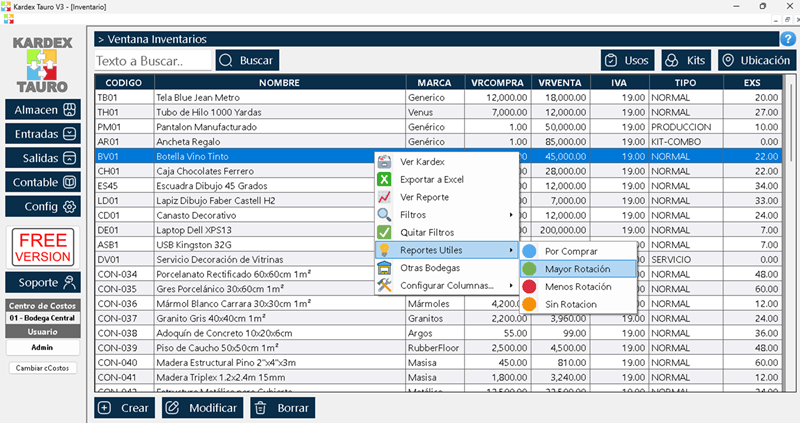
When notebook entries start getting in the way, a simple inventory system with invoicing, such as Kardex Tauro, records incoming goods, outflows and reconciliations automatically and leaves the time free for what really matters: serving the people who walk through the door well. Inventory control does not have to become a second job. With simple rules and consistency, the corner store can know, every day, how much it sold, how much it earned and how much it has. And that, for a business that lives day to day, is worth more than any sophisticated system.