Inventory for food distributors: batches, expiry dates and routes
Inventory for food distributors: batches, expiry dates and routes
If you distribute food to shops, restaurants and cafeterias, your inventory does not work like a spare-parts warehouse or a hardware store. Your products have expiry dates, your customers order today what they will sell tomorrow, and your driver leaves in the morning with a load that must come back as confirmed deliveries, cash and, sometimes, returns. This article explains how to keep that operation under control with five tools: batch control, FEFO dispatch, handling of route returns, controlled waste and the daily route reconciliation.
An operation that turns over fast and has a deadline
The food distributor combines three conditions that few wholesale businesses have at the same time: high volumes, margins that do not forgive waste, and sales that close out on the street, far from the warehouse and the desk. A poorly planned load creates two problems at once: product that comes back because it did not sell, and customers left without stock, who call the next day or move to a competitor.
On top of that, time works against you from the moment the goods arrive. A case of yogurt, fresh cheese or table cream has a sell-by deadline, and every day it sits on the shelf moves it closer to waste. That is why a distributor's inventory is managed by batch and expiry date, not as loose units stacked in the warehouse. What separates an orderly operation is simple:
- Product is identified by batch from the moment it arrives, not when it is about to expire.
- The vehicle is another point of sale: what is loaded wrong comes back or is lost.
- Customers mix payment methods and situations: cash, credit, exchanges, returns of product close to expiry.
When those three conditions are managed by hand, the owner ends up deciding from memory and loose papers. With an organized record, decisions are made with data.
Batch control: record the batch and the expiry date on every receipt
The first step is that every receipt into the warehouse is recorded with its batch and expiry date. Writing that 120 units of yogurt arrived is not enough: you must record which batch they belong to and when they expire. With that information, the inventory stops being a pile of identical boxes and becomes a list of items that can be sorted by urgency.
Recording the batch answers the questions this business asks every day: what expires first, how many units remain from each batch and, if a customer returns a box from a specific batch, who was sold that batch and how many units could be affected. It is the same logic as the barcode applied to the useful life of the product.
An example of batch control for a single product, natural yogurt sold per unit:
| Batch | Expiry date | Units received | Units sold | Units returned | Balance in warehouse |
|---|---|---|---|---|---|
| Y-1407 | September 30 | 120 | 96 | 4 | 28 |
| Y-1421 | October 15 | 200 | 140 | 0 | 60 |
With that table in view, the dispatch decision is direct: batch Y-1407 goes out first because it expires on September 30, and its balance of 28 units includes 4 returned units that were re-entered under their original batch. The balance is calculated as receipts minus sales plus re-entered returns: 120 minus 96 plus 4 is 28. If those 4 returns had not been recorded, the system would show 24 units while the warehouse holds 28: a mismatch that later shows up as unexplained shortages or surpluses.
FEFO dispatch: what expires first goes out first
FEFO stands for first expired, first out: the first thing that must leave the warehouse is what expires first. It sounds simple, but in practice it demands discipline, because the natural instinct is to dispatch what arrived first or what is closest at hand. The correct rule is to sort the warehouse by expiry date, not by preference or arrival order.
Practical rules for dispatch:
- Put the batches closest to expiry at the front of the shelf and the newer ones behind.
- Build each load from the expiry list, not from the warehouse keeper's memory.
- Instruct the warehouse staff to never dispatch a new batch while an older one is still waiting to go out.
- Check the batches that came back from the previous route before sending them out again.
Selling what expires first does not only protect your own waste: it also protects the customer who resells the product. A shop that receives yogurt with little shelf life left returns it or stops buying; a restaurant that receives fresh product with a good window becomes a steady customer.
Route returns: re-enter only what is still good
At the end of the day, the driver comes back with what did not sell: product the customer refused to receive, boxes that were not delivered, and units the customer returns because they are close to expiry or damaged. The golden rule is that not everything that comes back goes back on the shelf. Each return is classified before re-entering:
- In good condition with useful shelf life: re-entered to the original batch, with its date, and back in the FEFO line.
- Close to expiry, with damaged packaging or in bad condition: not re-entered; it goes to waste or to a special handling area, such as promotion, a supplier credit note or disposal.
If the re-entry is not recorded, the batch balance is wrong: the system says there are 24 units and the warehouse holds 28, or the other way around. And if damaged or near-expiry product is re-entered, the next route will carry it to another customer, who will return it again: waste travels in the vehicle, takes up space, costs fuel and hurts the relationship with whoever receives it.
Controlled waste: measure to negotiate and improve
In a food distribution business, waste has two main causes: expiry and damage in transit. Every write-off for either cause must be recorded with its reason. It may look like paperwork, but it is one of the records that saves the most money, because recorded waste becomes information for decisions.
With a constant waste record you can:
- Calculate how much is lost per month and per cause: expiry, damage, breakage.
- Identify the problem products, the ones that always end up unsold and expire.
- Negotiate with the supplier with figures in hand: product exchanges, credit notes, more frequent deliveries in smaller quantities.
- Measure whether the operation improves month to month and which decision worked.
Unrecorded waste is just money that goes away without a trace. Recorded waste shows where the problem is: if expiry weighs more than damage, the problem is in purchasing and dispatch; if damage weighs more, the problem is in loading and driving. Different diagnoses, different solutions.
Prices and price lists by customer
A distributor does not sell at a single price. The corner shop that buys three cases a week does not get the same treatment as the restaurant that orders twice a week, or the cafeteria that buys daily. That is why prices should be organized in lists: a list for shops, a list for restaurants, a list for high-volume customers, each with its own margin or reference price.
The correct list is assigned to the customer when the order is built, and the driver carries the invoice or delivery note with that customer's prices, not a general rate. That avoids two classic problems: overcharging the good customer and giving away margin to the small one.
The route load and the daily reconciliation
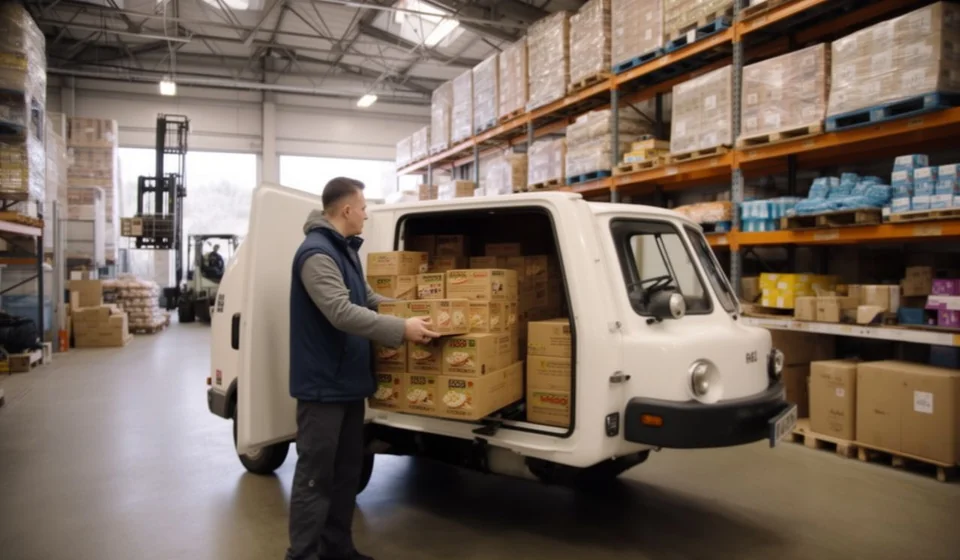
The load is built from the day's orders, not from total inventory. Each order is dispatched against available stock and, within it, against the batch that expires first. When the load is finished, the warehouse must be left with an explainable balance: what there was, minus what went out, is what remains.
An example of a route load with three products:
| Product | Day's order | Available in warehouse | Dispatched | Left in warehouse |
|---|---|---|---|---|
| Natural yogurt | 150 | 88 | 88 | 0 |
| Fresh cheese | 60 | 120 | 60 | 60 |
| Table cream | 45 | 40 | 40 | 0 |
Units are expressed in the selling package. In the case of the yogurt, the available 88 units are 28 from batch Y-1407 and 60 from batch Y-1421, so FEFO dispatch takes the 28 units of the batch that expires on September 30 first and completes with 60 from the October batch. The order asked for 150 and only 88 were available: the customer is told about the shortage before leaving, not when the driver arrives with less than promised.
At the end of the day, the sales route reconciliation uses three figures:
- Total invoiced on the route: everything that left the load and was delivered.
- Money received: cash and other payment methods from customers.
- Value of the returns received and of what is still pending collection.
The reconciliation formula is direct: the total invoiced must equal the money received plus the returns plus the balance to collect. If the sum does not match, there is a shortage or surplus that must be explained the same day, while the driver is still at the warehouse and the papers are fresh. Leaving it for tomorrow turns a small doubt into an unsolved problem.
What system a food distributor needs
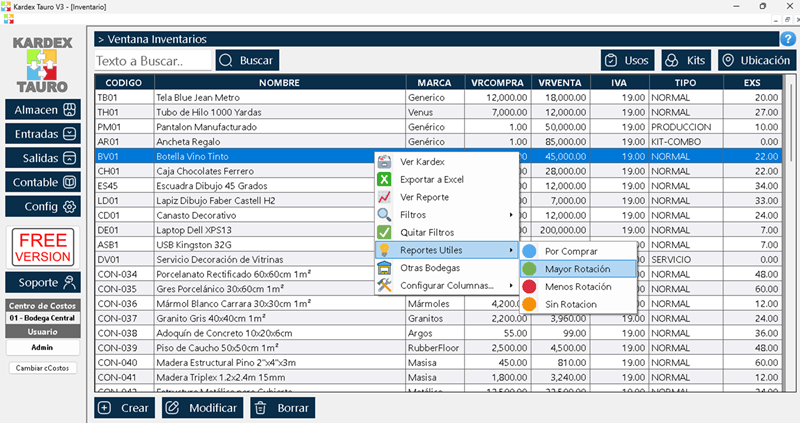
When the business grows, a spreadsheet cannot sustain this level of control: batches get mixed, expiry dates get lost between rows, and route reconciliation becomes a task that takes hours. What you need is a system that handles batches and expiry dates on every receipt and issue, controls prices by customer list, invoices the route, records returns and waste with their cause, and lets you reconcile the day against the load. An inventory program such as Kardex Tauro is designed for that job: every movement stays tied to its batch and the information is ready to build the next load.
A distributor's advantage is not only buying cheap: it is selling everything before it expires, arriving complete to customers, and knowing every day how much came in, how much went out, how much was lost and why. Batch control, FEFO dispatch and route reconciliation, properly kept with a program like Kardex Tauro, are what turn a high-turnover operation into an orderly, predictable business.
