Inventory for optical stores: frames, lenses and warranties without losses
Inventory for optical stores: frames, lenses and warranties without losses
A customer walks into the optical store mid-morning. He tries on three frames in front of the mirror, settles on one from the display stand and pays at the counter. It looks like a perfect sale, and it is: the problem starts afterward. The frame that just left was the only unit of that reference on display, and nobody wrote down that the showcase now has an empty spot. Three weeks later another person comes in asking for the same model, in the same color and in the same size. The salesperson checks and finds out there is nothing to show, or that only the model in another color or another size remains. The display lied: it looked as if the business had the product, when in fact it had been out of it for days.
That scene repeats itself in optical stores far more often than it seems, because their inventory has a special feature: it is made of unique, expensive, very similar pieces that move constantly between the showcase, the counter, the lab and the customer's face. A frame is not a nail or a bag of screws: it is a product that can be mixed up with ten others if it is not recorded properly, that gets damaged when handled carelessly, and whose value can be lost entirely with a single slip. This article organizes the item types that coexist in an optical store, explains why frames and warranties get lost, and leaves practical rules so that control does not depend on anyone's memory.
Why the inventory of an optical store is a special case
In a traditional inventory business, almost all items are identical: a hundred units of the same product are interchangeable and any of them will cover a sale. In an optical store the opposite happens. A frame that is sold leaves with a specific customer, and whatever remains of that reference may be in another color or another size; a lens is made for an exact prescription and will not work for someone else; and the warranty depends on knowing which piece, with which number, was delivered to whom.
Then there is the money. Brand-name frames and special lenses are among the most expensive products per unit that a small business can carry, and a large share of that value spends months on display without turning over. When a piece like that is lost, swapped or damaged, it is not a minor shortage: it is a large slice of the month's profit disappearing. That is why control in an optical store is not a back-office task, but a routine that belongs at the counter, in the lab and at the display stand.
The item types that coexist in an optical store
Before counting anything, you have to distinguish what is being counted. At least six types of items coexist in the same optical store, and each one is controlled in a different way. Mixing them up is the first reason the numbers do not add up:
| Item type | What it is | How it is controlled |
|---|---|---|
| Display frame | The one in the showcase or on the rotating stand, in front of the customer | Define whether it is sellable stock or a sample; if sold, replace it the same day |
| Boxed frame (stock) | The one kept in storage, not on display | By reference, color and size: every combination is a different item |
| Finished stock lens | Common single-vision lenses in the best-selling prescriptions | By prescription (sphere, cylinder, axis) and treatment, in units |
| Special-order lens | Progressives, bifocals or high-index lenses made to order | As an order, not as stock: date, lab promise, arrival and customer notice |
| Sample lens | The one used to demonstrate treatments and tints | As a sample: not sellable stock; replace it if it gets damaged |
| Supplies | Test drops, screws, nose pads, cords, cleaning cloths | Basic consumption: reorder at a minimum point or with a quick count |
The display lies if you do not decide what each frame is
The most expensive mistake an optical store can make is treating the display frame as if it were not inventory, or worse, as if it were inventory and a sample at the same time. The frame on display is not necessarily the one you sell: it is the one the customer sees. If you do not decide what role it plays, the count never balances, because the same piece counts as display, as stock and as a sale depending on the day.
The rule is to make one decision per line and stick to it. If the showcase is sellable stock, the displayed frame is one more unit of inventory: when it is sold it is deducted, and it is replaced with another identical unit from the box if one exists, or a purchase order is raised so the reference does not end up with a hole. If the showcase is a sample area, the frame is not sold: it plays a commercial role, it is marked as a sample, and if a customer falls in love with it, the boxed unit is sold and the sample is replaced with an identical one. What you cannot do is sell the sample, fail to replace it and leave the display lying to the next customer.
Reference, color and size: every combination is a different item
A black metal frame in size 52 is not the same item as the same model in black size 54, nor as the gold one in size 52. They sound alike, they look alike and they even share a box, but for inventory purposes they are three different products: each one has its own price, its own stock and its own demand. A record that only notes the model will tell you there are twelve units of the reference, but not how many are in the color and size the customer is asking for right now.
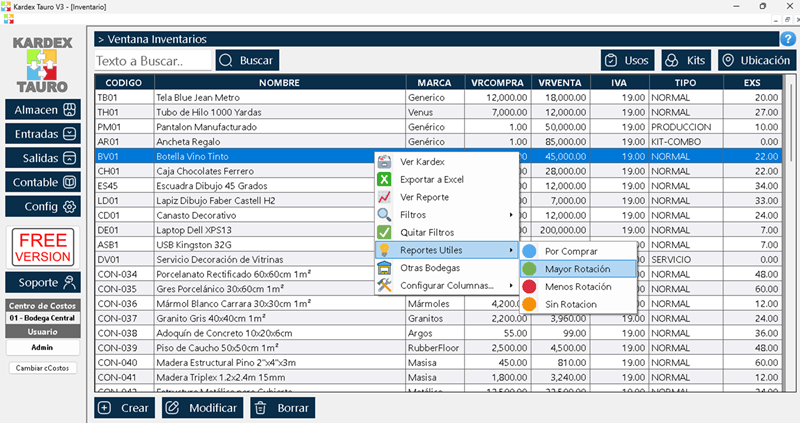
Most frames carry the reference and the size engraved on the temple (for example 52-18-140), and many include a serial or batch number. That piece of data is the key to control: the minimum identification for each unit is reference plus color plus size, and with that you build the code used in the sale, the count and the warranty. Keeping the record per combination, the way Kardex Tauro builds it, avoids the most uncomfortable question at the counter: knowing that the model exists but not knowing which color or size is left.
Warranties: if the serial number was not recorded, there is nothing to enforce
The frame is sold with the manufacturer's warranty, and often with an extended warranty from the store itself. When the customer comes back with a broken temple or damaged coating, the first thing the supplier asks is which exact piece was sold: serial number, reference and date. If none of that was recorded at the sale, the claim falls apart, and the optical store ends up absorbing a cost it should not have borne, or denying the customer a right he actually had.
Recording the warranty does not take a minute if it is done at the moment of the sale. These details are written down:
- Sale date and invoice or delivery-note number.
- Full reference, color, size and serial number of the frame.
- Customer's name and phone number, and which lens was mounted on that frame.
- Warranty period and its end date, to know whether the claim is still valid.
With that record, when the customer calls after a month, three months or a year, the answer is immediate: yes, this piece was sold on March 14, the serial matches the batch the supplier covers, and the warranty expires in September. Without the record, the answer depends on the memory of the salesperson who handled that sale, and that memory is usually at another job by now.
Special lens orders: track them as orders, not as stock
Progressive, bifocal, high-index or specially tinted lenses are not bought to keep in a box: they are manufactured against the customer's order. That is why they should not enter stock as if they were available merchandise: they are an order in transit, with a customer waiting and a lab working. The typical problem is not that the order fails to arrive, but that it arrives, someone puts it away in a drawer or on a lab shelf, and nobody notifies the customer. He calls after twenty days, the order has been in the store for ten, and the optical store comes across as irresponsible.
Every special order needs a minimum follow-up, with these details:
- Order date and the lab it was sent to.
- Promised delivery date, to know when to start worrying.
- Prescription, lens type and the frame it will be mounted on, if applicable.
- Customer details, amount paid or deposited, and how to reach them.
- Arrival date and the date the customer was notified.
Follow-up has two critical moments: arrival and notice. When the order arrives, it is checked against the order form (prescription, brand, treatment) and the call to the customer is scheduled for the same day. If the customer does not pick it up within a week, a second notice. An order nobody announces is idle money and a bad reputation; an order with follow-up is a sale that closes itself.
The weekly display count: the area where most is lost
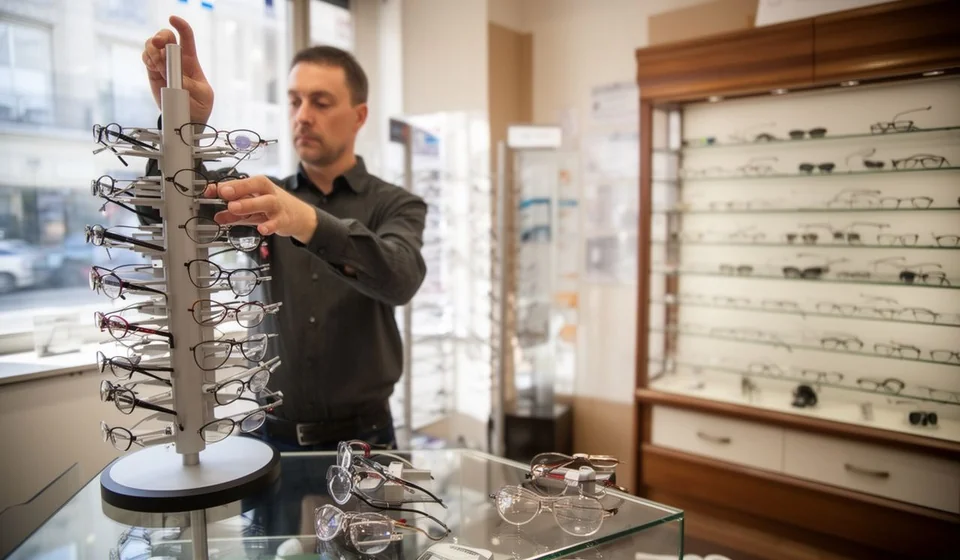
If you have to pick a single place to count every week, that place is the display. It is the highest-loss area of an optical store because displayed pieces move without an invoice: they go out for fitting trials, they move to the lab to mount a sample, they are borrowed for a photo, they fall and get damaged, or a distracted customer walks out wearing a frame. All of that happens in the most visible space in the store and almost never leaves a record.
The display count takes no more than fifteen minutes if it is done with a method:
- Print or open the list of references that should be on display, with their color and size.
- Walk the showcase and the rotating stand, marking what is there and in the right place.
- Note what is missing and look in the lab and in the stock boxes before declaring a loss: many pieces turn up in the workshop.
- Check whether the frames still there are the correct ones, or whether someone moved a piece from another reference into the empty spot.
- Record the real shortages and decide: replace from the box, order from the supplier, or write it off so the stock tells the truth.
That half hour every week is what stops the display from becoming a silent hole: a reference that is missing and nobody replaces, a serial that was lost and can no longer be claimed, a size the customer asked for that did not exist.
Rules so the optical store does not lose money
- Every frame is identified by reference, color and size, and the serial number is kept when it has one.
- Decide per line whether the display is stock or samples, and mark samples as such.
- At the sale, record serial, reference, date and customer: that is the basis of every warranty.
- Special orders carry the order date, the lab promise, the arrival and the customer notice.
- Count the display once a week, with no exceptions.
- Every frame that leaves the display is replaced the same day, or its purchase order is raised.
An optical store does not lose money because its products are expensive, but because they get mixed up: the display frame with the boxed one, one color with another, one size with another, a serial with none. Telling every piece apart by reference and serial number, treating special orders for what they are and counting the display every week is a matter of daily discipline, and that work becomes manageable when the record is kept by a system built for it: control by serial and by reference, like the one in Kardex Tauro, fits an optical store because there every unit is different, expensive and has its own history. Whoever keeps that control knows what they have, what they sold, what should arrive and what is under warranty. Whoever does not discovers the hole in the display when the customer is already asking for the product.
