Markup and margin: how to set your selling price without giving profit away

Markup and margin: how to set your selling price without giving profit away
At the counter and in the back room, the same sentence repeats itself: “I make 30% on this product.” Almost nobody who says it can explain whether that 30% is calculated on what they paid for the goods or on what they charge the customer. And that ambiguity, which looks like an accounting detail, is one of the most common reasons a business sells a lot, moves merchandise every week, and still discovers at the end of the month that the profit is much smaller than it thought. This article explains with numbers the difference between markup and margin, shows where money is lost when they get confused, and leaves a practical rule for setting prices without giving profit away.
Markup and margin: two definitions that change your numbers
Markup, also called the mark-on, is the percentage added to the cost to obtain the selling price. The formula is direct: selling price = cost × (1 + markup). If a product costs you 100 and you apply a markup of 30%, the price ends up at 130. It is the most common way retailers set prices quickly, especially when the products in one category are bought with similar expected profits.
Margin, on the other hand, is the profit expressed as a percentage of the selling price: margin = profit ÷ selling price. In the same example, the profit is 30 and the selling price is 130, so the real margin is 30 ÷ 130 = 23%. Not 30%: 23%.
That is the whole difference, and it is also the source of nearly every mistake. Markup is calculated on cost; margin is calculated on the sale. Because the selling price is always higher than the cost, the same percentage produces different results, and the margin always ends up lower than the markup used to build the price. Understanding this once saves you months of balancing the cash drawer and finding less money than expected.
“I make 30% on it”: the most expensive mistake in retail
When a merchant says they make 30% on a product, they almost always mean they added 30% to the cost of the goods. That is markup. But when a customer, a partner, or a bank asks how much they earn and the answer is “30%”, the other side understands that out of every 100 that come in from sales, 30 are profit. That is margin, and it is a higher number than what is actually being earned.
With a cost of 100, a 30% markup leaves the price at 130 and a profit of 30, which represents 23% of the selling price. To have a real margin of 30% you need to sell at 142.86, which equals a 42.86% markup on cost. The table shows it directly:
| Concept | If you apply a 30% markup | If you want a 30% margin |
|---|---|---|
| Product cost | 100.00 | 100.00 |
| Markup applied on cost | 30% | 42.86% |
| Selling price | 130.00 | 142.86 |
| Profit per unit | 30.00 | 42.86 |
| Real margin on the sale | 23% | 30% |
Neither price is wrong by itself: it depends on how much you want to earn and on what the market allows. The problem is confusing one measure with the other. Whoever believes they work with a 30% margin but actually applies a 30% markup is earning seven points less than they think on every sale, and the difference only shows up when the month-end accounts are balanced and money is missing.
Equivalence table: from markup to margin without a calculator
To avoid doing the mental math every time you set a price, keep this table. Using a cost of 100 as the base, each markup produces the margin shown:
| Markup (mark-on on cost) | Selling price (cost 100) | Profit | Real margin on the sale |
|---|---|---|---|
| 25% | 125.00 | 25.00 | 20% |
| 30% | 130.00 | 30.00 | 23% |
| 42.86% | 142.86 | 42.86 | 30% |
| 50% | 150.00 | 50.00 | 33% |
| 75% | 175.00 | 75.00 | 43% |
| 100% | 200.00 | 100.00 | 50% |
If what you know is the margin you want and you need to know how much to add, the reverse formula is just as simple: markup = margin ÷ (1 − margin). For a 30% margin, the mark-on is 0.30 ÷ 0.70 = 42.86%. For a 50% margin, the mark-on is 100%, meaning you must sell at twice the cost. Memorize only the row your business uses and check the price against this table before publishing it.
Four situations where confusing markup and margin costs you money
The confusion is not a theoretical problem for accountants. It turns into lost money in four very concrete moments of daily operation:
- Discounts and promotions. The discount is announced on the selling price, and if the price was built with a low markup, a common discount can leave the sale below cost. Example: cost 100, markup of 15%, price 115. You offer 20% off and the customer pays 92: you lose 8 on every unit sold, and the more you sell, the more you lose. With a 25% markup the price is 125 and after 20% off it lands at 100: you sell at cost, with no profit and without counting freight, time, or risk. That is why the normal price must include the discount you plan to offer, not absorb it later.
- Sales commissions. If your salesperson earns 5% on the sale and the product goes out at 130 with a cost of 100, the commission is 6.50 and the profit left is 23.50, which is 18% of the sale, not 23%. And if the salesperson also gave a 10% discount to close the deal, the price drops to 117, the commission to 5.85, and the final profit to 11.15: a 9.5% margin. Commission and discounts eat the markup much faster than it seems.
- Comparing profitability between products. Two products with markups of 50% and 100% sound very different, but their real margins are 33% and 50%. Compared by markup, one seems to leave twice as much as the other; compared by margin you see the truth: for every 100 sold, one leaves 33 and the other leaves 50. If you decide which product to push, which line to promote, and which one to discontinue, compare margins, not mark-ons.
- The question “how much do you make?”. A partner, a bank, or a wholesale buyer will ask it. If you answer with the markup, you are inflating your real profit, and whoever decides to lend money or invest based on that number will find the difference later. But the person most harmed is you: deciding whether a product is worth it, how much to buy, and the minimum price to sell, with an inflated number, leads to wrong purchases and wrong prices.
The golden rule: one measure, used every time
Decide whether your business works with markup or with margin and use that same measure to set prices, evaluate offers, and review results. Jumping from one to the other depending on the moment is the surest way to end up with inconsistent prices and accounts that do not balance.
Additional rule: if your business runs discounts, work with margin. The discount is calculated on the selling price, just like the margin, so both percentages speak the same language. The formula to set a price with margin is price = cost ÷ (1 − margin). With a cost of 100 and a target margin of 30%, the price is 100 ÷ 0.70 = 142.86, as we already saw. And if you are planning a season with 20% off and you want the margin to still be 30% after the discount, the normal price must be 100 ÷ (0.80 × 0.70) = 178.57. That way the discount is financed by the price, not by your profit.
Margin is calculated on the real cost, not on the invoice
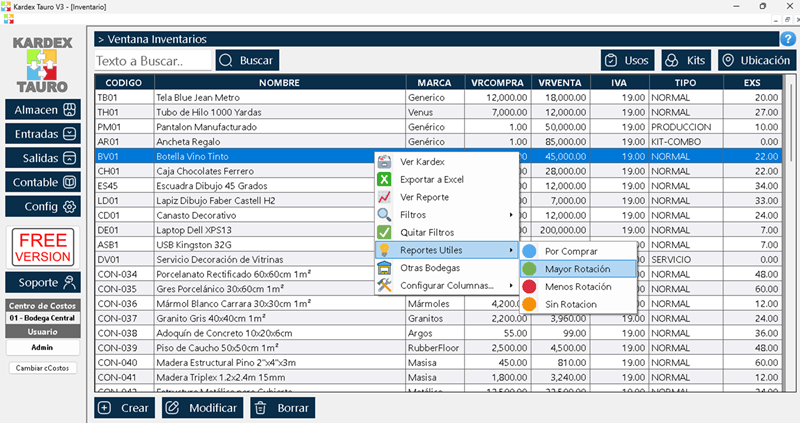
Everything above assumes the cost is correct, and there appears the second favorite mistake of retail: using only the supplier invoice value as the cost. The real cost includes freight, packaging, insurance, and non-recoverable taxes, plus the cost of holding the goods in the warehouse. If freight adds 5%, a product invoiced at 100 has a real cost of 105, and sold at 130 it leaves 25, not 30: a 19% margin, not 23%. A markup that looked good on paper can be a poor margin over the real cost. That is why you should record the full cost of every incoming shipment from the moment it arrives, a topic developed in the article about the components of product cost; an orderly inventory record, like the one you can keep with Kardex Tauro, stores that data product by product and uses it to calculate the cost of what is sold.
In short: two numbers, one rule
- Markup is added to cost: price = cost × (1 + markup). It is used to build the price.
- Margin is the profit on the sale: margin = profit ÷ price. It is used to measure how much you really earn.
- The same percentage is never equal in both measures: the margin is always lower than the markup that produces it.
- If your business runs discounts or pays commissions, think in margin, because discounts and commissions are also calculated on the sale.
- A price that, after discounts and commissions, ends up below the real cost is not a sale: it is a loss with an invoice.
Next time you set a price, first decide which number you are building it with, and when someone asks how much you earn, answer with the margin, the measure that leaves no room for misunderstanding. Having the real cost and the price of every product up to date is the foundation of that calculation, and an inventory system like Kardex Tauro keeps that information available product by product so no price is set blindly and no profit is given away by carelessness.