Your supplier raised prices: how to decide whether you should too

Your supplier raised prices: how to decide whether you should too
The news arrives by email, by phone, or right on this month's invoice: your supplier raised the price of the product you sell the most. Your first instinct usually takes one of two forms, and both are a mistake. One is panic: raise your selling price today, without doing the math, so you do not lose money. The other is resignation: swallow the increase and keep selling at the same price, hoping the difference barely shows. Between those two extremes there is a shorter path than it seems: work out the real impact on your margin and decide with numbers in front of you.
This article walks you through that process step by step. You will learn how to identify which products went up and by how much, how to calculate how much margin you lose if you change nothing, how to choose among the four strategies available to respond, and how to recognize the exact moment when raising your price stops being an option and becomes a necessity. Everything is built around one concrete numerical example you can replicate with your own calculator.
Step 1: identify what went up and by how much
Before you decide anything, put together the full list of affected products. Do not settle for the general impression that everything went up: many suppliers adjust only some items, or apply different percentages depending on the product. The only reliable way to know is to compare invoices. Review your latest purchase of each item and write down the old cost and the new cost shown on the quotation or on the current invoice.
For every affected product you need five pieces of data:
- Old cost: the last purchase price you paid before the increase.
- New cost: what you will pay on your next purchase.
- Current selling price: what you charge for that product today.
- Units you sell per month: an increase on a best seller is not the same as one on an item that sells twice a year.
- Stock you still have: everything you bought at the old cost will still sell at your usual margin, and that buys you time to decide calmly.
That list is the starting point for everything that follows. Without it, any decision you make is a shot in the dark.
Step 2: calculate how much margin you lose if you do nothing
The most common mistake is reacting in proportion: the cost went up 10%, so I raise the price 10%. That calculation is almost always wrong, because what defines your business is not the cost but the margin, meaning the difference between your purchase cost and your selling price.
Look at an example. You buy a product for 80 and sell it for 130. Your profit per unit is 50, and your margin over the selling price is 38.5%. The supplier raises the cost to 90. If you keep the price at 130, your profit drops to 40 and your margin falls to 30.8%. You sold the same amount, at the same price, and earned less on every sale.
| Item | Value |
|---|---|
| Old cost | 80 |
| New cost | 90 |
| Current selling price | 130 |
| Current margin | 38.5% |
| Margin if you keep the price at 130 | 30.8% |
| Price needed to keep a 38.5% margin | ~146 |
Look at the last row. To protect your margin it is not enough to add the extra 10 you now pay for the product to the price: if you sell at 140, your margin settles at 35.7%, still below the original. You need to get close to 146. The reason is simple: the margin is calculated over the selling price, and that 38.5% also applies to the cost increase itself.
The formula to do this in your own business is: new price = new cost ÷ (1 − margin you want to keep). With a cost of 90 and a target margin of 38.5%, that is 90 ÷ 0.615, which is about 146. There is a second way to look at the same calculation: your price of 130 is 1.625 times the old cost, in other words a 62.5% markup over cost. If you apply that same factor to the new cost, 90 × 1.625, you reach the same result.
Run this calculation per product before you touch a single price tag. It will show you that some increases are serious and others barely hurt, and that difference rarely matches your first impression.
Step 3: choose one of the four available strategies
Once you have the number, there are four paths. None is right or wrong in the abstract: each one fits a different situation.
- Keep the price and absorb the increase: you keep selling at 130 and accept a lower margin for a while.
- Pass on the full increase: you apply your usual factor to the new cost and sell at about 146, so your margin does not change.
- Pass on only part of the increase: you raise the price, but less than the calculation calls for, for example to 140, and absorb the remaining difference.
- Rework the purchase or the product: you switch suppliers, presentation, or packaging to recover margin without touching the final price.
| Strategy | When to use it | Main risk |
|---|---|---|
| Keep the price | Small increase, healthy stock at the old cost, or a loss-leader product that drives other sales | Shrinking margin if the increase becomes permanent |
| Pass on the full increase | Sustained increase across the market, margin already tight | Losing sales if your price ends up above competitors |
| Pass on part of the increase | You want to protect volume and customer loyalty without giving away all the margin | A middle-ground decision you must review on the next order |
| Rework the purchase | The increase breaks your profitability and real alternatives exist | Time and cost of switching, different quality or lead times |
Keeping the price makes sense when the increase is small, when you bought plenty of stock at the old cost, or when the product is a magnet that pulls other sales along: raising it can cost you more in lost sales than you gain in margin. But holding the line is not free: you are funding the difference out of your own profit. Put a date on the decision and review it again on your next order, because if the increase is permanent, holding the price is only postponing the problem.
Passing on the full increase is the cleanest option when the whole market moved: if every supplier raised prices and your competitors face the same cost, you can raise your price without giving customers anywhere else to go. The golden rule is not to use the moment to overcharge: if your target margin holds, your price goes up by just the right amount, and customer trust stays intact.
Passing on only part of the increase is the middle option, and it is often the smartest when you want to protect volume. You sell at 140, your margin drops from 38.5% to 35.7%, but you stay close to the market and buy time to watch whether the supplier's increase holds or competitors move too. You can also raise in steps: one adjustment now, and if the increase is confirmed on the next order, complete the rest.
Reworking the purchase is the strategy everyone forgets. Before you resign yourself to the increase, ask two other suppliers to quote the same product: sometimes the increase is not uniform and someone absorbed it. Also review presentations: buying the larger package lowers the cost per unit, and a private label or a different format can support your price without the customer noticing. One detail matters: customers compare the price per unit or per kilo, so any change in presentation must keep the relative price competitive.
Step 4: look at the psychological price and the competition
A price is not decided with margin math alone; it is also decided in the customer's head. If every store in your area sells that product at 129 and you raise yours to 146 because the calculation said so, you will sell less even with a perfect margin. Price has a comparison component: customers always have a rough idea of what the things they buy often should cost.
So before you set the new price, check what three or four competitors charge for the same product, and think about psychological pricing: figures ending in 9 are perceived as cheaper, and a jump from 130 to 146 can feel like a huge increase even when the margin stays the same. Maybe the answer is raising to 139 instead of 146 and making up the difference with volume, better service, or things customers value. Margin per unit matters, but total margin depends on how many units you actually sell.
Step 5: communicate the change in advance if you sell to other businesses
If you sell to other businesses, your customers also have suppliers and also live off their margin. A price increase that shows up as a surprise on the invoice leaves them no time to adjust their own price lists and pushes them to look for another supplier. So when the increase is real and you decide to pass it on, give notice early: two to four weeks in advance is a reasonable window.
Include the new price list in the notice, the exact date it takes effect, and, if possible, an honest line about the reason: the purchase cost went up. Honor the old prices for orders already quoted or on the way, and offer a transition period if a customer has big commitments. Treat your customers the way you would like your supplier to treat you, and most of them will accept the adjustment without drama.
When it really is time to raise your price
Not every supplier increase deserves a change to your price list. These three signals tell you the moment has arrived:
- The increase is sustained, not a one-off spike. If the cost went up on two or three consecutive purchases, it is a trend. If it was an isolated event, an extra freight charge, or temporary scarcity, wait before moving your prices.
- The cost already weighs too heavily on the price. When the purchase cost is above 65% or 70% of your selling price, any small change from the supplier wipes out your margin in one blow. That structure was already fragile before the increase.
- The margin fell below your minimum. Every business has a profitability floor, even if it is not written down: the percentage below which you cannot cover rent, staff, and expenses. If the increase puts you under that floor, raising the price is not a business decision; it is the only way to keep operating.
Three more checks before you raise
When the calculation says you should raise, run these three checks first, in this order:
- Is the increase uniform across the market? Ask another supplier or check your supplier's competitors. If the same product is still available at the old cost elsewhere, the increase may be negotiable, or you have every reason to switch.
- Can you negotiate volume or payment terms? A larger order, a quarterly purchasing commitment, or paying in advance often earns discounts that turn a 12% increase into a 5% one. A single phone call can be worth more than an hour of calculations.
- Is there an alternative presentation? Sometimes the supplier launched a bigger format with a better cost per unit, or the same goods cost less under another brand. Switching presentations lets you hold your consumer price without eating losses.
The supplier decides the increase; you decide the response
None of these decisions is made well from memory or in a rush. What separates the business that absorbs a supplier increase from the one that starts losing money without understanding why is the speed at which it updates its numbers: the new cost of every product, the resulting selling price, and the margin left after the change.
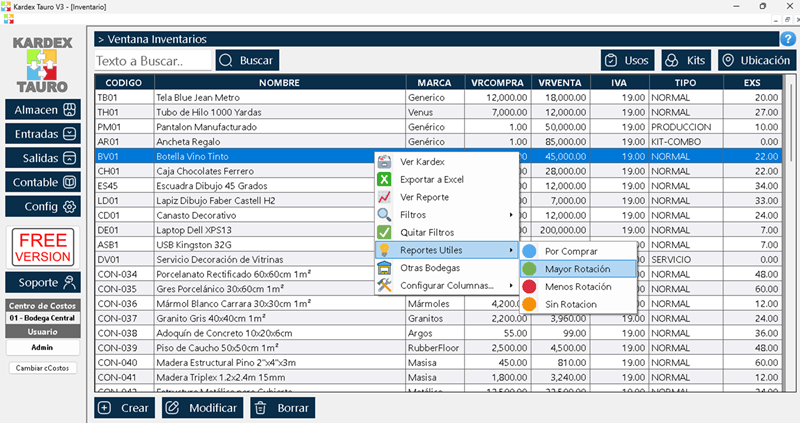
Keeping that control on loose paper or in your head is exactly what fails when you need it most. With inventory and stock card software like Kardex Tauro, you record the updated purchase cost, see the margin of every product at a glance, and adjust your prices based on data. You do not choose your supplier's price increase; you do choose how to respond.