Make to order or make to stock: how to decide (MTO vs MTS)
Make to order or make to stock: how to decide (MTO vs MTS)
Every workshop and every small factory reaches the same fork in the road sooner or later. A customer asks for a product and you decide when to make it: when the order arrives, or beforehand, so it sits ready on the shelf. In manufacturing jargon those two ways of working have names: make to order (MTO) and make to stock (MTS). This is not a theoretical debate. The choice defines how much money you have tied up in inventory, how long your delivery takes, what margin you can charge and, at the end of the month, whether your shop runs at a steady pace or in fits and starts.
The problem is that almost nobody learns to make this decision in an orderly way. Production follows the way it has always been done, or the strategy changes on pure instinct when a bad month arrives. This article proposes something different: a simple criterion, applied product by product, to know when it pays to make to order, when it pays to make to stock, and how to combine both without turning your warehouse into a graveyard of finished goods.
What make to order (MTO) really means
Under a make to order scheme you fabricate nothing until the customer confirms the purchase. The production order is born from a sale: the customer orders, you produce and deliver. The product never waits on a shelf; it leaves the workshop straight to the person who commissioned it.
The advantages are clear. Inventory risk is minimal, because nobody produces something that has no buyer yet. The product can be adapted to the customer: dimensions, finishes, materials, presentation. And because it is custom work, the customer usually accepts a better price and is willing to wait for the production time.
There are costs too. Your delivery time goes from I have it today to I deliver it in ten days, and that takes you out of urgent purchases. Shop capacity is at the mercy of orders: there are weeks of overload and weeks of idle time, with payroll equally expensive in both. And if the order is cancelled halfway through production, the work already done can almost never be sold to another customer.
Typical examples of make to order:
- Custom furniture and made-to-order carpentry.
- Garments and uniforms produced on order, with the customer's sizes and logos.
- Machinery, metal structures and engineering work built to specification.
- Custom printing, labels and packaging with the customer's own design.
What make to stock (MTS) really means
Under make to stock you produce ahead of demand, pushing finished goods into the warehouse, and you sell from inventory. The production order does not come from a customer but from a stock level: when inventory drops below a certain point, you produce again to refill it.
The big advantage is immediate delivery. The customer who walks in today leaves today with the product, and that matters a lot in repeat-purchase items, where the seller without stock loses the sale. You can also produce in large, even batches, use capacity better, buy raw materials in volume and keep the team busy during slow order weeks.
The cost is inventory. Finished goods sitting still are sleeping money: they have already consumed raw materials, labor and space, and they only turn into cash when sold. If they do not sell at the expected pace, they age, get damaged, go out of fashion or become obsolete, and you end up selling them below cost or throwing them away.
Typical examples of make to stock:
- Bread, food and beverages for daily consumption.
- Generic packaging and containers that every customer uses the same way.
- Standard catalog items that always sell the same way, with no customization.
MTO vs MTS side by side: the comparison table
Before getting into nuance, it is worth seeing the two strategies next to each other. Neither is better in the abstract: each row tells you where one wins and where the other pays.
| Aspect | MTO (make to order) | MTS (make to stock) |
|---|---|---|
| Delivery time to the customer | Days or weeks: you must produce after receiving the order. | Immediate: the product is already finished and ready to deliver. |
| Inventory risk | Low: you produce nothing without a confirmed buyer. | High: finished goods may not sell and become dead stock. |
| Use of capacity | Irregular: peaks when orders arrive and gaps when they do not. | Leveled: you produce at a planned pace and keep the team busy. |
| Margin per unit | Usually better: the customer pays for customization and for waiting. | Tighter: you compete on price against whoever has the same product ready. |
| Typical examples | Custom furniture, made-to-order garments, machinery, custom printing. | Bread and beverages, generic packaging, standard catalog products. |
| When to choose it | Expensive, perishable, customizable products or products with uncertain demand. | Cheap-to-produce products with steady sales that customers will not wait for. |
Read the table row by row and you will see the pattern: MTO solves the inventory problem and MTS solves the delivery problem. That is why the answer is almost never about picking a single strategy for the whole shop.
The truth about real workshops: almost everyone runs a hybrid
The most common mistake small manufacturers make is feeling forced to pick a side. We are make to order. We are a catalog business. In practice, almost any healthy manufacturing business ends up using both strategies at once, because it carries two kinds of product in the same portfolio.
Think of a furniture workshop. The same business can make to stock its basic line of chairs and folding tables, which sell by themselves all year, and make to order the special designs, the office furniture with unusual dimensions and the jobs with custom finishes. The basic line provides cash flow and steady workload; the make-to-order line provides margin and sets the business apart from competitors.
The same applies to a garment shop: the standard uniforms that every company requests are sewn to stock in common sizes, while orders with embroidered logos, special fabrics or out-of-range sizes are made to order. Applying MTS to what always sells and MTO to the special stuff is not indecision; it is precisely the right strategy.
The trick is deciding with criteria where one strategy ends and the other begins. That is what the two rules below are for.
How to decide product by product (not company by company)
Forget the label of your business and look at each product in your portfolio separately, because the answer changes from product to product. Ask yourself these questions in order, and let the answers carry you toward one strategy or the other:
- Will the customer wait for the production time? If the buyer of that product needs it today or this week, there is no debate: there must be stock, it is MTS. If the customer accepts waiting because the product is made to measure, you can operate make to order.
- Does the product always sell the same way? If it is a standard item that nobody customizes and that sells all year without changes, making to stock is natural. If every sale asks for something different, make to order keeps you from piling up pieces that nobody else will want.
- Is it expensive to produce or to hold? A product with costly raw materials, one that takes up a lot of space or demands working capital punishes idle stock. There, make to order protects your cash.
- Is it perishable or short-lived? Food, products with expiry dates, fashion items and products that change version every year should only be made to stock in conservative quantities; everything else should be made to order.
- Is it customizable? If the customer values a product adapted to them, with their measurements, colors or engravings, MTO lets you charge for that value. A generic product, on the other hand, has no such advantage and competes on availability.
When you finish the tour, every product on your list will have an answer. It is normal for the result to be mixed: some products ask for stock and others ask for orders. Welcome to the hybrid.
How to run the hybrid without losing control
The hybrid only works if every product has clear operating rules. The practical recipe has three parts.
First, define your base catalog. These are the products that always sell and that you decide to keep in stock. For each one set a reorder point: the minimum inventory level that, when reached, triggers a new production order. While consumption is stable, that point is calculated with the average daily consumption multiplied by the days it takes you to replenish, plus a safety cushion for surprises.
Second, define your specials. Everything that is not in the base catalog is produced to order. For that you need two things: a price quoted in advance and a realistic promised delivery time. The typical mistake is promising a special the lead time of the base catalog and then failing to deliver; the promised time must include material purchasing, fabrication and quality control, without optimism.
Third, put a date on every order. A special without a committed delivery date becomes an endless pending task that messes up the plant. Schedule the production order the moment you confirm the sale: that way capacity is reserved and the customer knows exactly when they receive.
The two costs you need to know
The decision between stock and order comes down, in the end, to comparing two costs that are asymmetric:
| Situation | What it costs you | How it hurts | How to prevent it |
|---|---|---|---|
| Running out of stock of a basic product | Lost sales and customers who go to the competition. | It hurts sales and reputation, but it is reversible: you restock and the customer comes back. | A well-calculated reorder point, reviewed whenever consumption changes. |
| Producing specials that do not sell | Raw materials, labor and space tied up in products nobody ordered. | It hurts cash: the money is trapped in dead stock that must be discounted or discarded. | Produce specials only with a confirmed order, and with a deposit when the material is costly. |
Read the second row carefully: dead stock is the expensive mistake. Running out of a basic item is fixed with a week of production; a batch of unsold specials can take months to move, and it often moves at a loss. That is why the small manufacturer's golden rule is to be generous with stock of what sells for sure and disciplined about make to order for everything else.
What to review every week
A hybrid does not sustain itself: it is sustained by three numbers you should review every week. The first is the stock level of base catalog products, so you trigger replenishments before hitting zero. The second is inventory age: any finished product sitting still for more than thirty or sixty days is a sign that it got too much MTS and too little MTO. The third is the list of pending make-to-order jobs with their promised dates, so no special gets forgotten in a corner of the plant.
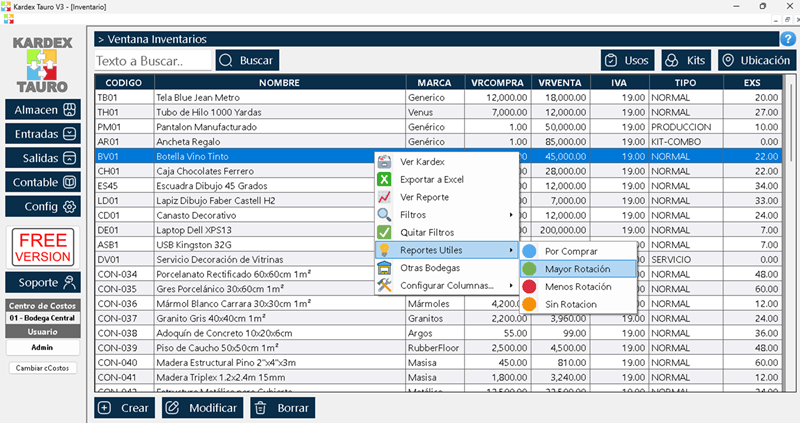
If you keep those three numbers in a spreadsheet or in the software you use to manage your stock ledger, like Kardex Tauro, the hybrid becomes almost automatic: stock is replenished when it should be, and orders are produced when they were promised. The discipline of reviewing them weekly is what separates a workshop that controls its inventory from one that only reacts to emergencies.
Decide per product, not per fashion
No production strategy is superior to the other: they are tools for different problems. Make to stock what always sells, what customers will not wait for and what is cheap to hold; make to order what is expensive, perishable, customizable or uncertain in demand. Most workshops need both answers at once, and that is fine: a well-run hybrid beats either extreme.
For the scheme to work, the production order must travel clean from the moment it is decided to the moment it ships: what is being made, how much, with which materials and against which order. Software like Kardex Tauro helps right there: it keeps the stock ledger of raw materials and finished goods, and when you generate a production order it automatically discounts the inputs from inventory, so both the batch for stock and the make-to-order special leave a clear trace of what came out of the warehouse. With that information in view, deciding between make to order and make to stock stops being a gut feeling and becomes a decision based on numbers.