Accounting in the Middle Ages: monasteries, manors and fairs
Accounting in the Middle Ages: monasteries, manors and fairs
Between the fall of Rome and the Renaissance, Europe kept its accounts in a very different way from ours. When the Western Roman Empire collapsed during the fifth century, it was not only cities, roads and long-distance trade that disappeared: the great administrative machinery that had recorded taxes, censuses and spending for centuries also fell apart. For almost a thousand years accounting never stopped existing, but it changed owner, form and medium, moving from the state's archives to monasteries, rural manors and, later, to merchants who filled the roads of Europe with goods once again.
This article is part of a series on the history of accounting. The Renaissance —double-entry bookkeeping among the Italian merchants and the work of the friar Luca Pacioli, who described it in writing in 1494— is told in the companion articles of the series. Here we stop earlier, in the centuries when accounts were written to govern land, feed religious communities and certify the contracts sealed at the fairs.
An economy that loses its money
With the disappearance of the empire, circulating money became scarce, long-distance trade shrank and wealth went back to a very old measure, land. The economic unit of the age was the manor, which included the land the lord worked directly, the woods and common pastures, and the strips of the peasants, who paid for their holding with rents in kind —grain, poultry, wine— and with days of labour on the lord's land.
In that world, managing was above all managing stock. The lord did not sell his harvest in a distant market: he consumed it, shared it and stored it for the winter or for bad years. Someone had to know how much grain was in the barn, how much wine in the cellar, how many oxen in the stable and which tools were in good repair. That memory rested on the stewards of every estate, who rendered account to the lord once or twice a year, often orally or with notched tally sticks, a device the English treasury would use for centuries.
The Carolingian royal estates and the Capitulare de villis
The most famous example of that seigneurial accounting put down in writing is Carolingian. Around the year 800, Charlemagne ruled an empire that stretched from the North Sea to northern Italy, and he usually governed it by means of capitularies: decrees divided into chapters that regulated everything from warfare to the administration of his domains. One of them, known as the Capitulare de villis, is a gem for the history of administration: a long set of instructions addressed to the stewards of the royal villas, the king's agricultural estates scattered across the empire.
The capitulary ordered that every villa be perfectly known and equipped. It demanded inventories of the cultivated land and the woods, of livestock of every kind —oxen, horses, sheep, pigs, poultry—, of the ploughs, tools, mills and beehives, and a statement of how much was sown, harvested and produced. Each steward had to know every last detail of what his estate produced and stored, so that the sovereign always knew what he owned and what he could expect from each of his properties.
For this story, the document matters twice over: it turns inventory-taking into an official duty of the steward, and it shows early medieval accounting as an exercise in things —land, livestock, grain, tools— far more than in money: a physical inventory ordered by an emperor.
Monasteries: the great stock managers
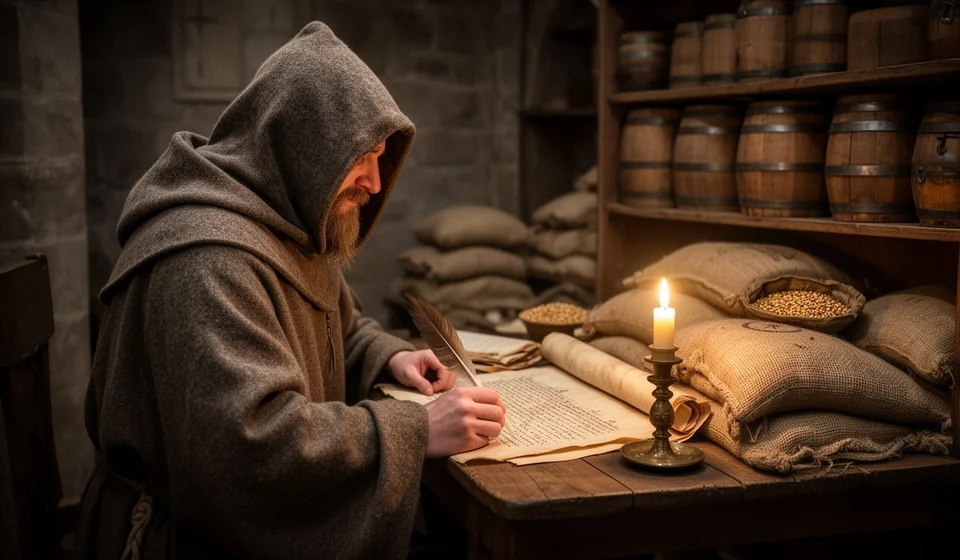
If manors kept the accounts of the land, monasteries kept some of the most complete accounts of the early Middle Ages. Abbeys accumulated land, vineyards, mills and workshops through the donations of kings and nobles, and the Rule of Saint Benedict, which ordered monks to work and support themselves, made them natural administrators. A great monastery was an agricultural and artisanal enterprise: the community and its guests had to be fed and nothing could be allowed to run out, because an empty pantry could not be refilled from a corner shop.
That responsibility fell on specific offices. The cellarer looked after the food and the utensils and had to render account of his stewardship; the abbot supervised the whole and answered to the donors and the ecclesiastical authorities. To support that administration, monasteries relied on their scribes: alongside religious books, the scriptoria copied and preserved very practical documents, such as the cartularies gathering copies of property titles and donations, the polyptychs describing the abbey's land plot by plot, the rents each peasant paid and the labour days owed, and the records of tithes, income and expenses reviewed year after year.
Kingdoms: the Domesday Book and the pipe rolls
As kingdoms grew, they too wanted to know exactly what they owned. The most impressive example came from the England of William I: in 1085 the king, who had conquered the realm in 1066, ordered his commissioners to ride through every county and compile a register of all the property of the kingdom. The result, completed in 1086, is the Domesday Book, the book of the Day of Judgement, because no appeal was allowed against what it said.
The Domesday Book is an inventory on the scale of an entire kingdom: manor by manor it recorded who held it, who had held it before the conquest, how many plough teams worked it, which peasants and livestock lived there, how many mills, woods and meadows it contained, and what it was worth then and what it had been worth. Written on parchment and preserved in two volumes, it remains an essential source for understanding medieval England.
The same urge for control produced, a few decades later, one of the most remarkable accounting series in history: the pipe rolls of the English treasury. Each year the record of the crown's accounts was sewn into one long parchment roll that was rolled up like a tube, and in it were entered the king's income and expenses: the rents of the royal lands, the fines of the courts, the payments to officials and suppliers. The oldest surviving roll dates from 1130 and, from the middle of the twelfth century, the series is practically unbroken.
Guilds and fairs: trade starts keeping records again
From the eleventh and twelfth centuries onward, the European economy revived: towns grew, roads and ports stirred back to life, and with them returned money and the need to keep accounts. In the towns, the craftsmen of each trade organized themselves into guilds, also called confraternities or craft corporations. The guilds controlled the quality of what was made and sold, set prices and wages, regulated apprenticeship —from apprentice to journeyman and on to master— and maintained a common chest to help the sick, the widows and the funerals of their members; all of that required records of members, written regulations and accounts of the collective fund.
On that urban base flourished the great fairs of Champagne in the twelfth and thirteenth centuries. Four towns of the region —Troyes, Provins, Bar-sur-Aube and Lagny— hosted a cycle of fairs that followed one another through the year and turned the area into the great market of western Europe. There the Italian merchants, arriving with spices, silks and financial skills, met the merchants of Flanders and northern Europe, who brought cloth and wool. Sales were wholesale and often on credit, and since nobody wanted to travel with sacks of coins along dangerous roads, debts were recorded, offset at successive fairs and settled at agreed dates and places. Specialized officers certified contracts and settled disputes: the fair worked as a clearing house for European credit.
New numbers for new accounts
Counting in medieval Europe was not easy. Roman numerals were good for noting things down but clumsy for calculating, and computations were almost always done with the abacus, a board with counters moved across columns of value. In 1202, a mathematician from Pisa named Leonardo Fibonacci published the Liber Abaci, a book of calculation that presented Europeans with the Indo-Arabic numerals, with their zero and their positional system, which made addition, subtraction, multiplication and division far easier. Fibonacci did not invent the system, but his work was decisive in spreading it among merchants, who adopted it gradually during the thirteenth and fourteenth centuries. For accounting the change was enormous: at last it was possible to note zero and to do long calculations without losing the thread.
Alongside the new numbers appeared a decisive financial instrument: the bill of exchange, a document in which a merchant ordered the payment of a sum, in another city and often in another currency, to a third party or to whoever presented the document. The bill allowed merchants to travel with paper instead of metal, to defer payments from one fair to the next and to avoid the perils of the road. Since the Church disapproved of usury, credit was often presented as a currency exchange between different places, and this financial form, born in the fairs, became one of the engines of European trade.
Single entry: the dominant way of keeping accounts
Throughout the Middle Ages, the usual way of keeping books was single entry, in which each transaction is recorded once, as income or expense, without the double-registration principle that characterizes double entry. The typical merchant worked with several books: a memorandum where everything was noted at once, a journal where the operations were copied in chronological order, and a ledger where an account was opened for each person —customers, suppliers, partners— recording what each gave and received. That accounting answered a very practical question, what do I have and to whom; double entry would add another: where does my profit come from?
Let us close with a note of precision: the earliest books that some historians consider to be written in double entry appear around 1340 in Genoa, in the registers of the massari, the officials in charge of the city's treasury. They are an early and brilliant exception: the spread of the system, its adoption by the great Italian merchants and its first printed description, in Pacioli's Summa of 1494, belong to the Renaissance and are told in the companion articles of this series.
What each medieval institution recorded
To order our journey, this table summarizes what each institution of the age recorded, on what medium and for what purpose.
| Institution | What it recorded | Medium |
|---|---|---|
| Carolingian royal villas (around 800) | Lands, woods, livestock, tools, mills and harvests of the king's estates | Capitularies and estate records on parchment |
| Monasteries | Lands, rents and obligations of peasants (polyptychs), tithes, income, expenses, pantry and cellar | Cartularies, polyptychs and account books on parchment |
| English crown, Domesday Book (1086) | Manors, owners, livestock, mills, woods and value of the kingdom's lands | Great parchment manuscript, two volumes |
| English treasury, pipe rolls (from 1130) | Annual income and expenses of the crown: rents, fines, payments | Parchment rolls sewn and rolled up |
| Craft guilds | Quality of products, apprentices, members and accounts of the common chest | Regulations and guild registers |
| Fairs of Champagne (12th and 13th centuries) | Transactions, debts and credit between merchants | Fair records and bills of exchange |
| Municipality of Genoa (around 1340) | Accounts of the officials of the public treasury | Ledgers of the massari |
Anyone who opens an inventory book today or checks the stock of their warehouse is repeating, without knowing it, a gesture more than a thousand years old: the Carolingian steward counting his oxen, the cellarer inventorying the monastery pantry, the clerk of the Domesday Book and the notary of the fair of Troyes all answered the same question that any business asks today: what do I have, where is it, how much is it worth and what am I missing?
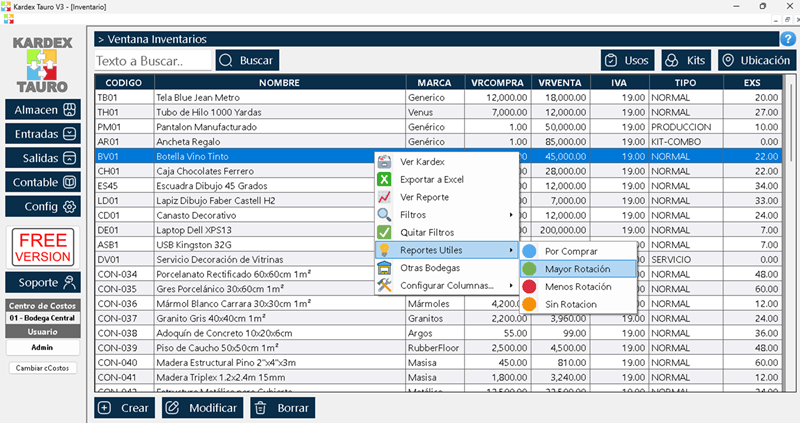
Only the tool has changed. What was then written on parchment with a goose quill is recorded today in seconds with an inventory program. Software such as Kardex Tauro lets a modern business keep control of its stock —entries, exits and counts— with the same spirit of order that moved those medieval scribes, but without depending on memory or on piles of paper. Accounting has changed its medium; the need that created it has not.