Accounting in the Renaissance: fairs, bills of exchange and trading houses
Accounting in the Renaissance: fairs, bills of exchange and trading houses
Between the fifteenth and the sixteenth centuries, European trade changed scale. The sea routes of the Mediterranean and the Atlantic grew denser, goods travelled farther, and money stopped being a mere medium of exchange and became an instrument to be lent, exchanged, insured and invested. In that world, keeping books ceased to be the habit of tidy merchants and turned into a skill required to run businesses that crossed borders, currencies and payment terms. This article is not a biography: Pacioli and Datini have already been covered in this blog and appear here only in passing. The real subject is the setting: the payment fairs, the bill of exchange and the great trading houses that turned accounting into a system.
The Italian city-states: a financial laboratory
The mercantile Renaissance was, above all, an Italian story. Venice, Florence, Genoa and Milan were not a unified kingdom but a mosaic of independent city-states that competed with one another and, in the process, innovated. Venice dominated trade with the East: spices, silk, cotton and precious stones reached its wharves and were redistributed across Europe. Genoa, Venice's maritime rival, controlled much of the traffic of the western Mediterranean and was a financial power of the first order. Florence specialised in banking and woollen cloth, having no port of its own. Milan stood out for arms, armour and metalworking, as well as for its bankers.
The absence of a central power dictating the rules favoured mercantile custom: commercial usage was respected from city to city, merchants' courts settled disputes quickly, and well-kept account books were admitted as evidence. At the same time, the merchant changed his trade. He no longer always travelled with his cargoes: he became sedentary and ran a network of factors, agents and correspondents by letter. To govern from a distance he needed to know, at any moment, what he owned, what he owed, what was owed to him and what to expect from each voyage. That need explains the rise of commercial arithmetic, taught in the abacus schools to merchants' sons, and the growing refinement of the account books.
The fairs: Europe's payment calendar
The fairs were the great payment machine of Renaissance Europe. In spirit and technique they descended from the fairs of Champagne, which in their medieval heyday had brought Flemish clothiers, Italian merchants and buyers from half of Europe together in northern France. When those fairs declined in the fourteenth century, other places took over the torch. In the fifteenth century, Lyon became the capital of the payment fairs: up to four meetings a year, with safe-conducts, royal privileges and their own courts, drawing bankers from Florence, Genoa, Switzerland and Germany.
At Lyon, goods were not only sold: above all, debts were settled. Merchants from all over Europe drew their bills of exchange payable at the fair and, when the term arrived, the bankers and their agents sat down to offset. What Peter owed John and John owed Peter cancelled each other out, and only the final balance was paid in coin, which was usually small. This technique, called clearing or compensation, saved immense shipments of bullion: little money was needed to move a great deal of credit. If the balance was not paid in cash, it was covered with a new bill on the next fair, chaining credit from one meeting to the next.
In the mid-sixteenth century the centre of these meetings moved to the Franche-Comté, to Besançon, whose fairs became known as the Bisenzone fairs, and from 1579 they were held in the Italian city of Piacenza for the last decades of the sixteenth century and the early seventeenth. The detail matters: the fairs forced merchants to think of time as a financial calendar, with debts falling due on a few dates each year, all of it recorded in the books.
The bill of exchange: paying without moving coins
The instrument that made that system possible was the bill of exchange. Its genius lay in separating the payment from the place and the moment of the underlying deal. A merchant in Bruges who owed payment for a consignment of wool in Venice did not need to send sacks of coins over unsafe roads and seas: he bought a bill from a banker, who ordered his correspondent in Venice to pay the sum to the named beneficiary in local currency at a future date. The journey of money thus became a journey of paper, far cheaper and safer.
In its classic form the bill involved four parties: the drawer, the drawee, the payee and the buyer. Over time the document became transferable by endorsement, so that a single bill could pass from hand to hand and settle several debts before maturity. The banker's profit was not a declared interest, for usury was frowned upon and often prohibited, but the difference between the exchange rate at which he bought and sold foreign currency, together with the term of the credit. The price of money was hidden, so to speak, in the exchange.
For accounting, the bill of exchange was a silent revolution: it forced merchants to record commitments that would be fulfilled in another city and another month, in accounts of bills receivable and payable that corresponded to no goods in the warehouse. A business could no longer be read by looking at the stock alone; the books had to be read.
Banks and trading houses: from the Medici to the Fuggers
No enterprise embodies Renaissance accounting better than the Medici bank in Florence, founded by Giovanni di Bicci in 1397 and turned by Cosimo de' Medici, in the first half of the fifteenth century, into the largest financial network in Europe. As the historian Raymond de Roover documented, the bank was not a single firm but a structure like a holding company: each branch, from Rome to Bruges or London, operated as a separate company with its own capital, partners and account books, in which the parent house in Florence held a share.
Each branch kept its own double-entry books and reported to Florence through regular correspondence and inspections; the manager, called a factor, was answerable for his stewardship. Accounting thus served more than profit calculation: it allowed delegation without loss of control. The decline came at the end of the fifteenth century: in 1494, the year French troops entered Italy, the bank was winding up.
In the sixteenth century the centre of gravity of European capitalism moved north. In Augsburg, the Fugger house, founded in the late fourteenth century by Hans Fugger, became with Jakob Fugger, called the Rich (1459-1525), the most powerful firm on the continent. Jakob had learned bookkeeping in Venice, where the Fuggers kept an office in the Fondaco dei Tedeschi, and applied the Venetian method to an empire of another kind: loans to the Habsburgs secured on the silver and copper mines of the Tyrol from 1487, a near-monopoly in the copper trade and agencies scattered across Europe. The firm's archives preserve the records showing how he used double entry to govern his international network from Augsburg.
Marine insurance: risk becomes a premium
The sea was the greatest uncertainty of Renaissance trade: storms, shipwrecks, privateers and wars could ruin an entire cargo. Marine insurance was born to cover that risk. As early as the mid-fourteenth century notarial insurance contracts were being drawn up in Genoa; a Genoese policy of 1343 is often cited as one of the best-documented early examples, although historians debate which was truly the first. Florence developed its own market, with specialised brokers, the sensali, who found underwriters for each voyage; each underwriter signed the policy for a share of the risk, hence the idea of subscribing, and charged a proportional premium.
The premium depended on the route, the season, the type of vessel and the political climate: in ordinary times it ranged between about 2 % and 4 % of the insured value, and it soared in times of war or piracy. Venice long protected its merchants with armed convoys, the mude, and its private insurance market developed later, towards the end of the fifteenth century. The archive of the merchant Francesco Datini, in Prato, preserves nearly four hundred policies taken out in Pisa, Florence and Genoa at the end of the fourteenth century: the premium was already a customary cost, entered in the books as part of the price of the goods. Risk, once borne silently by the merchant, had become a measurable, recordable service.
Printing spreads the Venetian method
Printing with movable type, spreading from the mid-fifteenth century, gave accounting something it had never had: printed manuals in the vernacular. The starting point was Pacioli's Summa, printed in Venice in 1494, which included a treatise on double entry inspired by Venetian practice. Practical Italian manuals followed for the ordinary merchant, such as those of Tagliente (1525) and Manzoni (1540); the Low Countries saw adaptations such as the one Jan Ympyn Christoffels published in Antwerp in 1543; London saw an English exposition by Hugh Oldcastle, also of 1543; and German and French printed versions appeared throughout the sixteenth and seventeenth centuries.
The consequence was enormous: a technique formerly handed from master to apprentice within each house became standardised, its vocabulary of debits and credits, journals and ledgers fixed in the manuals and travelling with them. A merchant in Antwerp and one in Seville could now understand each other on paper, with the same structure of books and the same criteria for every transaction. Accounting ceased to be a family secret and became a public, teachable body of knowledge.
The ledger in a Renaissance trading house
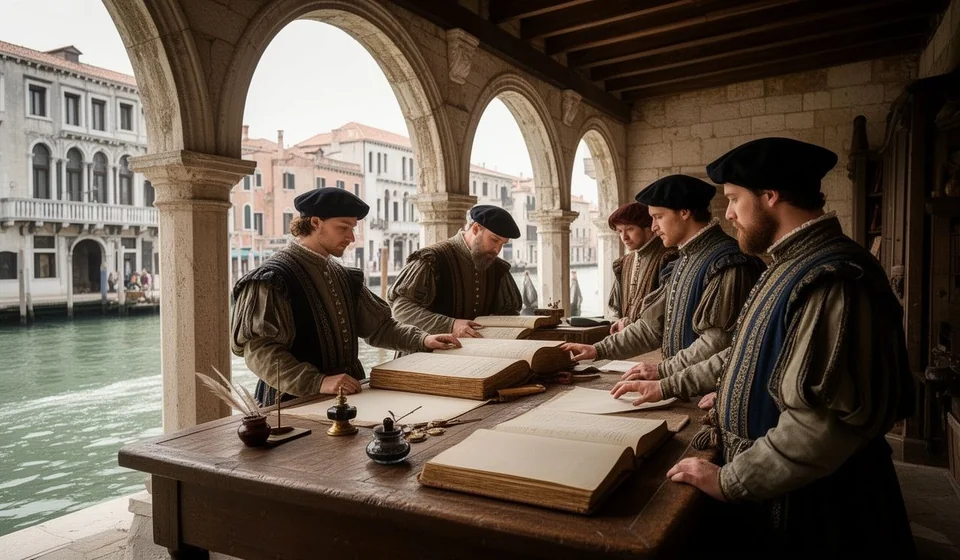
What did accounting look like from the inside in a Renaissance trading house? On the merchant's counter lay, bound and foliated, several books with different functions. The memorandum or waste book recorded the day's operations as they happened, without much order. The journal then described them one by one, in chronological order, explaining each deal. And the ledger, the Venetian libro mastro, was the heart of the system: each account occupied a two-page folio, with the debit on the left and the credit on the right, and each entry was crossed with its counterpart in another account, noting the folios back and forth so that the chain could be verified. Alphabetical indexes of debtors and creditors made it possible to find any account. Periodically the books were closed and a balance was struck, that balancing of accounts that turns the whole business into a picture of its state. In many cities the books were shown to the mercantile authorities and carried evidentiary weight in court.
Double entry fitted the nascent commercial capitalism so well for a practical reason: it separated capital from profit and debt, and allowed measuring the result of a going concern with partners, agents managing distant markets and credits that would be collected months later. Historians note that it was not indispensable for calculating profits, and that many modest houses managed with simple records; but in large, decentralised firms such as the Medici bank or the Fugger house it was the tool that made delegation, auditing and control possible. Accounting and commercial capitalism grew up together, and not by chance.
A comparative overview
| City or house | Notable practice | Instrument or accounting record |
|---|---|---|
| Venice (15th-16th centuries) | Trade with the East, armed convoys (mude) and a late insurance market | Two-page ledger, insurance policies and cargo registers |
| Florence: the Medici bank | European network of branches with their own capital and books | Holding structure, branch books and control by correspondence |
| Fairs of Lyon and Besançon | Periodic settlement of Europe's debts | Bills domiciled at the fair, clearing of balances and fair books |
| Genoa | Marine insurance and high finance | Notarial policies since the 14th century and route-based premiums |
| Augsburg: the Fugger house (16th century) | Credit to princes and the copper trade | Letters of credit between agencies and central double-entry records |
From the Renaissance to the modern inventory
We have kept more from the Renaissance than it seems. Double entry is still the foundation of modern accounting; today's compulsory books descend from those foliated memorials, journals and ledgers; and the idea of controlling scattered branches, agents and warehouses through central records was born in the trading houses of the fifteenth and sixteenth centuries. The inventory, too, that account of goods which the Venetian merchant closed at the end of every financial year, has its roots there: knowing what there is, what it is worth and what is missing is the oldest and, at the same time, the most modern way of running a business.
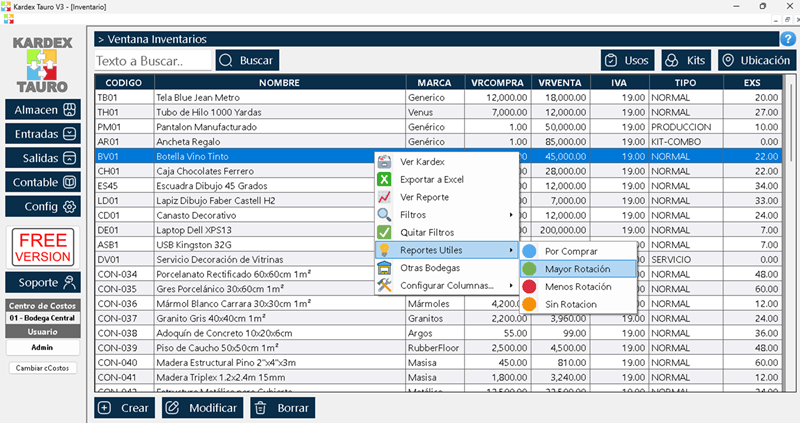
Today that task is not carried out on a bound ledger but with management tools that record every receipt and issue of goods instantly. An inventory system such as Kardex Tauro is, in that sense, the digital heir of the old Venetian ledger: it keeps track of stock, movements and the value of each product, so that the business owner can see his warehouse the way the Renaissance merchant saw his books, at a glance and with the certainty that everything balances. The logic is the same; only the paper and the ink have changed.