The history of the accounting profession: from scribes to the public accountant
The history of the accounting profession: from scribes to the public accountant
Long before the word "accountant" existed, the function did. In every temple, palace, workshop or trading house there was someone in charge of writing down what came in, what went out and what remained. That age-old trade — keeping accounts in an orderly way and answering for them — travelled a long road before becoming what we know today as the accounting profession. This article tells that story: from the scribes of the earliest civilisations, through the bookkeepers of the Renaissance and the professional societies of the nineteenth century, to the modern public accountant, with his or her examination, designation, code of ethics and independent role as a guardian of the accounts.
It was neither a linear nor a quiet evolution. There were societies that shut their doors, laws that demanded that accounts be examined, and women who had to wait decades to be admitted. Knowing that history helps us understand why the public accountant today is not simply someone who is "good with numbers", but a professional with a public responsibility.
Scribes and reckoners: a craft thousands of years old
The first record-keeping specialists appeared alongside the first large storehouses. In Mesopotamia, around the fourth millennium BC, temple administrators recorded grain and livestock coming in and going out on clay tablets; in Egypt, scribes kept track of the pharaoh's granaries, of taxes and of the rations paid to workers. Those scribes were more than copyists: they were officials of accounts, trained in schools, able to measure, weigh and leave a written record of property. The point worth stressing here is this: in antiquity, accounting was a function of the temple, the palace or the state, exercised by specialists serving those in power, not an independent profession.
Rome added a new shade. Alongside public officials who answered to the state, the great Roman households had stewards — often slaves or freedmen called dispensatores — who kept the family's books and answered for them to the master. A distinction time would make enormous was already taking shape: keeping the books is one thing, examining them, verifying them or accounting for them is quite another. That separation between the person who records and the person who controls is the seed of auditing.
In the Middle Ages, monasteries, manors and kingdoms kept records of their lands, rents and harvests, but it was in the trading cities of thirteenth- to fifteenth-century Italy that the craft flourished most intensely. Venice, Florence and Genoa lived on commerce and credit. There the ragionieri, municipal officers in charge of public accounts, did their work, and the masters of the abacus taught, in their schools, the arithmetic of trade and the art of keeping books. Most bookkeepers trained as apprentices at a merchant's side, and double entry — recording every transaction twice, on the debit and credit sides — spread gradually between the thirteenth and fifteenth centuries.
At the end of the fifteenth century the knowledge of the workshop stopped being a secret: Benedetto Cotrugli wrote a treatise for the perfect merchant around 1458, and in 1494 the friar Luca Pacioli published his Summa, which spread the "Venetian method" of double entry across Europe. But let us be precise: neither Cotrugli nor Pacioli created the profession. In 1500 the bookkeeper was still a merchant's employee, a town official or a teacher of arithmetic. It was a learned, respected trade, but without a title, examination or association defining who could practise it. Changing that would take the industrial world of the nineteenth century.
The nineteenth century: from occupation to organised profession
The Industrial Revolution changed the scale of everything. Railways, banks and great factories demanded capitals that no single merchant could provide, and joint-stock companies appeared: businesses whose owners, the shareholders, did not manage them directly. That separation between ownership and management created a new need: someone had to examine the accounts on behalf of those who had put up the money, without depending on the managers. From that need came the demand for an independent expert in accounts: the public accountant, the professional who works on his or her own account and answers to third parties.
In Britain, the cradle of industrialisation, the profession organised earlier than anywhere else. Many of the first public accountants had started by handling bankruptcies: the courts appointed them as "accountants in bankruptcy" to wind up estates, inventory the assets and distribute whatever was left among the creditors. Others had been chief bookkeepers of trading houses and had set up on their own. In the 1850s and 1860s these practitioners began to form societies, setting themselves apart from mere bookkeepers and from unscrupulous amateurs.
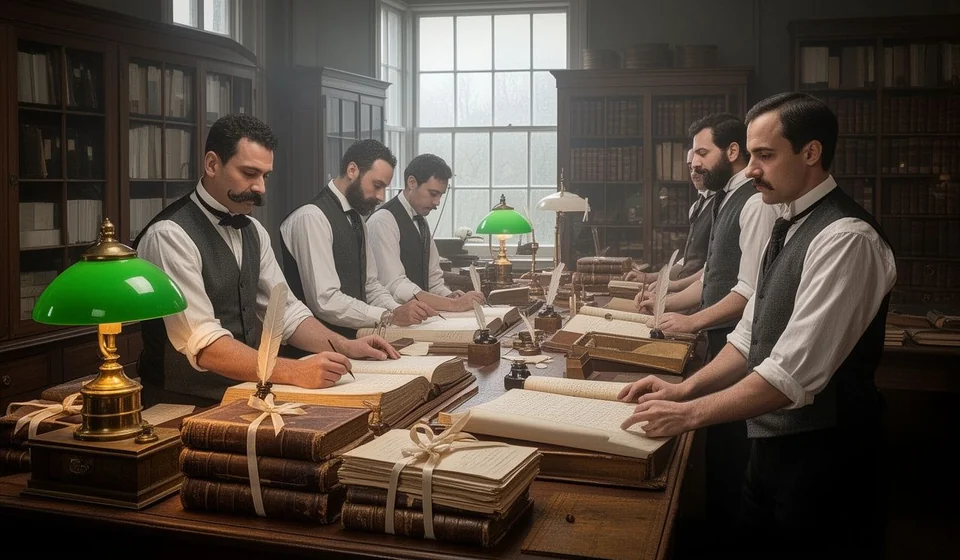
Three dates mark that decisive step. In 1854 the Society of Accountants in Edinburgh received its royal charter and is regarded as the world's first professional society of accountants; similar societies followed in Glasgow and Aberdeen, which in 1951 joined the Edinburgh body to form the Institute of Chartered Accountants of Scotland. In England and Wales, several local societies merged and, on 11 May 1880, Queen Victoria granted the royal charter that created the Institute of Chartered Accountants in England and Wales, the ICAEW. The chartered accountant was born: admission required passing examinations — or proving long experience, in the case of the founders — and serving a period of supervised training with a member, the so-called articles. For the first time, an institution controlled who could call himself an accountant and how he had to behave.
Across the Atlantic the process followed closely. Many of the first public accountants in the United States were British professionals who had emigrated or arrived to audit investments of English capital. In 1887 the American Association of Public Accountants was founded in New York: the first national association of accountants in the country and the direct predecessor of today's AICPA. Soon after, state regulation of the title began: New York passed the first certified public accountant law in 1896 and established an examination for the famous CPA designation. State by state, the certified public accountant spread across the country. Within a few decades, the occupation had become a profession with a title protected by law, an entry examination, associations and codes of conduct.
Auditing: the engine of professional growth
If anything drove the profession forward, it was auditing. British company legislation in the nineteenth century was the great accelerator: the Joint Stock Companies Act of 1844 required registered companies to present an audited balance sheet; the acts of 1856 and 1862 made auditing optional again; but the mood changed after the collapse of the City of Glasgow Bank in 1878, which ruined thousands of investors and put the bank's auditor on trial. Distrust turned the examination of accounts into an ever more demanded service, and the Companies Act of 1900 made the annual audit compulsory once more for registered companies.
Auditing gave the accountant a clearly defined social role: not writing the books but examining them on behalf of shareholders, creditors or the courts. That position demanded independence, and independence began to become the profession's central value. The first great firms grew in the heat of bank and railway audits: William Deloitte opened his office in London in 1845, Samuel Price founded his firm in 1849, and in Scotland firms expanded that would soon operate across the British empire. Those small Victorian offices are the direct ancestors of today's global audit networks.
In the United States there was no federal obligation to be audited until the securities laws of 1933 and 1934, which required listed companies to present financial statements reviewed by independent accountants. From then on, auditing became the heart of the profession worldwide. One detail worth remembering connects all of this with inventories: from the earliest days, a central part of every audit was checking that the stocks declared actually existed. Auditors attended the annual physical counts of merchandise, compared what had been counted with what had been recorded, and followed the trail of the stock cards. Verifying what is in the warehouse has been, for more than a century, one of the most concrete and repeated tasks of the profession.
Women and the opening of the profession
Throughout the nineteenth century, women worked in accounting — above all as bookkeepers, a field considered "feminine" and clerical — but the professional societies and their examinations were closed to them. The story of Mary Harris Smith sums it up bluntly. Born in London in 1844, she learned bookkeeping, worked as an accountant for a mercantile firm in the City and opened her own office in 1887. That same year she tried to join the Society of Incorporated Accountants and Auditors and was rejected on grounds of her sex; in 1891 she tried the ICAEW, with the same result. After the British act of 1919 that removed disqualifications on grounds of sex, she renewed her application and in May 1920, at the age of 75, was admitted as a member of the ICAEW: the first woman chartered accountant in the world.
In the United States, Christine Ross followed a similar path. Born in Nova Scotia, she moved to New York, where in 1898 she passed the CPA examination among the best of her group; the state board, however, delayed issuing her certificate because she was a woman, and she did not receive it until 1899. She was the first woman certified public accountant in the United States. Years later, in 1943, Mary T. Washington became the first African-American woman to earn the CPA designation and founded one of the first Black-owned accounting firms in the country. These pioneers show something important: the gateway was the institutions of the nineteenth century — membership, examination, certificate — and it was precisely they that, one by one, opened their doors.
The modern public accountant
Over the twentieth century the figure consolidated almost everywhere. Today the public accountant is a professional whose designation is granted by law or by a professional body, after completing studies and examinations, and who must keep current through continuing education. The profession is governed by codes of ethics requiring integrity, objectivity, confidentiality and, above all, independence: the value of an auditor's opinion rests on not depending economically on the client being examined. There are also technical standards for preparing financial statements and for performing audits, so that reports are comparable and reliable anywhere. In many Spanish- and Portuguese-speaking countries the public accountant achieved a similar institutionalisation, with designations regulated by the state, professional councils and a public-trust function over financial statements.
Technology changed the mechanics of the craft: calculating machines, then computers and today's software replaced the enormous ledgers, but the essence remains the same — faithfully representing the economic reality of an organisation and providing assurance about it. The profession has also diversified into taxes, costs, management, internal control and auditing, but all its branches share the same common trunk.
Milestones that shaped the profession
A table helps to see at a glance how the accounting profession was built over thousands of years.
| Milestone | Year | What changed for the profession |
|---|---|---|
| Scribes of temples and palaces in Mesopotamia and Egypt | From around 3000 BC | The first specialists in recording and controlling property appear |
| Ragionieri and masters of the abacus in the Italian cities | Thirteenth to fifteenth centuries | The craft is taught with method and double entry becomes widespread |
| Treatises by Cotrugli and Pacioli spread by the printing press | 1458 and 1494 | Accounting knowledge leaves the workshop and spreads in writing |
| British company and audit legislation | 1844 to 1900 | Independent examination of accounts becomes a legal requirement |
| Society of Accountants in Edinburgh | 1854 | The world's first professional society of accountants is founded |
| Institute of Chartered Accountants in England and Wales | 1880 | Royal charter: the chartered accountant is born, with examinations and supervised training |
| American Association of Public Accountants | 1887 | First national association in the United States, predecessor of the AICPA; the CPA title is regulated from 1896 |
| Mary Harris Smith and Christine Ross | 1920 and 1899 | The first women enter the organised profession |
From the granary scribe to the accountant who watches the inventory
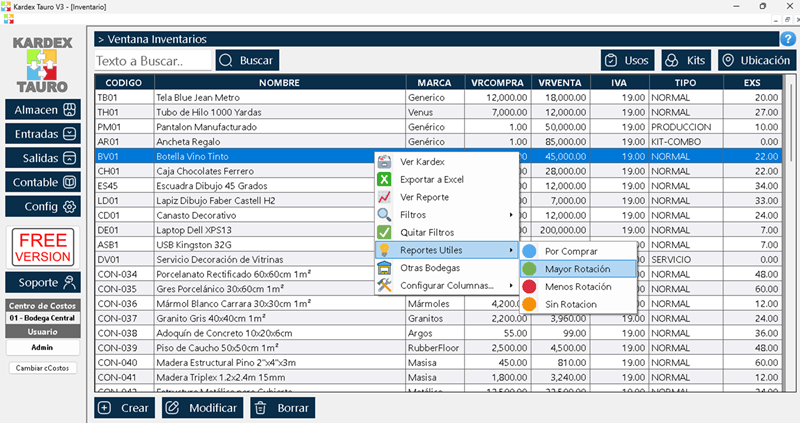
The public accountant of today still performs, with modern tools, the oldest task in the world of business: knowing with certainty what the company owns, how much it owes and how much it earned. And within that task, few things are as concrete as inventory. When an accountant or an auditor carries out a physical count and compares it with the stock records, they are repeating a ritual thousands of years old: the same one performed by the scribe who noted the temple's grain, the bookkeeper who watched the merchant's goods and the Victorian auditor who verified a railway's warehouses. What changed is the instrument: the stock card once filled in by hand now lives inside inventory software such as Kardex Tauro, which keeps the stock record up to date so that the accountant, heir to that long chain of custodians of the accounts, can trust the numbers he or she signs. Few threads in accounting history are as long as the one linking the temple scribe to today's public accountant.
