The first accounting schools and faculties in the world
The first accounting schools and faculties in the world
Today, anyone who wants to work in accounting enrols in a faculty of economic sciences, studies for several years and earns a recognised university degree. That path seems so natural that it is hard to imagine that, for centuries, accounting was not taught at any university at all: it was a trade learned on the job, next to an experienced merchant or bookkeeper. Between that craft apprenticeship and the modern faculty lies a journey of almost seven hundred years, with abacus schools in the Renaissance, higher schools of commerce in the nineteenth century and, finally, the full entry of the discipline into the university. This article tells that story and answers a simple question: where and when did the world begin to teach accounting?
Before the classroom: a trade learned by doing
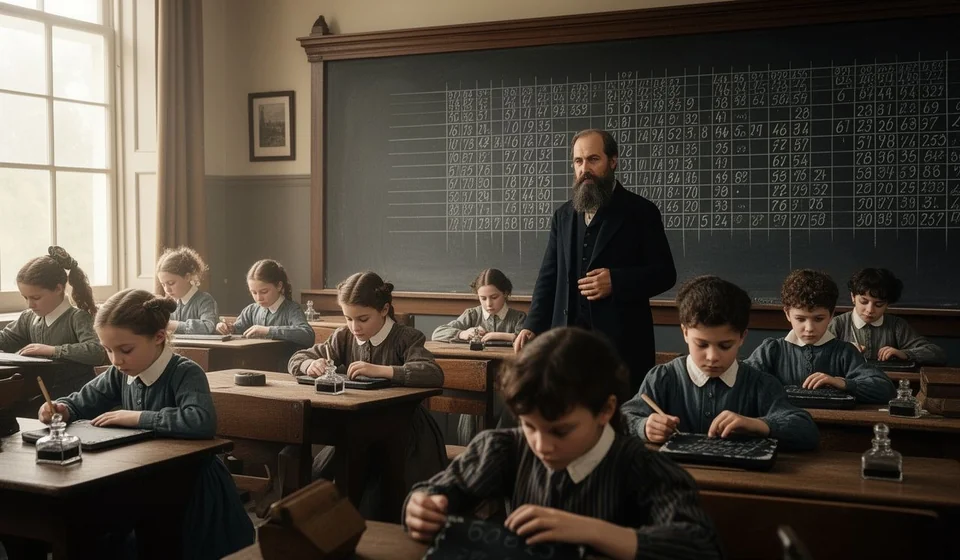
For most of history, accounting knowledge passed from master to apprentice, just like any other craft. A young man who wanted to go into trade started working very early in a workshop, a warehouse or a merchant's office, where he learned to keep the books by copying entries, watching his elders and correcting his own mistakes. Double-entry bookkeeping, perfected among the Italian merchants of the late Middle Ages, was taught that way, almost in secret, as practical knowledge tied to a business rather than as a subject of study.
There was, however, an important earlier step: the abacus schools of Renaissance Italy. From the thirteenth century, cities such as Florence, Venice, Genoa and Pisa saw the rise of the so-called scuole d'abaco, private institutions where lay teachers instructed the sons of merchants in the practical arithmetic that trade demanded: the four operations with Indo-Arabic numerals, currency exchange, prices, interest and partnership rules. They were neither universities nor accounting schools proper, but they trained the young men who would later keep the books of commercial houses, and they spread the mathematics that made modern accounting possible. Works such as Leonardo of Pisa's Liber Abaci, written in the early thirteenth century, helped carry that knowledge across Europe.
Europe in the nineteenth century: the higher schools of commerce appear
The Industrial Revolution and the expansion of international trade changed the rules. Companies grew, banks and joint-stock companies multiplied, and suddenly there was a rising demand for clerks able to keep books, calculate costs and understand finance. Craft apprenticeship was no longer enough: institutions were needed where commerce could be taught systematically. France led the way: in 1819 the École Supérieure de Commerce was founded in Paris on the private initiative of two former Napoleonic officers, Germain Legret and Amédée Brodart. It is regarded as one of the first business schools in the world and the oldest still operating; its classrooms taught accounting, languages, commercial geography and commercial law, all with a deliberately practical orientation.
The example spread across the continent. In Belgium, the Institut Supérieur de Commerce of Antwerp, founded around 1853, ranks among the oldest institutions of higher commercial education in Europe. In Italy, a royal decree of 6 August 1868 created the Regia Scuola Superiore di Commercio in Venice, promoted among others by the economist Luigi Luzzatti: it was the country's first higher school of commerce and over time grew into today's Ca' Foscari University, which still occupies the Gothic palace on the Grand Canal from which it takes its name.
Germany added its own piece in 1898, when the Leipzig Chamber of Commerce founded the Handelshochschule, the country's first academic school of commerce. Among its first students was Eugen Schmalenbach, regarded as one of the founding fathers of modern business administration as a scientific discipline. Austria and other European countries joined the movement: at the turn of the twentieth century, higher commercial education was no longer a rarity but a recognised network of institutions.
The United States: accounting enters the university
Across the Atlantic, the great leap took place inside the universities themselves. In 1881, the industrialist and philanthropist Joseph Wharton donated the funds to create, at the University of Pennsylvania, the school that bears his name: the Wharton School. It was the first collegiate business school in the United States and one of the first of its kind in the world; its declared purpose was to train people who would become "pillars of the State, whether in private or in public life". Although accounting did not hold the central place it occupies today, Wharton opened the door for the study of commerce and finance to be considered a career worthy of a university.
Two decades later, in 1900, New York University founded the School of Commerce, Accounts and Finance, one of the first university schools in the country devoted expressly to business, accounting and finance. Behind its creation stood Charles Waldo Haskins, a certified public accountant and co-founder of the firm Haskins & Sells, who was convinced that accounting deserved rigorous university training. That school, known today as the Stern School of Business, proved that bookkeeping could be taught at the highest academic level.
It is worth remembering, however, that in the United States the profession organised itself before the university did. Public accountants joined professional associations from the late nineteenth century, and those associations, together with the states, created the first examinations for the certified public accountant title, the famous CPA, first examined in New York State in 1896. Universities came later, but they came to stay: throughout the twentieth century accounting programmes multiplied and became the usual gateway into the profession.
From technical course to degree career
Accounting's passage through the university was neither automatic nor uniform. In many countries it began as a handful of courses inside commerce programmes; gradually those courses were organised into full careers with their own curricula, dedicated departments and, later, graduate studies and academic research. Accounting ceased to be seen as a mere recording technique and came to be understood as a discipline with theory, professional judgement and social responsibility: an evolution that accountants' associations drove with their examinations and codes of ethics while the faculties consolidated the training.
That double origin explains something still true today: academic accounting never fully abandoned its practical roots. A good university programme combines theory with recording exercises, cases drawn from real companies and, in many countries, supervised professional practice. The profession demanded that blend from the very beginning, and the faculties learned to provide it.
Latin America: the national schools of commerce
In the Spanish-speaking countries of the Americas, institutional commercial education arrived during the nineteenth century, inspired by European models. Mexico offers an early example: in 1845 the Instituto Comercial was created in Mexico City; over the years it became the Escuela Especial de Comercio, then the Escuela Nacional de Comercio y Administración and, from 1890, the Escuela Superior de Comercio y Administración, today part of the National Polytechnic Institute. From its earliest curricula it included commercial arithmetic and single- and double-entry bookkeeping, together with languages and commercial geography; its classrooms produced the country's first accountants.
Argentina followed a similar path: in 1890, under President Carlos Pellegrini, the country's first school of commerce was founded in Buenos Aires, today the Escuela Superior de Comercio Carlos Pellegrini, linked to the University of Buenos Aires. In other nations of the region, the national schools of commerce performed for decades the role that faculties play today: training the bookkeepers and accountants required by commercial houses and governments, before accounting entered the university in earnest during the twentieth century.
A tour of the milestones
The table below summarises the institutions that marked the path of accounting education, from the first schools of commerce to the university programmes.
| Institution | Year | Country | Contribution |
|---|---|---|---|
| École Supérieure de Commerce, Paris | 1819 | France | One of the world's first business schools; still active |
| Instituto Comercial (now ESCA) | 1845 | Mexico | Beginning of official commercial education in the country |
| Institut Supérieur de Commerce, Antwerp | c. 1853 | Belgium | One of the oldest higher commercial schools in Europe |
| Regia Scuola Superiore di Commercio, Venice | 1868 | Italy | Italy's first higher commercial school; today Ca' Foscari University |
| Wharton School (University of Pennsylvania) | 1881 | United States | The country's first collegiate business school |
| Escuela de Comercio de la Capital (now Carlos Pellegrini) | 1890 | Argentina | The country's first school of commerce |
| Handelshochschule Leipzig | 1898 | Germany | Germany's first academic school of commerce |
| School of Commerce, Accounts and Finance (NYU) | 1900 | United States | Pioneering university school of business, accounting and finance |
As is usual with founding dates, each institution has its own history of name changes, levels and locations; the table shows the year in which each opened its doors with the character that made it famous.
From nineteenth-century desks to today's faculties
A century and a half after Venice's Regia Scuola di Commercio, hardly any major university lacks a faculty or department of economic, administrative or accounting sciences. What was a Parisian exception in 1819 became first a European movement, then a worldwide network and finally a consolidated discipline, with public accounting degrees, master's programmes and doctorates on every continent. Today's student still learns the double-entry method taught in the commercial schools of the nineteenth century, but also studies costs, taxation, auditing, information systems and international standards.
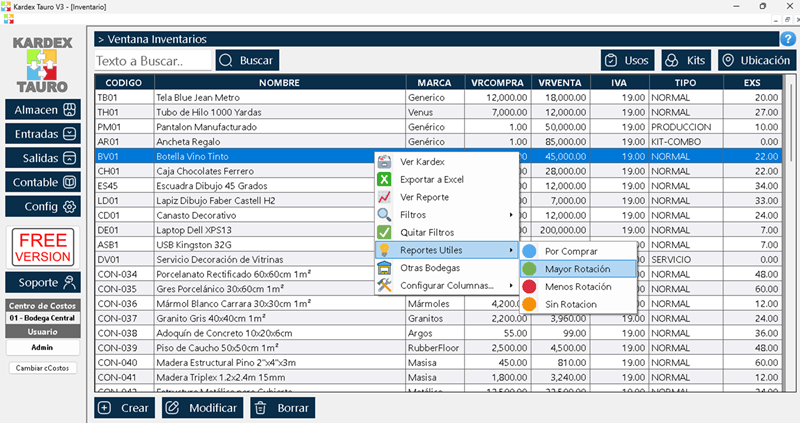
That university training relies, more and more, on tools that make accounting work more orderly and reliable. Anyone who keeps a business's books knows that records are worth only as much as their support: without careful control of stock, no ledger tells the full story of a company. That is why, alongside classroom knowledge, programmes such as Kardex Tauro help today's accountants and managers keep their inventory up to date, with the same discipline the old abacus masters demanded of their pupils, but with twenty-first-century technology.