The Domesday Book and the great inventories of history
The Domesday Book and the great inventories of history
Before spreadsheets and barcode scanners, knowing exactly what you had was a solemn and expensive affair: you had to travel the land, look at what was there, count it and set it down in writing. For centuries, kings, empires, notaries and companies ordered great counts of goods that are the direct ancestors of the modern physical inventory. None of them was as famous as the Domesday Book, the great survey that William the Conqueror commissioned in 1086 to find out what the kingdom of England contained. Its story, together with that of the other great inventories, explains why counting what you own has always been one of the obsessions of rulers and of merchants.
What the Domesday Book was
The Domesday Book is the manuscript that records the Great Survey of England, ordered by William the Conqueror. According to the Anglo-Saxon Chronicle, at Christmas in 1085 the king held long deliberations with his council at Gloucester about how the land of the kingdom was occupied and by what sort of men; he then sent his men all over England, into every shire, to find out how many hides of land there were in each one, what land and livestock the king himself owned and what dues he ought to receive each year. He also had them record how much land his archbishops, his bishops, his abbots and his earls held, and what or how much every landholder in England had in land or in livestock, and how much money it was worth.
The result was a record of estates, lords and values that covered almost the whole kingdom. For each property the scribes noted who had held it in the time of King Edward the Confessor, who held it then and what it was worth at three different moments: on the last day of Edward's reign, when the new lord had received it, and in 1086 itself, the year of the survey. The entries listed the arable land, the plough teams with their oxen, the peasants of each class, the meadows, the woodland, the mills and the fisheries. The chronicler summed up the thoroughness of the whole operation in a famous phrase: the inquiry was carried out so very narrowly that there was not a single hide, nor a yard of land, and, as he adds with disapproval, not even an ox, nor a cow, nor a swine was left out of the record.
The book covered more than thirteen thousand places and survives in two volumes. Great Domesday gathers most of the counties and, according to specialists, appears to have been copied out by a single scribe onto parchment; Little Domesday, devoted to Norfolk, Suffolk and Essex, is more detailed and even recorded the livestock on the lords' home farms. The figures served above all the king's fiscal rights, but they also helped to settle disputes about who owned what land twenty years after the Norman Conquest of 1066.
Why it is called Domesday
The name, which comes from Middle English and literally means the Day of Judgement, was not used from the start: the manuscript was first known as Liber de Wintonia, the Book of Winchester, after the city where it was kept in the royal treasury. The nickname became popular in the twelfth century, and the treasurer Richard FitzNeal explained why in his Dialogue concerning the Exchequer, written around 1179: the people called the book Domesday, that is, the day of judgement, because just as no judgement of that final and terrible trial can be evaded by any subterfuge, so when a controversy arose in the kingdom about any matter contained in the book, its word could not be denied or set aside without penalty. An inventory that had become a definitive sentence: nothing shows better the authority that the great register came to enjoy.
How the survey was organized
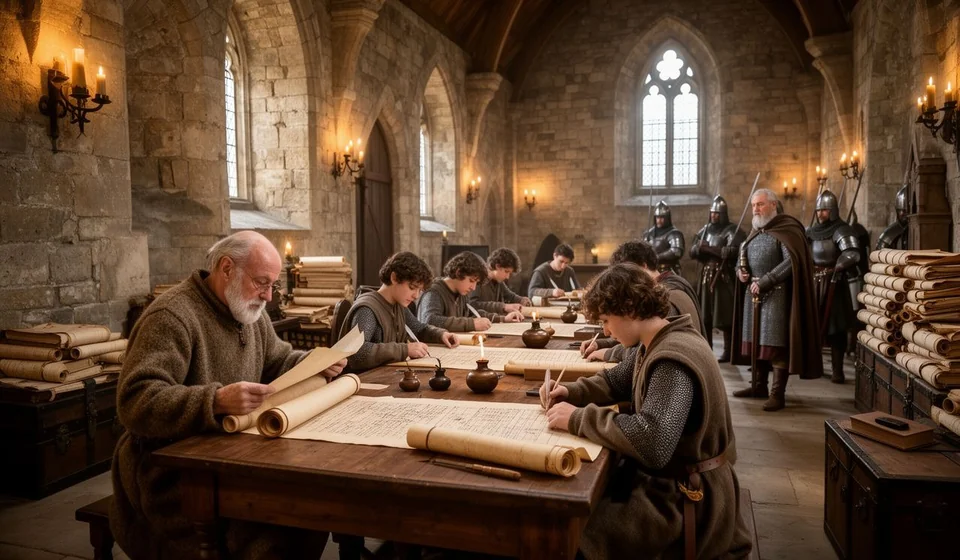
The operation was not a simple headcount: it was a coordinated inspection programme carried out on the ground. The kingdom was divided into circuits, groups of shires visited by royal commissioners. In each district the commissioners held public sessions in which they put a fixed set of questions to the local men, who answered on oath; according to historians, the local juries were made up half of Englishmen and half of Normans so that the statements would be as impartial as possible. The answers were checked and then taken to Winchester, where the scribes of the royal writing office summarised them and copied them onto parchment. In short, it was a survey of resources built from sworn testimony, inspection circuits and a central drafting office: the same logic that any large inventory operation would still follow nine centuries later.
Why states made inventories
William did not invent the genre: states had been counting what they owned for centuries, because they needed to know what they could tax and what they could rely on for defence. The Roman census is the clearest ancestor. Every five years, two magistrates called censors — an office created around 443 BC, although tradition attributed the first census to King Servius Tullius in the sixth century BC — summoned the citizens to register their names, their ages and their property. The list was used to apportion taxes and to know how many men could bear arms; when the work was done, a purification ceremony called the lustrum closed the cycle, and from that word the idea of a five-year period passed into several modern languages.
Much earlier, in pharaonic Egypt, scribes measured the fields after the annual flood of the Nile and noted on papyrus the plots, their crops and the tribute they owed. The famous Wilbour Papyrus, a cadastral register of the Ramesside period written around 1150 BC, shows how the state inventoried the land in order to tax it. In every case the logic is the same: the inventory was born together with power, because power collected tribute, raised armies and needed to know the kingdom it ruled. To count was to rule.
The genre of estate inventories
States were not the only ones that counted. Between the late Middle Ages and the Renaissance, European cities developed a genre of their own: the post-mortem inventory. When a person died leaving property to be divided, a notary or a testamentary executor walked through the house, often room by room, and drew up a list of every piece of furniture, every garment, every jewel, every pot, every book and every outstanding debt. The document protected the heirs — who accepted the inheritance with the benefit of inventory, answering only up to the value received — and the creditors, who could claim against goods identified one by one. Workshops and shops were inventoried too, with their tools, their raw materials and their stock of merchandise.
Thousands of these documents, drawn up before notaries between the thirteenth and the seventeenth centuries, survive in European archives today, and they are a goldmine for historians: thanks to them one can reconstruct how people dressed, what they cooked, how a house was furnished or what a shopkeeper sold. A celebrated example is the inventory of the Florentine merchant Bernardo di Giorgio de Bardi, drawn up in 1419, which lists everything from a cradle to the lambs on his farms; another is the inventory of the house of the Portuguese merchant Emmanuel Ximenez in Antwerp, made in 1617, with its library, its silverware and even the laboratory in the attic. Alongside these, the port archives hold inventories of shipwrecks and cargoes: lists drawn up before the authorities of what was salvaged from a sunken or stranded ship, needed to share out the losses, collect insurance and return the goods to their owners. Before statistics existed, the inventory was the most exact way to describe a life, a trade or a shipwreck.
From kingdoms to companies
As trade expanded, the inventory ceased to be a matter for kings and notaries alone and became a business practice. The great colonial companies, such as those trading with Asia and the Americas, kept warehouses in ports and factories on three continents whose value lay almost entirely in merchandise: spices, textiles, metals, dyes. Keeping the record of those stocks and counting them when the ships arrived and when they departed was the only way to know how much capital the company really had, thousands of miles from its headquarters. Periodic stocktaking thus became a routine inseparable from large-scale trade.
By the twentieth century, the inventory had become industrial. Factories and department stores adopted the annual physical inventory: once a year, usually at a quiet time or during the year-end holidays, the plant or the store was closed and every available employee spent days counting piece by piece, shelf by shelf, while auditors watched over the procedure. The result served to adjust the books, value the stock in the financial statements and detect theft, errors or shrinkage. That year-end ritual, with the business halted for days, was for decades the very image of inventory taking.
Inventory today: counting without stopping the business
Stopping an entire operation to count it has an enormous cost, which is why modern companies prefer not to wait for a single great count. Cycle counting divides the warehouse into sections or categories and counts one part every week or every month, so that over the course of a year everything has been verified at least once; the most valuable or fastest-moving items are counted more often, and discrepancies are detected early, while their cause can still be investigated. The rotating inventory thus achieves the goal that the Domesday Book pursued — to know, with certainty, what there is — without shutting down the business or waiting for the year-end close.
Great counting operations in history
| Operation | Date | What was counted | What it was for |
|---|---|---|---|
| Land register of Ramesside Egypt (Wilbour Papyrus) | Around 1150 BC | Plots, crops and tributes | Levying taxes on land |
| Roman census of the censors | Every five years, from 443 BC | Citizens, ages and property | Apportioning taxes and raising armies |
| Domesday Book | 1086 | Lands, lords, peasants, livestock, mills and values | Knowing, assessing and taxing the kingdom; settling disputes |
| Post-mortem inventories before notaries | Thirteenth to seventeenth centuries | Goods of houses, workshops and shops | Protecting inheritances, credits and guardianships |
| Shipwreck and cargo inventories | Fourteenth to eighteenth centuries | Salvaged merchandise and ship remains | Sharing losses, collecting insurance, doing justice |
| Stock counts of the colonial companies | Seventeenth and eighteenth centuries | Stocks of overseas warehouses and factories | Knowing the capital invested in merchandise |
| Annual factory physical inventory | Twentieth century | All stock, with the plant shut down | Auditing the books and valuing the balance sheet |
| Cycle and rotating counting | Today | Parts of the warehouse by rotation | Controlling stock without stopping operations |
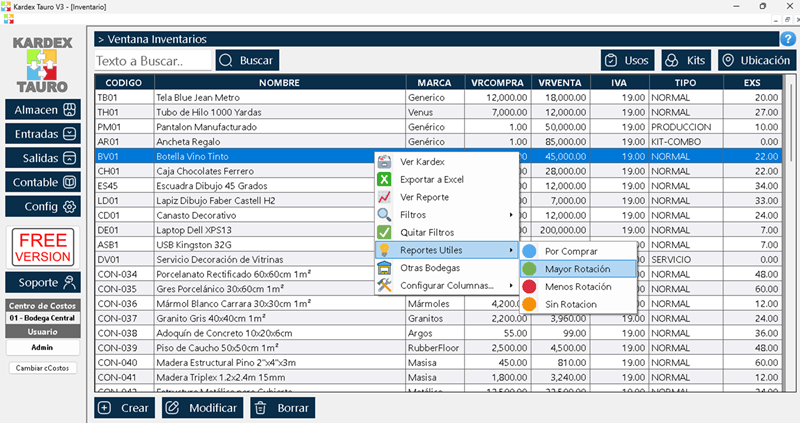
From the Winchester parchment to the storekeeper's screen runs a single thread: the need to know what you have, where it is and what it is worth. The scale has changed, but the question remains the same, and today companies answer it with permanent records and periodic counts instead of great annual campaigns. For that daily work of keeping track of stock and reconciling what was counted with what was recorded, digital tools such as Kardex Tauro carry on, nine centuries later, the spirit of William's great book: that nothing should be left unrecorded.