The history of auditing: from the verifier scribe to the external auditor
The history of auditing: from the verifier scribe to the external auditor
Who watches over the bookkeeper? The question is as old as accounting itself, and the answer has changed shape over the centuries: first a palace official, then a listener seated before a steward rendering his accounts, later an accountant hired by the shareholders and, today, an external auditor who gives an opinion on financial statements to the market. This article traces the history of that function, the independent verification of accounts, from the scribes who checked other people's records to the auditor who signs an opinion. The history of the accounting profession, with its schools, guilds and associations, has already been told in another post on this blog; here the profession appears only in passing, because the real subject is the act of auditing itself: checking, with independence, what others recorded.
Verification before the word existed
Long before the word audit existed, the practice did. In the earliest civilizations, the scribes who recorded grain, livestock and tribute knew that their tablets would be reviewed by other officials: cross-checking was part of the job, because a record without verification was of little use. In classical Athens, democratic distrust of those who handled public money produced a remarkable system. Every magistrate who had administered funds had to render his accounts on leaving office: ten logistai, citizens chosen by lot, examined his figures, looked for missing amounts or improper collections and, when they found irregularities, took the case to court. They were not career officials but ordinary citizens temporarily invested with a supervisory role: a remote but recognisable ancestor of the auditor.
Rome contributed less in accounting technique than Greece but turned control into an institution. The quaestors managed the public treasury and answered for it; the censors oversaw state contracts; and magistrates had to give an account of their term when it ended. The principle was the same as in Athens: whoever handles other people's resources must be able to prove, with records, that they were used properly. That the idea now sounds obvious only makes its history more remarkable: for centuries, most of humanity lived without it.
To audit meant to hear: the origin of the word
The word we use today was born from a physical act: listening. Auditor comes from the Latin audire, "to hear". In medieval Latin the auditor was the judge or examiner of accounts, and in English the word is documented from the early fourteenth century meaning "an official who receives and examines accounts". It was no metaphor: accounts were examined aloud.
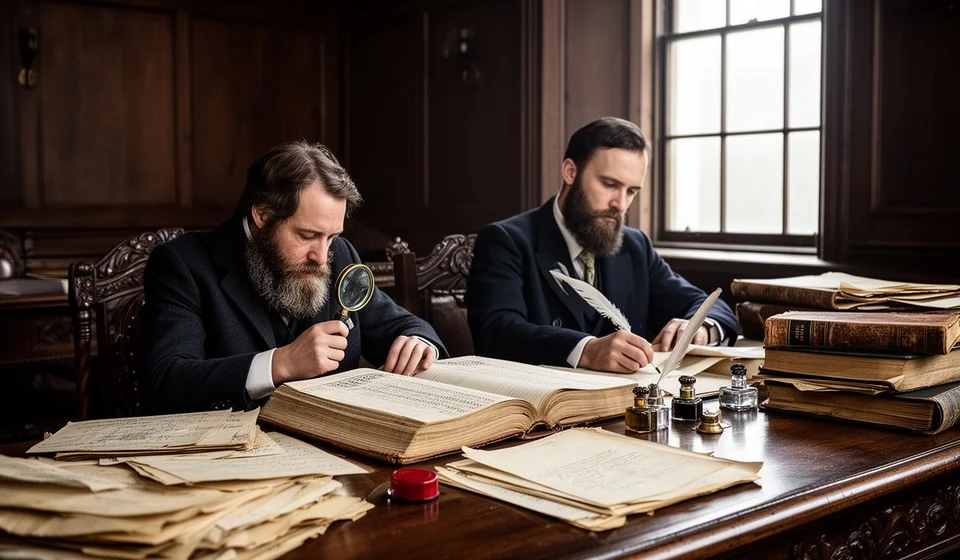
On medieval manors and in monasteries, the administrator, the bailiff of the estate or the monk in charge of an office, rendered his accounts once a year before the lord, the abbot or their delegates. He read out the year in figures: rents collected, expenses paid, cattle born and lost, harvests sold. The auditors listened, compared what was said against receipts and rolls, and approved or challenged each item. That ceremony was, literally, a hearing of accounts: an account that was spoken and a verification that was done by listening. The verb to audit preserves that memory, and at some English-speaking universities a student who sits in on a course without enrolling is still called an auditor.
Verification follows the money: factors, branches and books that travelled
As trade revived, verification ceased to be the exclusive business of kings and abbots. The merchant who crossed the fairs could not personally watch every sack of wool or every bill of exchange: he needed others to sell, buy and collect on his behalf. That is how factors and agents appeared, people who ran someone else's business far from the owner's eyes. And the old question returned: how could the owner know that the factor was not cheating him?
The great trading houses answered by turning accountability into routine. From the archives of Francesco Datini, the fourteenth-century merchant of Prato, to the companies of the Renaissance, factors had to keep their own books and send the head office a regular account of their operations; the records of branches were compared against those of headquarters and differences were investigated. The thousands of surviving letters and ledgers show how practical an obsession control had become: the owner wanted to know, in numbers, what had happened to his money. The change was subtle but decisive: this was no longer a matter of hearing an annual statement but of reviewing continuous books, comparing records between offices and tracing individual transactions. The seed of modern auditing, the examination of papers rather than only of words, had been planted.
Nineteenth-century Britain: the law makes auditing compulsory
The decisive step came in nineteenth-century Britain, when the Industrial Revolution multiplied joint-stock companies: railways, banks and factories owned by thousands of shareholders who took no part in management. Shareholders needed reliable information, and management was the one producing it: between the two, the law placed the auditor.
The Joint Stock Companies Act of 1844 allowed companies to be incorporated by simple registration and required them to submit their accounts to auditors. The experiment did not hold: the Act of 1856 removed the obligation, and for decades auditing remained voluntary, although many companies kept it by their own decision, writing it into their articles. Two shocks changed the course. The first was the collapse of the City of Glasgow Bank in October 1878, one of the largest banks in the United Kingdom: its directors had dressed up the balance sheets and, because shareholders' liability was unlimited, the failure ruined nearly all of them. The scandal led to the Companies Act of 1879, which required banks to have their accounts audited every year. The second was consolidation: the Companies Act of 1900 restored, for registered companies, the duty to submit the annual accounts to an auditor. The compulsory annual audit we know today had arrived.
That demand also supported the birth of the modern profession: in the same century the first associations of accountants were organised in Scotland and England, and the figure of the public accountant who audits on behalf of the shareholders rather than management took shape. That professional history, with its names and dates, was already told on this blog in its article on the accounting profession; here it is enough to note that auditing, until then occasional, became a permanent service required by law.
The United States: auditing reaches the stock market
On the other side of the Atlantic, auditing became compulsory through the door of the capital market. Before 1929, American companies offering shares to the public were not required to publish verified financial statements; disclosure was uneven and often misleading. The stock market crash and the Great Depression persuaded legislators that investors' confidence needed a solid foundation.
The Securities Act of 1933 demanded truthful information when securities were offered, and the Securities Exchange Act of 1934 created the Securities and Exchange Commission (SEC) to oversee the markets. Under that framework, listed companies must file financial statements audited by independent public accountants: auditing ceased to be a private matter between owners and managers and became a condition imposed by the State for access to public money.
From then on, and throughout the twentieth century, external auditing grew with the large corporation. Accounting firms became organisations with offices in dozens of countries, the auditor's opinion became a requirement of stock markets around the world, and independent verification consolidated as an industry of global scale.
Modern auditing: external, internal and governed by standards
During the twentieth century auditing branched out. External auditing, performed by an independent public accountant, produces the opinion that accompanies the financial statements: it states whether they present fairly the company's position. Internal auditing, by contrast, is a function of the organisation itself: its professionals review processes, controls and risks to help management keep information reliable and resources protected. Both share the same instinct, check before you trust, but they answer to different audiences.
As complexity grew, so did the standards. Individual expertise was no longer enough: the auditor works under established procedures that say how to plan a review, what evidence to obtain and how to document it. Concepts such as materiality (how large an error must be to matter), sampling (reviewing a part to conclude on the whole) and risk assessment (where an error or fraud is most likely) organise the work. Verification had stopped being an art of listeners and had become a discipline with methodology, supervision and working papers.
Trust under examination again: the turn of the twenty-first century
History, however, is not a straight line towards more control. At the beginning of the twenty-first century, scandals such as Enron, the American energy giant that collapsed in 2001 after hiding debts with accounting devices, and the demise of its audit firm, Arthur Andersen, showed that auditor independence could fail in practice. The United States responded with the Sarbanes-Oxley Act of 2002, which strengthened management's responsibility for the financial statements, tightened the requirements of independence and created the PCAOB, a public body in charge of overseeing the auditors of listed companies. Far from a regulatory detail, the episode recalled the oldest lesson of the discipline: the value of an opinion depends on the true independence of the person who signs it from those who prepared the numbers.
Auditing is also counting what exists
Auditing does not look only at papers: it looks at things too. One of the oldest chapters of verification is checking that what the records say actually exists, and few places concentrate that test like the warehouse. Counting stock physically, the stocktake, is a practice centuries old: the steward who declared so many head of cattle had to show the cattle, not just the parchment.
That logic is still alive. When inventories are significant, the auditor usually attends the physical count, because stock is one of the items where an error hides easily: a miscounted figure, damaged goods still carried in the books or a duplicate entry. The audit trail connects the warehouse to the accounts: every receipt and every issue should be traceable from the original document to the balance in the ledger. That is why the verification of inventory is not a luxury reserved for large companies: any business that keeps goods faces the same question as an auditor, does what I have recorded match what I have in the storeroom?, and answering it requires reliable records and a periodic count to test them against.
The history of account verification can be told through a handful of milestones:
| Milestone | Year | What changed in auditing |
|---|---|---|
| The logistai examine the magistrates of Athens | 5th-4th century BC | Citizens chosen by lot review, at the end of their term, the accounts of those who handled public funds. |
| The auditor "hears" the steward's accounts | Middle Ages | Lords and abbots listen to the annual account of their administrators; from audire, "to hear", comes the word auditor. |
| Trading houses control their factors and branches | 14th-16th centuries | Owners compare the books of distant agents and branches; verification becomes an examination of papers. |
| Joint Stock Companies Act | 1844 | In the United Kingdom, joint-stock companies must submit their accounts to auditors. |
| Collapse of the City of Glasgow Bank | 1878 | The failure of a major bank leads to the Companies Act of 1879, which requires banks to be audited every year. |
| Companies Act | 1900 | The compulsory annual audit is restored for registered companies in the United Kingdom. |
| Creation of the SEC | 1933-1934 | In the United States, listed companies must present financial statements audited by independent accountants. |
| Sarbanes-Oxley Act | 2002 | After the Enron scandal, auditor independence is reinforced and the PCAOB is created to oversee auditors. |
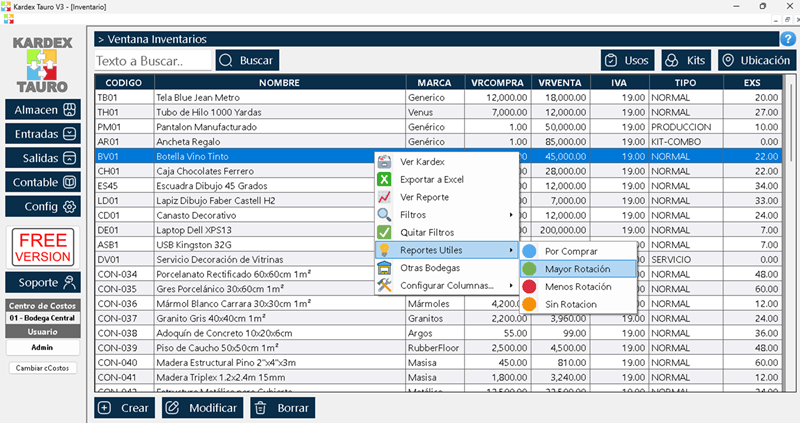
The line that joins the scribe who checked the palace records with the auditor who signs an opinion is the same: no one should have to take the numbers on faith. What changed is scale and tools. What was once settled by hearing a declaration beside the castle fire, or by comparing by hand the books of a distant branch, is now settled by systems that record each movement as it happens and leave the evidence ready to be checked. Whoever runs a warehouse lives that same discipline, and it is called inventory control: an up-to-date record, compared every so often with what is physically on the shelves, is the everyday version of an audit. Software such as Kardex Tauro does for a business's inventory what the auditor does for a company's accounts: it lets the recorded and the real be confronted without relying on memory or good faith.