The history of financial statements: from the estate inventory to the annual report

The history of financial statements: from the estate inventory to the annual report
Every year, millions of companies close their books and publish a summary of where they stand: what they own, what they owe, how much they earned and where the money came from and went. That set of documents, the financial statements, is so much a part of economic life that it is hard to imagine a world without it. Yet the financial report as we know it has a short history, and it did not begin where most people would guess: not in the offices of regulators or the boardrooms of banks, but in a far older and humbler practice, the habit of making lists of what one possessed.
This article follows that road, from the estate inventory drawn up before a notary to the audited annual report published and compared every year. One question runs through all the centuries: when someone entrusts money to a business, how does that person find out what happened to it?
Before the financial statement: the inventory of goods
For centuries, the natural way of accounting for wealth was to list the things that made it up. Long before anyone conceived of a balance sheet, there was the inventory: a written list of the goods of a person, a family or a firm. The notaries of medieval and early modern Europe drew up inventories when someone died, so that the inheritance could be divided without fraud; inventories were made to record the dowry a woman brought into marriage; judges ordered inventories of a bankrupt merchant's property; and when a ship was wrecked, port authorities and insurers inventoried the salvaged cargo so that losses could be shared fairly.
Business partnerships began the same way: the first practical document of a company was the statement of what each partner contributed, and when a partnership was dissolved or renewed, a closing inventory was made so that what remained could be divided. That tradition of great official reckonings has famous landmarks, such as the Domesday Book ordered by William the Conqueror in England in 1086, a story this blog has already told in full. Here it matters only as a point of departure: inventories were lists of things, not reports about a business.
The difference is essential. An inventory answers simple questions: what is there, how much of it, and whose it is. It is a snapshot of goods, taken almost always for a legal reason: to protect heirs, dowries, creditors or insurers. It does not tell whether the business is doing well or badly, it does not separate what is owed from what is owned, and it computes no profit. For that list to become a financial statement, two earlier inventions were needed: double-entry bookkeeping, which recorded every operation twice and made it possible to check that the books were in balance, and the custom of closing the books periodically to see how much had been gained or lost.
The merchant's closing of the books: the balance is born
From the late Middle Ages on, the great merchants of Italy and Flanders kept increasingly orderly account books: a memorial where everything was noted, a journal where operations were recorded in sequence, and a ledger where each account gathered its own history. But keeping the books up to date was not enough: from time to time one had to stop and see the result of the business as a whole.
That moment of stopping is the closing of the books, and from it the balance was born. At the end of the year, the merchant transferred the balances of all the ledger accounts into a summary statement: what he had (cash, merchandise, debts owed to him) against what he owed, with the difference as a gain or loss added to or subtracted from his capital. The very word says it: balance comes from the image of the scales with their two pans, what one has and what one owes, which at the year's close had to come into equilibrium. In Venetian practice that great annual summary was called the bilancione, the big balance that crowned the year's bookkeeping.
That knowledge circulated among practitioners, but it became public in 1494, when the friar and mathematician Luca Pacioli published his Summa de arithmetica in Venice. Inside that mathematical encyclopedia travelled a treatise on bookkeeping in the Venetian manner, with precise instructions: how to write the journal, how to post entries to the ledger and, above all, how to close the ledger at year's end, transfer the balances, prove that everything squared and then open a new book. Pacioli did not invent double entry, which was already used in the Italian cities, but his printed book spread it across Europe; this blog's history section devotes a full article to him.
It was a private document, seen by the merchant, his partners and, in case of litigation, the judges.
The great trading companies: the balance becomes accountability
The decisive turn came with the India companies. In 1600 Queen Elizabeth I of England granted its charter to the English East India Company, and in 1602 the States General of the Dutch Republic created the Vereenigde Oostindische Compagnie, the Dutch VOC, by merging several rival companies. The solution was to gather the money of thousands of people, who received transferable shares in return.
That change brought an unprecedented accounting problem. A shareholder of the VOC might be a craftsman or the widow of an Amsterdam official who would never see a ship; he or she could not inspect warehouses or sit down to review the company's ledger. Only one road remained to know whether the money was safe: to demand accounts. The directors, educated in the secretive tradition of the merchant, resisted publication of their books as long as they could, fearing the numbers would fall into the hands of competitors. But shareholders demanded periodic information, results and dividends, and the tension between commercial secrecy and the investor's right to know shaped the accounting of the seventeenth and eighteenth centuries. The English East India Company lived through similar conflicts: its owners met in assemblies, elected committees and demanded accounts from the directors.
The outcome was a new and lasting idea: the balance as accountability towards absent owners. When management and ownership separate, the periodic financial report becomes the bridge between the two shores. That bridge, first built across the India companies, is the direct ancestor of the modern annual report.
The nineteenth century: laws, companies and railroads
During the nineteenth century the financial report moved from good practice to legal requirement. In Britain, speculative bubbles and the frauds of joint-stock companies drove Parliament to act. The Joint Stock Companies Act of 1844 created a public register of companies and ordered directors to keep books, balance the accounts and prepare a full and fair balance sheet, which auditors chosen by the shareholders had to examine and which was presented and read at the annual general meeting.
The pendulum, however, swung back. The Act of 1856, inspired by laissez-faire, softened those requirements: the balance sheet and the audit were moved into a model set of articles that companies could adopt or ignore, and many ignored them. Only around 1900 did the audit become compulsory again for most British companies, and through the twentieth century the profit and loss account was formally added to what the law required to be laid before the members. The reform of 1947-1948 also enshrined the formula that still governs the English-speaking world: the accounts had to give a true and fair view of the company, verified by a professional auditor.
Meanwhile a new industry pushed financial information towards publicity: the railroads. No earlier industry had needed so much capital from so far away: tracks were laid for hundreds of miles, investors lived in cities that might never see the line, and their money was trapped in iron and locomotives for decades. To attract that money, American railroad companies published annual reports with figures for revenues, expenses and profits, and their statements became the model of the report to investors. When fraud demanded it, the state stepped in: the Interstate Commerce Commission, created in 1887, was empowered to prescribe uniform systems of accounts, and between 1894 and 1907 it issued compulsory classifications that made the reports of every railroad in the country comparable and public. A conviction was born that the twentieth century would make universal: the numbers of a great enterprise are not a private matter.
The twentieth century: standardization and the report as communication
The twentieth century turned financial information into a right of the market. The crash of 1929, which ruined millions of investors who had bought shares without reliable information, convinced American regulators that financial publicity was the investor's best defence. The Securities Act of 1933 required issues of securities to be accompanied by registered financial information, and the Securities Exchange Act of 1934 created the SEC and obliged listed companies to file periodic reports: information ceased to be a favour and became a duty towards the market.
That is why the twentieth century is also the story of standardization: committees of experts, professional bodies and, later, international frameworks seeking a common language. The result is the set known today: the balance sheet or statement of financial position, showing what the company owns and owes at a date; the income statement, showing how much it earned or lost in the period; and the statement of cash flows, showing where the money came from and went. Around the statements, the annual report grew into an object of communication: the chairman's letter, photographs and charts turned an accounting document into a showcase for the company.
Inventory inside the report: from counting to valuing
Amid all that evolution, the oldest line of the balance sheet is also the most easily forgotten: inventory. The earliest documents in this story counted sacks, bolts of cloth or barrels of wine. A financial statement, however, cannot list sacks: everything must be expressed in money, because only then can what one owns be added up, what one owes be subtracted and the profit be computed. Inventory inside the report is still, deep down, the medieval list of goods, but translated into a single figure: that of the stock on hand.
That translation from counting to valuing has familiar consequences. Stock appears on the balance sheet as an asset, what the company has to sell; but it is also tied to the result, because what is sold leaves the warehouse at its cost, and that cost is deducted from revenue to calculate profit. That is why the value assigned to stock is no small detail: depending on how the goods left in the warehouse are valued, both the asset on the balance sheet and the cost of sales, and with them the reported profit, will change. The central idea, however, is historical: when the financial report learned to value what it had previously only counted, inventory stopped being a list and became a miniature financial statement inside the balance sheet.
The table below summarizes the whole journey.
| Period | Document | For whom it was made | What it showed |
|---|---|---|---|
| Middle Ages and early modern era | Notarial inventory: inheritances, dowries, shipwrecks, bankruptcies | Heirs, judges, insurers, creditors | A list of goods, quantities and ownership; sometimes with appraisals |
| 14th to 16th centuries | Annual closing of the ledger and the merchant's balance (the Venetian bilancione) | The merchant himself, his partners and judges in disputes | Debts, credits, merchandise and the gain or loss of the year |
| 17th and 18th centuries | Periodic accounts and balances of the India companies | Shareholders who took no part in management | The state of the company and the result of invested capital |
| 19th century | Audited statutory balance sheet and early annual reports | Shareholders, the public register and distant investors (railroads) | Financial position and results, with growing uniformity |
| 20th century onwards | Audited financial statements and the annual report | Shareholders, securities markets and regulators | Position, results, cash flows and explanatory notes |
From the merchant's ledger to today's report
The next time someone speaks of presenting financial statements, it is worth remembering where the custom comes from. Behind today's balance sheet stand the inventories drawn up before a notary so that an inheritance would not be lost to disputes; behind the income statement stand the merchants closing their ledgers to learn whether the year had been good; and behind the annual report stand the shareholders of the VOC demanding to know what had happened to their money in seas they would never see.
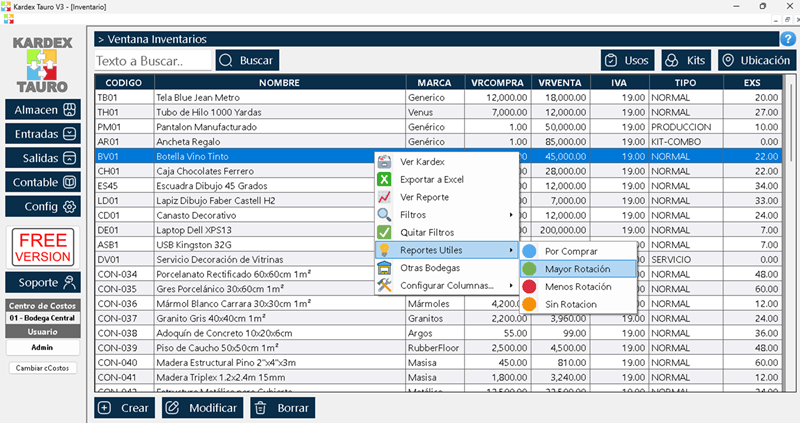
What changed is not the question but the scale. Today every business, however small, relives that scene of the Venetian merchant at every month-end: checking that the books balance, valuing what remains in the warehouse and looking its result in the eye. The difference is that the books are now kept by software and the balance is obtained with a click. Tools such as Kardex Tauro look after precisely the piece this article has followed across the centuries: the stock records that end up as the inventory figure on the balance sheet. Keeping those records up to date, as the good merchant did with his ledger, remains the best guarantee that the report tells the truth.
