The history of the bill of exchange
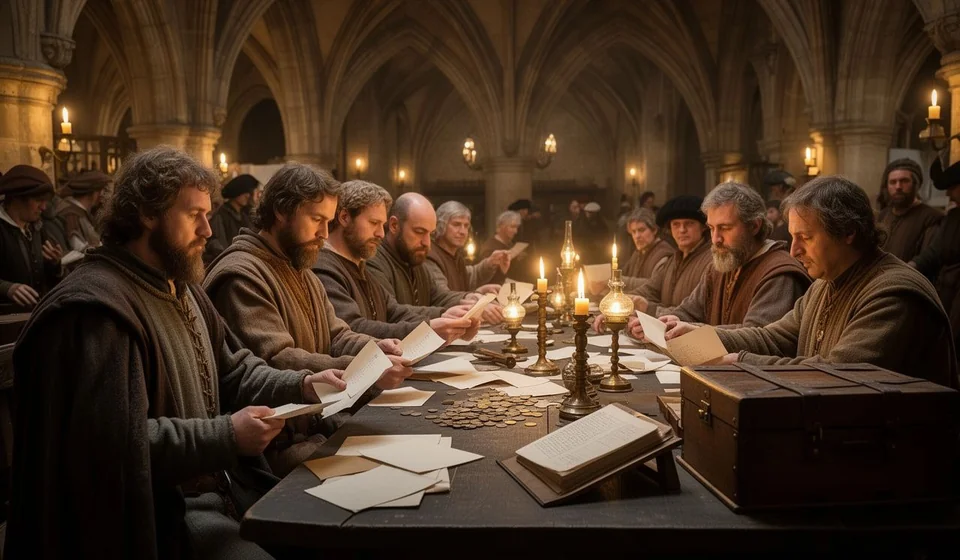
The history of the bill of exchange
The bill of exchange is one of the longest-lived financial instruments in history: a written order by which one person, the drawer, instructs another, the drawee, to pay a definite sum of money to a third party, the payee, at a fixed place and time. For more than seven centuries it was, alongside coin, the great vehicle of international trade. Through its circuits travelled the value of wool, spices, cloth and grain long before central banks, modern paper money or electronic transfer existed. To know its history is to know how Europe learned to move money without moving coins.
The problem it solved: paying in a distant city
Picture a thirteenth-century merchant who has sold cloth in a town three weeks away and wants to be paid at home, or who must buy spices in another city he cannot reach with ready cash. His options were few and all of them poor. The first, transporting coins, carried enormous risks: unsafe roads, bandits, shipwrecks, tolls and the sheer weight of the metal. The second, waiting to offset purchases against sales in each city, chained the business to a slow web of barter-like exchanges. There was also a political obstacle: many kingdoms followed bullionist policies that forbade or taxed the export of precious metals, for they considered silver and gold the true wealth of the realm. Exporting coins could be flatly illegal.
Monetary confusion made things worse: every city, every lord and every fair had its own coins, with different weights and fineness, and their relative value changed constantly. The merchant did not need to transport metal; he needed his money to be worth something elsewhere. The solution was to separate value from its physical support and to move, not the coins, but the right to collect them in the place of destination. That has been the trade of the bill of exchange from its origins to the present day.
Antecedents: the contract of exchange and the Italian merchants
The medieval root of the bill is the contract of exchange, the cambium of merchant law. In the classic operation, someone who needed funds in another city handed a banker a sum in the local currency; the banker undertook that his correspondent in the destination city would pay the equivalent amount, in the currency of that place and at the agreed rate, to the person the client named. At first such agreements were usually drawn up before a notary, with all the formalities of Roman law. Over time, the letter the banker sent to his correspondent ordering the payment became more important than the notarial contract: that letter was already a bill of exchange, an instrument that travelled by itself, could be sent by courier and presented for payment.
Historical evidence places the spread of the bill in its mature form mainly from the thirteenth century onward, at the hands of the Italian merchant-bankers: Lombards, Tuscans, Florentines, Venetians and Genoese, who wove networks of correspondents across the great routes of the Mediterranean and northern Europe. Some authors point out that similar instruments had circulated earlier in the Arab world and that the Italian bankers perfected them; legal historians also recall that cities such as Barcelona regulated the acceptance of bills as early as the fourteenth century. The essential point is that, in the late Middle Ages, the bill was at once a means of payment, a credit instrument and a way to transfer money between cities without moving metal, and that behind every bill stood two bankers who trusted each other: the correspondents.
The first great stage for these practices was the Champagne fairs of the twelfth and thirteenth centuries, where Italian merchants met Flemings, Germans and Frenchmen. There exchange contracts were agreed, accounts were settled between houses of different countries, and many of these obligations were made payable at the fairs. When the Champagne fairs declined, the technique did not vanish: it migrated to other cities and to the new payment fairs, more specialised ones.
The payment fairs: when bills were cleared
In the fifteenth and sixteenth centuries the payment fairs arose: periodic meetings of bankers whose purpose was no longer to sell goods but to settle bills. The most famous was the fair of Lyon, which by the middle of the sixteenth century had become one of the great clearing centres of Europe, where bills drawn on all the important cities converged, maturing on the occasion of the fair. The Genoese bankers, kept out of Lyon by competition and politics, organised fairs of their own, first at Besancon in the Franche-Comte from 1535, and from 1579 at Piacenza in northern Italy, where they continued to operate under the name of the Bisenzone fairs. In the decades around the year 1600 they were, in the view of historians, the great clearing house of the continent.
The mechanism of these fairs deserves attention, for it sums up the logic of the whole system. The sessions lasted several days in a fixed order: the bills falling due were presented and accepted, each banker declared his claims and debts with the others, positions were offset multilaterally, and only the final balances were paid in cash, in the currency of the fair. In the end, a banker who owed in one city and collected in another could settle without a single coin crossing the road between them. Bills not only paid debts: they were also used to grant credit between fairs and to speculate on the movements of exchange rates between cities.
Endorsement: the bill becomes transferable
In its original form, the bill was an order of payment in favour of a named person. The payee could collect it, or ask someone else to collect it on his behalf, but passing it on to a third party as payment was not easy. The practice of endorsement, signing the back of the document to transfer it to another person, transformed the instrument completely. Historians place its appearance and spread towards the end of the sixteenth century and the beginning of the seventeenth. On the continent it circulated earlier through clauses making the bill payable to bearer, and the first documented evidence of endorsement proper dates from the early seventeenth century: a Neapolitan pragmática of 1607 mentions it, and the French jurist Jacques Savary dated the practice to around 1620.
In England the evolution was slower, because the common law was reluctant to admit that a credit could be transferred without the debtor's consent. Bills payable to order did not become general in English practice until after 1622, and took decades more to prevail. It was in the eighteenth century that the English courts, above all under the influence of Lord Mansfield, incorporated the customs of merchants into the common law and gave full legal force to endorsement. With it, the bill ceased to be a message between two bankers and became a title that circulated from hand to hand: whoever received it could pay with it in turn, and each endorser answered to the subsequent holders. Commercial credit began to circulate as money circulates today.
Discounting: the bill becomes liquidity
The next step was discounting: buying a bill before its maturity for less than its face value. The difference between what is paid and what the bill promises is the reward of whoever advances the money, and it depends on the time remaining until maturity and on the debtor's risk. For a long time this operation clashed with the old prohibitions on interest, on usury, and was practised covertly or in more tolerant cities; only when those restrictions were relaxed could it be done openly. It was above all in seventeenth- and eighteenth-century England that discounting became a regular business: the London goldsmith-bankers, who kept the deposits of merchants and issued notes of their own, began to discount bills, and after the founding of the Bank of England in 1694 the discounting of commercial bills became one of the central operations of English banking and, later, of the country banks.
The effect was revolutionary. A merchant who had sold on credit no longer had to wait until maturity to use his money: he could take the bill to a bank, cash it on the spot for a little less, and keep buying and selling. The bill ceased to be only a means of payment and became a tool of liquidity, able to turn future credit into present cash. Over the centuries that mechanism financed the working capital of Atlantic commerce and of the Industrial Revolution, when English banks discounted domestic and foreign bills to sustain production and the movement of goods.
Regulation: from mercantile custom to uniform law
For centuries the bill was governed by the custom of merchants, the so-called lex mercatoria, applied by the courts of the fairs, the consulates and the trading cities. The mercantile ordinances and compilations of the seventeenth and eighteenth centuries put many of those practices in writing, and the countries of the common-law tradition consolidated the field in the nineteenth century by codifying the case law accumulated on bills, notes and cheques. The problem was that every country had its own rules, and the bill, by nature, crosses borders: a merchant needed to know that the document he signed in his own city would be valid in the one at the other end of Europe.
In the twentieth century the law of bills was finally unified on an international scale. After the preparatory work of The Hague conferences in the early years of the century, the League of Nations convened conferences in Geneva that adopted, in the 1930s, conventions with a uniform law on bills of exchange and promissory notes in 1930, and on cheques in 1931; the uniform law on bills entered into force in 1934. Many countries, above all of continental tradition, incorporated that uniform law into their own legal systems, while those of the common-law tradition kept their own codifications. The practical result was remarkable convergence: a well-drawn bill is recognised today, in its essential requirements, across a large part of the world.
The bill today
Far from disappearing, the bill of exchange remains alive in commerce and banking. It is used in international operations as a documentary means of payment, it is discounted by banks as short-term credit, it serves as security and as an instrument for collecting payment between companies, and in several countries it is still employed to finance instalment sales. Its electronic version, supported by rules that give value to the digital signature, today performs the same function as the medieval banker's letter: ordering the payment of a sum in a place different from the one where it was issued. The support changed, from parchment to the computer file; the logic did not.
A table to summarise the evolution
| Period | Development | Effect on trade |
|---|---|---|
| 12th-13th centuries | Italian merchants spread the bill and their networks of correspondents; the Champagne fairs are the great stage of exchange | Value begins to travel between cities as credit, without transporting coins |
| 15th-16th centuries | The payment fairs of Lyon and the Genoese fairs of Besancon, later Piacenza, clear bills from all over Europe | Debts between cities are settled by multilateral offset, with little cash |
| Late 16th-17th centuries | Endorsement allows the bill to be transferred on its back and to circulate from hand to hand | Commercial credit circulates and one bill can pay successive debts |
| 17th-18th centuries | Discounting: London goldsmith-bankers and then the Bank of England buy bills before maturity | Future credit becomes immediate liquidity for the merchant |
| 19th-20th centuries | Customs are codified and the Geneva conferences of 1930 and 1931 adopt uniform laws | Essentially common rules for the bill across much of the world |
| Today | Bank discounting and electronic versions of the bill with digital signature | The instrument adapts to the digital age without changing its original logic |
The table sums up seven centuries in a few lines: each development widened what the bill could do, from payment between two cities to the circulation of credit, immediate liquidity and, finally, international legal security.
From paper to screen: the bridge with the present
The bill of exchange solved, centuries ago, the problem of getting value from one place to another without transporting coins. Today the question that occupies many merchants is almost the reverse: knowing precisely what goods back their receipts and payments, and where each item is at any moment. For that daily task there are inventory management programs such as Kardex Tauro, which help companies keep control of their stock day by day. The bill, meanwhile, still does in payments what it always did: move value with a signature, without moving the metal.