What is accounting and why an inventory business needs it

What is accounting and why an inventory business needs it
Welcome to the first lesson of the accounting manual for small businesses. This course is designed for people who buy merchandise, keep it in a storeroom or on a counter, and sell it: neighborhood shops, hardware stores, stationery shops, bakeries, distributors and family-run businesses of every kind. Before we talk about stock cards, costs or financial statements, we must answer a fundamental question: what is accounting and why does a business that works with inventory need it?
The short answer is this: accounting is the language a business uses to talk about its own money. Without it, the owner knows what he believes he has, but not what he really has. With it, every sale, every purchase, every payment and every debt is recorded in an orderly way and becomes useful information for making decisions. In this lesson we will define what accounting is, what it is not, what it does for a business that buys and sells merchandise, who uses it, and why inventory is the hardest asset to control.
What accounting is
Accounting is the systematic and orderly recording of the economic operations of a business, expressed in money. The key word is systematic: it is not about writing down what you remember whenever you feel like it, but about recording each operation when it happens, with its date, its amount and its reason, and organizing those records so they can be summarized and reviewed. It is a method, not a memory.
Think of a hardware store. On any ordinary day dozens of economic events take place: three hammers are sold for cash, a customer buys paint on credit and promises to pay within fifteen days, the supplier's truck arrives with nails and screws, the electricity bill is paid, and a customer returns a wrong part and gets a refund. Each of those events changes the situation of the business: there is more or less money in the cash drawer, more or less merchandise in the storeroom, more or fewer debts to suppliers or rights to collect from customers. Accounting records all those changes and makes it possible to know, at any moment, the complete picture of the business.
All that information is organized around three basic questions: what the business has, what it owes, and what it has earned. What the business has is called an asset: the cash, the merchandise, the counter, the delivery van. What it owes is called a liability: the debt to the supplier, the bank loan. And what it has earned is shown in the result: what remained from sales after subtracting the cost of the merchandise sold and the expenses. When those three questions are answered with order and method, the owner can make decisions with open eyes instead of guessing in the dark.
What accounting is not
Knowing what accounting is not is just as important as knowing what it is, because the most common misunderstandings make many merchants neglect it for years. Accounting is not just paperwork for paying taxes. Paying taxes is one of the consequences of running a business and accounting helps to fulfill that obligation, but that is neither its main purpose nor its greatest value: accounting exists first so that the owner knows how his business is really doing.
Accounting is also not the loose notebook of scattered notes that many merchants carry in their pocket. Writing down the day's sales in a notebook is better than writing nothing, but it is not formal accounting: notebook entries follow no method, they do not distinguish between what was sold, what was spent and what was collected, they do not separate business money from personal money and, above all, they cannot be summarized into reliable reports. At best, the notebook answers how much money came into the drawer. It does not answer how much was really earned, how much the remaining merchandise is worth or how much is owed.
Accounting is not an exclusive matter for the accountant either, nor a requirement only for large companies. The accountant applies the technique, but the owner makes decisions with the information: if he does not understand the basics, he will always depend on someone else to explain how his own business is doing. And small businesses do not need less accounting than large ones; they need more care, because they cannot afford to be wrong.
What it does for a business that buys and sells merchandise
A commercial business lives off a cycle that looks simple: it buys merchandise, stores it and sells it at a higher price. But that cycle hides questions that no owner can answer from memory when the business has dozens of products and hundreds of operations each month. How much did I really earn this month? How much do customers who bought on credit owe me? How much do I owe my suppliers? How much is the merchandise in my storeroom worth? Do I have enough money for the next order? Am I giving away margin in my promotions? Each of those questions is a business decision, and each decision needs an accounting figure to be answered soundly.
Let us use a bakery that also sells groceries as an example. The owner believes August was an excellent month because the cash register took in a lot of money. But accounting shows him something else: a large part of that money corresponds to merchandise bought in July that had not been paid yet, part went to replace the oven, and the rest must cover the big flour order in September. The right question is not how much money passed through the register, but how much the business earned after subtracting the cost of what was sold and all the month's expenses. The table below summarizes the most frequent decisions of a business with inventory and the accounting figure that answers each one.
| Owner decision | Accounting figure that answers it | Where it appears |
|---|---|---|
| How much did I really earn this month? | Sales minus the cost of the merchandise sold and minus the month's expenses | Income statement |
| How much do customers who bought on credit owe me? | The total of credit sales that have not been collected yet | Accounts receivable |
| How much do I owe my suppliers? | The total of credit purchases that have not been paid yet | Accounts payable, inside liabilities |
| How much is the merchandise in my storeroom and on my shelves worth? | The quantity of each product times its purchase cost | Inventory, inside assets |
| Do I have enough money for the next order to the supplier? | The cash available plus what is expected to be collected in the coming days | Cash flow |
| Am I earning or losing money on promotions? | The selling price minus the cost of each product sold | Margin and cost of sales |
Notice the pattern: every important question of a commercial business ends up touching inventory, sales or purchases. That is why this manual gives so much space to those three topics: they are the heart of accounting for the small business.
Who uses accounting
Accounting information is not used by a single person. The first and most important user is the owner himself, who needs it to know whether the business is moving forward, how much he can spend, how much he can take home and which products deserve more effort. The accountant uses it to keep the formal records, prepare the reports and help the business meet its legal obligations. The bank uses it when the merchant asks for a loan to buy more merchandise: the bank wants to see, with orderly numbers, that the business generates enough income to repay the loan. And the government uses it, in general terms, to verify that the business reports and pays what corresponds according to the tax rules of each country.
Each of those users looks at accounting with a different interest, but they all look at the same records. A business with good accounting can show, within minutes, how much it sells, how much it owes and how much it earns. A business without accounting cannot show anything and depends on the owner's word alone, which becomes a real problem when it comes to getting credit, attracting a partner or selling the business.
Keeping records is not the same as having formal accounting
It is worth clarifying a difference that will run through this whole course: keeping auxiliary records is not the same as keeping formal accounting. Auxiliary records are specialized notes that control one concrete part of the business: the daily cash count, the list of customers who owe money, the schedule of accounts payable and, very especially, the stock card, which is the record of entries and exits of each product in the inventory. These records are the living memory of daily operations and are filled in at the counter and in the storeroom, not in the accountant's office.
Formal accounting is the complete system that brings all that information together under one method: every operation is recorded following uniform rules, classified, and summarized into general reports that show the full situation of the business. The relationship between the two is one of mutual support: formal accounting needs the auxiliary records to be up to date so it can summarize them, and the auxiliary records need accounting rules so that entries mean the same thing every day.
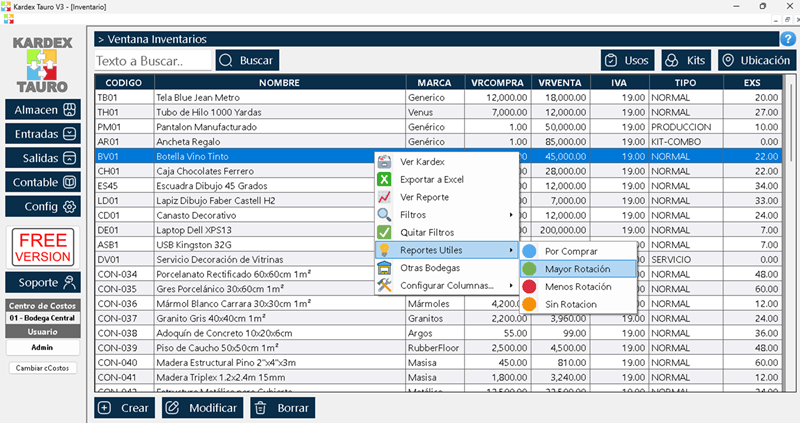
The stock card is the best example for a business with inventory. When a hardware store sells a gallon of paint, the stock card for that product records an exit; when the supplier's order arrives, it records an entry. If the stock card is well kept, at any moment you can know how many gallons should be on the shelf, and if the physical count does not match, the business knows there is a control problem. Practice tools such as Kardex Tauro do that recording work automatically, but the concept is the same one taught in this manual: every movement of merchandise must be recorded so that the inventory always tells the truth.
Common myths about accounting
Over the years, several beliefs about small business accounting have become entrenched, and it is worth reviewing them one by one, because the owner's real commitment to the subject depends on them.
| Myth | Reality |
|---|---|
| Accounting is only for paying taxes. | Its main job is to inform the owner: how much he earns, how much he has and how much he owes. Taxes are a consequence of the business, not the reason for accounting. |
| The notebook is enough until the business grows. | When the business grows without formal records, nobody knows how much profit was lost or which products pay off; rebuilding years of information is very expensive and money is usually lost in the attempt. |
| If I sell a lot, I must be earning. | Selling is not earning. If the cost of merchandise and expenses eat up the selling price, you can sell a lot and still lose money, as happens with badly calculated promotions. |
| Accounting is the accountant's business. | The accountant records and prepares reports, but the owner is the one who decides with them. An owner who does not understand his accounting runs his business blindfolded. |
| Inventory is controlled by counting the storeroom once a year. | Inventory moves every day and is controlled every day: every entry and every exit must be recorded so that the physical count confirms what the records say. |
| Mixing business money with household money does not matter. | Without separation you will never know how much the business really earns; personal expenses disguised as business expenses are the most common reason why accounts do not add up. |
Why inventory is the hardest asset to control
Of all the goods a business owns, inventory is the hardest to control, and it is worth understanding why before moving forward. Inventory is, almost always, the most valuable asset of a commercial business: it is the merchandise that was bought with money and has not yet been turned into sales. But it is also the asset that moves the most: it comes in through purchases, goes out through sales, gets returned, transferred, damaged, expired, lost and, sometimes, stolen. Each of those movements changes its value.
Inventory also has a special measurement problem. Cash is counted by looking at it; inventory is not. To know how much the merchandise in the storeroom is worth, you must know what is there, in what quantity, at what cost it was bought and whether it can still be sold. A bag of expired coffee, a wet box of screws or a batch of shirts in a size nobody buys are no longer worth what they cost. Without records, nobody can tell how much of the purchased merchandise became sales and how much was lost along the way: money disappears without a trace.
That is why this manual focuses on inventory, sales and purchases. They are the three operations that touch the merchandise: purchases bring it in, sales take it out, and inventory is the point where both meet. Whoever masters that cycle has solved the hardest part of his business accounting. In the coming lessons we will see how each of those operations is recorded, how merchandise is valued, and how auxiliary records, starting with the stock card, protect the merchant's most valuable asset.
A final note before closing: this course teaches general accounting principles that apply in any country, but concrete tax rules change from one place to another. Always consult your accountant to know what the local regulations require of your business.
Downloadable template: General journal template in Excel: entries that balance — the Excel template that goes with this lesson.