Accounts and the chart of accounts: how information is coded
Accounts and the chart of accounts: how information is coded
If every transaction of a business that buys and sells merchandise were written down in a single mixed list, at the end of the month it would be impossible to tell how much was sold, how much is owed to suppliers or how much merchandise remains in the warehouse. Accounting solves that problem with two simple tools: the account, which accumulates one single type of transaction, and the chart of accounts, which orders and codes every account of the business. This lesson explains what each one is, how numeric coding works and why it is wise to decide the chart before recording the first transaction.
What an accounting account is
An accounting account is the place where everything that happens with one type of transaction or resource is accumulated during a period. A good picture is a drawer with a label: every time the business does something related to that label, the movement is stored in that drawer, and at the end of the month each drawer is opened and checked. The Cash account, for example, stores all the entries and exits of physical money; the Merchandise inventory account stores the cost of the merchandise that is purchased, and also the cost of the merchandise that is sold, returned or adjusted. No movement is left loose: everything ends up inside the drawer that corresponds to it.
For drawers to work, each account needs three things: a name that cannot be confused with another, a definition of which transactions it accumulates and a code within the chart. Names are carefully managed in practice, because comparability depends on them: Accounts payable to suppliers, which is whom the business owes for merchandise, is not the same as Accounts payable in general, nor is Customers, who owe the business for sales, the same as Accounts receivable as a whole.
- A clear and unique name: Cash, Bank accounts, Merchandise inventory, Suppliers, Sales, Administrative expenses.
- A definition of what comes in and what goes out, with examples of real transactions of the business.
- A numeric code: the address that places the account inside the chart and makes it easy to find.
Think of a business that sells merchandise at retail. When a customer pays in cash, the bill goes into the Cash account. When the business buys merchandise on credit, a debt is born in the Suppliers account. When that merchandise is sold, it leaves Merchandise inventory and its cost moves to the cost of sales account. The same transaction touches several accounts, as the lesson on double entry showed, but each account only accumulates its own type of information. That is why, at the end of the period, it is possible to answer precisely how much money there is, how much customers owe, how much merchandise remains and how much was sold.
The chart of accounts: the ordered list of the business
The chart of accounts is the complete, ordered and coded list of every account a business can use. It works like the dictionary of accounting: it fixes which accounts exist, how they are named, what each one means and which number identifies each one. When everyone uses the same chart, the owner, the bookkeeper, the accountant and the software, a word means the same thing to all of them: if someone writes the code 1405 Merchandise inventory, there is no doubt about what is being discussed.
The chart is not a flat list of isolated names: it is organized in levels that follow the structure of the financial statements. At the highest level are the major groups of the accounting equation and of the income statement: assets, which are what the business owns; liabilities, which are what it owes; equity, which is the owners' resources; income, which is what is earned by selling; and expenses, which is what it costs to operate. Within each group, accounts are ordered from most liquid to least liquid, or by their nature, so the chart already prepares the information for the balance sheet and for the income statement.
A well-designed chart looks like a building with floors: the major groups are at the top and, going down, the drawers become more and more specific. That level structure is what makes coding with numbers possible and allows any account to be found just by looking at its code.
How information is coded
Coding means assigning each account a number that works as an address. The most widespread convention uses the first digit to indicate the major group: 1 for assets, 2 for liabilities, 3 for equity, 4 for income and 5 for expenses. This is a numbering convention that is very common in teaching and in many charts around the world, but it is not a compulsory universal rule: every business can adapt its numbering, and the formal chart is defined by the accountant according to local regulations. What matters is understanding the logic: a well-formed number says which group the account belongs to, how general or specific it is and where to look for it.
The typical structure has three levels: group, account and subaccount. The group is shown with one digit; the account, with the first two digits; the subaccount, with the first four. So, within group 1, which is Assets, the code 11 identifies the account Cash and cash equivalents, and the code 1105 identifies the subaccount Cash, the drawer where physical money is accumulated. If the business later needs more detail, additional digits are added to break down by branch, by type of product or by auxiliary record: the chart grows without breaking.
| Level | Digits in the code | Example | What it identifies |
|---|---|---|---|
| Group | 1 | 1 | Assets: everything the business owns and is owed |
| Account | 2 | 11 | Cash and cash equivalents: money at hand |
| Subaccount | 4 | 1105 | Cash: physical money kept in the business |
| Group | 1 | 2 | Liabilities: debts with third parties |
| Account | 2 | 22 | Suppliers: debts for merchandise purchases |
| Group | 1 | 4 | Income: what the business earns in the period |
| Account | 2 | 41 | Sales: income from selling merchandise |
| Subaccount | 4 | 4105 | Merchandise sales: detail of sales income |
| Group | 1 | 5 | Expenses: the costs and expenses of the period |
| Account | 2 | 51 | Personnel expenses: salaries and benefits of the team |
From the group to the drawer: a chart in action
To see how a code is read, it helps to walk through the accounts of a trading business from top to bottom. The following table shows the generic example code, the name of the account and what each one accumulates.
| Code | Account | What it accumulates |
|---|---|---|
| 1 | Assets | Resources and rights: money, accounts receivable, inventories, furniture and equipment |
| 11 | Cash and cash equivalents | Money at hand with no restrictions: cash and bank accounts |
| 1105 | Cash | The bills and coins physically kept in the business |
| 14 | Inventories | Merchandise purchased for sale, valued at its cost |
| 1405 | Merchandise inventory | The detail of the stock available for sale |
| 2 | Liabilities | The debts and obligations of the business with third parties |
| 22 | Suppliers | Debts for merchandise purchased on credit |
| 4 | Income | The income of the period from sales and other sources |
| 5 | Expenses | The cost of merchandise sold, personnel expenses and administrative expenses |
| 51 | Personnel expenses | The salaries and benefits of the staff |
Notice how the row 1105 is read: the first digit says it is an asset, the first two digits say it is money at hand and the four complete digits point to the exact drawer, the physical cash box. The same pattern repeats across the whole chart: the number 22 says the account lives in group 2, the liabilities group, and that it deals with debts to suppliers. When a credit purchase is recorded, the movement falls into drawer 2205, or whatever drawer the chart has defined, and not into any other account. That discipline of always using the same drawer is what makes final balances reliable.
The starter kit: accounts every inventory business needs
When a business starts keeping orderly accounts, it does not need a hundred accounts: it needs a small, well-thought chart that covers its real transactions. The following table shows the minimum accounts of a business that buys and sells merchandise, with a generic example code and the type each account belongs to.
| Code | Account | What it is | Type |
|---|---|---|---|
| 1105 | Cash | The physical money of the business | Asset |
| 1110 | Bank accounts | The money kept in bank accounts | Asset |
| 1305 | Accounts receivable | Credit sales that have not been collected yet | Asset |
| 1405 | Merchandise inventory | The stock available for sale, at its cost | Asset |
| 2205 | Suppliers | Debts for purchases on credit | Liability |
| 2405 | Taxes payable | The taxes the business must declare and pay | Liability |
| 3105 | Capital | The contributions of the owner or the partners | Equity |
| 4105 | Merchandise sales | The sales income of the period | Income |
The table leaves out two income statement accounts that are also essential, but that are not created when starting out: cost of sales and administrative expenses. Cost of sales feeds itself with every sale: when merchandise leaves the inventory, its cost is recorded in that account, a topic developed in a coming lesson. Administrative expenses are fed by every expense of the business: rent, utilities, office supplies, office salaries. The Taxes payable account is used for what the business must declare, and the exact rules depend on local regulations and on the accountant. Over time, customer returns, partial payments and other movements appear and use additional accounts: the chart gains them as the business grows, and what matters is starting with the minimum and using it always in the same way.
Why code information
Coding is not a technical whim: it is what makes accounting fast, orderly and comparable. These are the practical reasons to use codes instead of loose names.
- Speed: recording code 1105 is faster and less prone to error than writing Cash on every document, and the software looks up the account by its number.
- Order: movements always arrive at the same drawer, even when another person records them or they are recorded much later.
- Comparable reports: when closing the period, each code is added up and the balance of each account is obtained; with a stable chart, this year's reports can be compared with last year's.
- One shared language: the accountant, the bookkeeper and the software speak with the same codes; when the accountant asks for the detail of account 1405, everyone knows exactly what to deliver.
- Room to grow: adding new accounts does not disturb the existing ones, because the code leaves space for extra subaccounts and auxiliary records.
In practice, the code works like an identity number: nobody needs to memorize the whole list, but when a code appears, anyone can tell which account it is just by looking at its first digits.
Practical advice: a small chart at the start and a formal one with the accountant
The most common mistake of a small business is not having an incomplete chart, but having none at all and recording every transaction under whatever name the person who wrote it came up with. A month later, nobody knows whether Miscellaneous expenses means the same as Other expenses. That is why the advice is to start with a small chart, like the one in the previous table, to use it consistently from the very first record and to expand it only when a new and real transaction appears. When the business grows or the time for formal accounting arrives, the accountant reviews the chart, adjusts it to local regulations and defines the final codes: the chart is a working tool that adapts to the business, not a rigid mold.
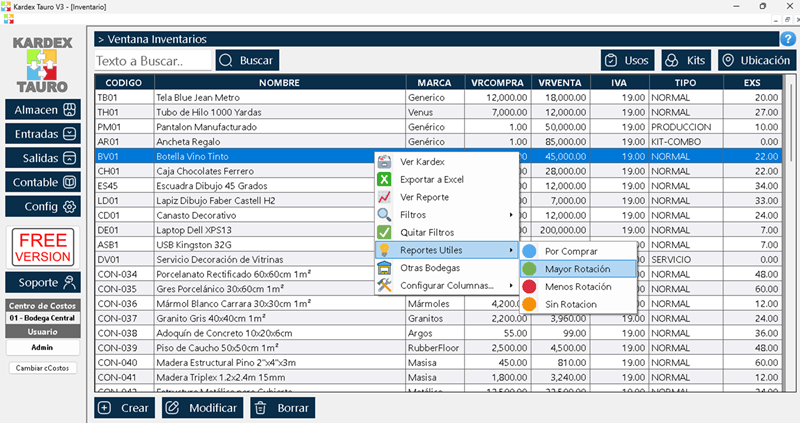
If the business uses an inventory program that records documents with their accounts, as happens with Kardex Tauro, the information arrives at accounting already ordered and coded: every purchase, every sale and every payment is identified with the account it belongs to, and the accountant receives the movements ready to classify and review. Coding well from day one saves hours of reconciliation at the end of every month.
Downloadable template: Chart of accounts template in Excel — the Excel template that goes with this lesson.